Inconsistency between definitions of power and work in continuum mechanics?

Click For Summary

Discussion Overview

The discussion revolves around the definitions of power and work in continuum mechanics, exploring the relationship between these concepts and the mathematical derivations involved. Participants are examining the equations that define work and power, and attempting to reconcile their differences through integration and differentiation.

Discussion Character

  • Technical explanation
  • Mathematical reasoning
  • Debate/contested

Main Points Raised

  • One participant presents the definitions of work and power in continuum mechanics and attempts to derive the relationship between them, specifically questioning the validity of their integration.
  • Another participant suggests that replacing displacement with velocity in the work equation leads to power, but questions how this can be justified mathematically.
  • A different participant raises concerns about the application of the product rule in the context of time-dependent integrals, indicating that certain terms may not be zero.
  • There is a challenge regarding the assumptions made in the definitions of work and power, particularly whether the stress tensor and body force are assumed to be stationary.
  • One participant references external sources to support their understanding of work and power, noting that while the textbook primarily discusses power, it aligns with definitions found elsewhere.
  • A final participant questions the source of the definitions provided, suggesting that there may be a misunderstanding or misinterpretation of the conditions under which they apply.

Areas of Agreement / Disagreement

Participants express differing views on the validity of the mathematical steps taken to relate work and power, with no consensus reached on the correct approach or assumptions involved. The discussion remains unresolved regarding the integration and differentiation of the equations.

Contextual Notes

Participants highlight limitations in the assumptions regarding the constancy of the stress tensor and body force, as well as the complexities introduced by time-dependent integrals in the context of continuum mechanics.

Klaus3
Messages
26
Reaction score
3
The definitions of power and work in continuum mechanics are:

$$ W = \int T \cdot u dA + \int b \cdot u dV (1) $$


$$ P = \int T \cdot v dA + \int b \cdot v dV (2) $$

##u## is the displacement vector, ##v## is the velocity, ##T## is the cauchy stress tensor, ##b## is the body force ##A## is area and ##V##, volume. ##W## is work and ##P## is power

I tried to show that ## P = \frac{dW}{dt} ##, but failed

At first i thought integrating Eq (1) but i was intimidated by the amount of algebra necessary to put the derivative inside the integral, then i tried integrating Eq (2)

$$ \int Pdt = \int \int T \cdot v dAdt + \int \int b \cdot v dV dt(3) $$

Commuting the Space and time integrals and applying the definition of velocity

$$ \int Pdt = \int \int T \cdot \frac{du}{dt} dtdA + \int \int b \cdot \frac{du}{dt} dtdV (4) $$

$$ \int Pdt = \int \int T \cdot dudA + \int \int b \cdot dudV (5) $$

And here is where i'm stuck. Equation (5) doesn't seem to match with equation (1) and i don't know if there is any mistake in the derivation. Instead of ##du## it should have been ##u## in Eq (5), but a priori i don't know how to make it appear. Any clues? Thanks
 
Physics news on Phys.org
v=\frac{du}{dt}
Replacing u in W to v, we get P.
 
  • Like
Likes   Reactions: SammyS and Dale
anuttarasammyak said:
v=\frac{du}{dt}
Replacing u in W to v, we get P.
How? ## v = \frac{du}{dt} ## but

$$ u = \int v dt $$

Then

$$ W = \int T \cdot \left( \int v dt\right) dA + \int b \cdot \left( \int v dt\right) dV $$


$$ \frac{dW}{dt} = \frac{d}{dt} \int T \cdot \left( \int v dt\right) dA + \frac{d}{dt} \int b \cdot \left( \int v dt\right) dV $$

Now what? I don't think i can simply "cancel" the outer time derivative with the inner time integral, can i?
 
Use the law of differential of product
(ab)'=a'b+ab'
and, if I understand the settings correctly,
\frac{dT}{dt}=\frac{db}{dt}=0
 
anuttarasammyak said:
Use the law of differential of product
(ab)'=a'b+ab'
and, if I understand the settings correctly,
\frac{dT}{dt}=\frac{db}{dt}=0
##\frac{dT}{dt}## and ##\frac{db}{dt}## are generally not zero. For example, imagine ##T## is a pressure, pressure is not necessarily constant on a general process.

Also, the product rule isn't straightforward for volume and area integrals, because generally they also vary with time (which is what ends up in the reynolds transport theorem)
 
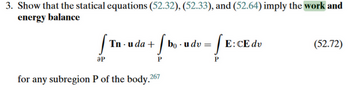
Does your textbook, which describes the definition of W and P, postulate stationary T and b ?
 
Last edited:
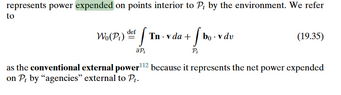
It does not, they just define it that way.
 

Attachments

  • power.png
    power.png
    21.7 KB · Views: 64
  • work.png
    work.png
    22.1 KB · Views: 43
The latter refers the three statistical equations so it seems not a general relation.
 
I just couldn't find an explicit mention of work in the textbook (its always power), but its still the same definition found in other places, such as:

https://en.wikipedia.org/wiki/Virtu..._of_virtual_work_and_the_equilibrium_equation

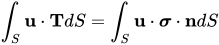
We start by looking at the total work done by surface traction on the body going through the specified deformation:

{\displaystyle \int _{S}\mathbf {u} \cdot \mathbf {T} dS=\int _{S}\mathbf {u} \cdot {\boldsymbol {\sigma }}\cdot \mathbf {n} dS}
i know the text talks about virtual work, but this excerpt specifically deals with regular work.
 
  • #10
Klaus3 said:
The definitions of power and work in continuum mechanics are:
Who said these definitions in what conditions ? You may be haunted by a wrong idea.
 

Similar threads

  • · Replies 11 ·
Replies
11
Views
2K
  • · Replies 18 ·
Replies
18
Views
1K
  • · Replies 6 ·
Replies
6
Views
1K
  • · Replies 2 ·
Replies
2
Views
2K
  • · Replies 2 ·
Replies
2
Views
2K
  • · Replies 4 ·
Replies
4
Views
8K
  • · Replies 1 ·
Replies
1
Views
2K
  • · Replies 43 ·
2
Replies
43
Views
5K
  • · Replies 10 ·
Replies
10
Views
2K
  • · Replies 27 ·
Replies
27
Views
1K