Understanding Browder Proposition 3.14: Increasing Function & Discontinuities

  • Context: MHB 
  • Thread starter Thread starter Math Amateur
  • Start date Start date
  • Tags Tags
    Function Increasing
Click For Summary
SUMMARY

The discussion focuses on Andrew Browder's Proposition 3.14 from "Mathematical Analysis: An Introduction," specifically addressing the relationship between the left and right limits of a function at a point within an interval. Proposition 3.14 establishes that a point \(d\) belongs to the set \(D\) if and only if \(f(d-) < f(d+)\). This is derived from Proposition 3.7, which asserts that for any point \(d\) in the interval \(I\), the left and right limits exist and are bounded by the value of the function at \(d\). The proof clarifies that discontinuity at \(d\) is characterized by the inequality \(f(d-) < f(d+)\).

PREREQUISITES
  • Understanding of limits and continuity in real analysis
  • Familiarity with the definitions of left and right limits
  • Knowledge of the concepts of increasing functions and discontinuities
  • Basic proficiency in mathematical proofs and propositions
NEXT STEPS
  • Study the implications of Browder's Proposition 3.7 on continuity
  • Explore the definitions and properties of increasing functions in real analysis
  • Examine examples of discontinuities and their classifications
  • Learn about rigorous proof techniques in mathematical analysis
USEFUL FOR

Students of mathematical analysis, educators teaching real analysis concepts, and anyone seeking to deepen their understanding of continuity and discontinuities in functions.

Math Amateur
Gold Member
MHB
Messages
3,920
Reaction score
48
I am reading Andrew Browder's book: "Mathematical Analysis: An Introduction" ... ...

I am currently reading Chapter 3: Continuous Functions on Intervals and am currently focused on Section 3.1 Limits and Continuity ... ...

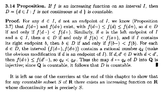
I need some help in understanding the proof of Proposition 3.14 ...Proposition 3.14 and its proof read as follows:
View attachment 9536
In the above proof by Browder we read the following:

" ... ... For any $$d \in I, d$$ not an endpoint of $$I$$ we know (Proposition 3.7) that $$f(d-)$$ and $$f(d+)$$ exist with $$f(d-) \leq f(d) \leq f(d+)$$, so $$d \in D$$ if and only if $$f(d-) \lt f(d+)$$. ... ... "My question is as follows:

Can someone please demonstrate (rigorously) exactly why/how it follows that $$d \in D$$ if and only if $$f(d-) \lt f(d+)$$. ... ... Help will be much appreciated ...

Peter
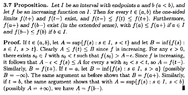
=======================================================================================The above post mentions Browder Proposition 3.7 ... so I am providing the text of that proposition ... as follows:
View attachment 9537
Hope that helps ...

Peter
 

Attachments
  • Browder - Proposition 3.14  .png
    Browder - Proposition 3.14 .png
    24.1 KB · Views: 143
  • Browder - Proposition 3.7 ... .png
    Browder - Proposition 3.7 ... .png
    22.8 KB · Views: 132
Last edited:
Physics news on Phys.org
Re: Increasing Function and Discontinuitiesl ... Browder, Proposition 3.14 ... ...

Peter said:
I am reading Andrew Browder's book: "Mathematical Analysis: An Introduction" ... ...

I am currently reading Chapter 3: Continuous Functions on Intervals and am currently focused on Section 3.1 Limits and Continuity ... ...

I need some help in understanding the proof of Proposition 3.14 ...Proposition 3.14 and its proof read as follows:

In the above proof by Browder we read the following:

" ... ... For any $$d \in I, d$$ not an endpoint of $$I$$ we know (Proposition 3.7) that $$f(d-)$$ and $$f(d+)$$ exist with $$f(d-) \leq f(d) \leq f(d+)$$, so $$d \in D$$ if and only if $$f(d-) \lt f(d+)$$. ... ... "My question is as follows:

Can someone please demonstrate (rigorously) exactly why/how it follows that $$d \in D$$ if and only if $$f(d-) \lt f(d+)$$. ... ... Help will be much appreciated ...

Peter
=======================================================================================The above post mentions Browder Proposition 3.7 ... so I am providing the text of that proposition ... as follows:

Hope that helps ...

Peter
After a little reflection I have realized that $$f$$ is continuous at any point $$x$$ if and only if $$f(x-) = f(x+)$$ ... so if f is discontinuous at $$d$$ then $$f(d-) \neq f(d+)$$ ... but ... we have that $$f(d-) \leq f(d+)$$ ... so therefore $$f(d-) \lt f(d+)$$ ...Is that correct?

Peter
 

Dear Peter,

Thank you for your question. I can understand your confusion with Proposition 3.14 and its proof. Let me try to explain it in a more detailed manner.

Proposition 3.7 states that for any point d in the interval I, which is not an endpoint of I, the left and right limits of a function f exist and are bounded by the value of f at d. In other words, we can say that the function f is continuous at d.

Now, in Proposition 3.14, we are looking at a specific set D, which is defined as the set of points in the interval I where the left and right limits of f are not equal. In other words, at these points, the function is not continuous.

In the proof of Proposition 3.14, Browder is showing that if d is in D, then the left and right limits of f at d are not equal, which is the definition of D. On the other hand, if d is not in D, then the left and right limits of f at d are equal, and therefore the function is continuous at d.

Now, to answer your question, we need to understand why d is in D if and only if f(d-) < f(d+). This is because if d is in D, it means that the left and right limits of f at d are not equal, and therefore one is strictly less than the other. On the other hand, if f(d-) < f(d+), it means that the left and right limits of f at d are not equal, and therefore d is in D.

I hope this explanation helps you understand Proposition 3.14 better. If you have any further questions, please feel free to ask.
 

Similar threads

Replies
3
Views
2K
Replies
2
Views
2K
  • · Replies 5 ·
Replies
5
Views
2K
  • · Replies 2 ·
Replies
2
Views
2K
Replies
2
Views
2K
  • · Replies 4 ·
Replies
4
Views
2K
  • · Replies 2 ·
Replies
2
Views
2K
Replies
2
Views
2K
Replies
2
Views
2K
  • · Replies 2 ·
Replies
2
Views
2K