Increasing voltage regulator current

Click For Summary
SUMMARY

The discussion focuses on increasing the current output of an LM338 voltage regulator to 6A by implementing a current boost configuration using a 2N6491 PNP transistor. The user calculated resistor values, including a 0.2-ohm current sense resistor (R1) and a base resistor (Rb) of 221 ohms, to ensure proper operation. Key considerations include managing output capacitance to prevent damage during power-up and ensuring the base current is adequately limited to avoid overloading the transistor. The conversation highlights the importance of using appropriate capacitors and current limiting techniques to maintain stability in high-current applications.

PREREQUISITES
  • Understanding of LM338 voltage regulator specifications
  • Familiarity with PNP transistor operation, specifically the 2N6491
  • Knowledge of resistor calculations for current sensing
  • Basic principles of capacitive reactance and its impact on regulator performance
NEXT STEPS
  • Research the LM338 datasheet for detailed specifications and application notes
  • Learn about current limiting techniques in linear voltage regulators
  • Explore the effects of output capacitance on voltage regulator performance
  • Investigate alternative high-current solutions, such as switching regulators
USEFUL FOR

Electronics engineers, hobbyists designing power supplies, and anyone involved in high-current voltage regulation applications will benefit from this discussion.

TheRedDevil18
Messages
406
Reaction score
2
I'm looking to draw about 6A. I have an LM338 regulator that can supply up to 5A. Searching the internet I came across this schematic,
boosti.gif


So basically when the 1R resistor drops 0.6V then the transistor conducts the remainder of the current. I calculated my own values for those two resistors. Was wondering if my values are fine,

I want 3A to pass through the regulator, so I got R1 to be,
R1 = 0.6V / 3A = 0.2 ohm

PR1 = 3^2 * 0.2 = 1.8 W

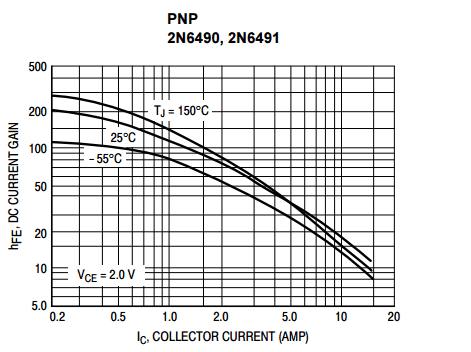
The remaining 3A can pass through the transistor, using the 2N6491 PNP transistor, this one
http://www.onsemi.com/pub/Collateral/2N6487-D.PDF

From the datasheet hfe at 3A is 50
upload_2017-5-3_23-57-36.png


So, Ib = Ic/hfe = 3A / 50 = 0.06 A

Vb = Vin - 0.6 (Vin = input voltage to the regulator)
= 13.85 - 0.6 = 13.25 V

Rb = Vb/Ib
= 13.25 / 0.06 = 221 ohm
 
Engineering news on Phys.org
I had done this before and almost similar to your steps except for this part:
TheRedDevil18 said:
Vb = Vin - 0.6 (Vin = input voltage to the regulator)
= 13.85 - 0.6 = 13.25 V

Rb = Vb/Ib
= 13.25 / 0.06 = 221 ohm
Now verify:
Place that 221 ohms in its place and apply KVL to the base - emitter loop.
 
That's an awful lot of capacitance to be hanging on the output.
 
  • Like
Likes   Reactions: sophiecentaur
Averagesupernova said:
That's an awful lot of capacitance to be hanging on the output.
I think it's OK for six amps.
However, the same might be a bit short for the input side.
 
  • Like
Likes   Reactions: sophiecentaur and davenn
The reason I wonder about it being to much capacitance is the amount of current draw on power up. The 3 terminal regulator on its own is quite likely able to handle a very very large capacitance. However, when we have the current boost transistor added on and we power up, it is like a short circuit until that cap on the output is charged. I know from experience that this type of current boost configuration WILL smoke when its output is shorted.
 
  • Like
Likes   Reactions: PhysicoRaj
Agreed. There's no point in filtering the output of a regulator. The output voltage will stay constant as long as the input is greater than or equal to a minimum voltage, which will be provided by the input capacitor for as long as possible.
The datasheet specifies a small cap at the output, just in case the output leads catch up EMI or transient noises.
 
PhysicoRaj said:
Agreed. There's no point in filtering the output of a regulator. The output voltage will stay constant as long as the input is greater than or equal to a minimum voltage, which will be provided by the input capacitor for as long as possible.
The datasheet specifies a small cap at the output, just in case the output leads catch up EMI or transient noises.
Depends on the usage. For instance at the upper end of the audio frequencies, the output impedance of the regulator is equivalent to a 50uF cap. That's not much for a 6A supply. edit:[/color] see post two down. end edit[/color]

Averagesupernova said:
The reason I wonder about it being to much capacitance is the amount of current draw on power up. The 3 terminal regulator on its own is quite likely able to handle a very very large capacitance. However, when we have the current boost transistor added on and we power up, it is like a short circuit until that cap on the output is charged. I know from experience that this type of current boost configuration WILL smoke when its output is shorted.
Use current limiting as shown in https://www.fairchildsemi.com/datasheets/LM/LM7805.pdf, pg 20, fig 14. It uses one transistor and one resistor.
 
Last edited:
Tom.G said:
For instance at the upper end of the audio frequencies, the output impedance of the regulator is equivalent to a 50uF cap. That's not much for a 6A supply.

I did not understand.. Or you might be talking for example about a leaky audio amp which requires supply bypass caps?
 
PhysicoRaj said:
I did not understand..
You're right , I'm off by a factor of two. The 50uF should have been 120uF.
If you look at the output impedance vs frequency of the LM338 you see that at 20kHz the impedance is a about 135 milliOhm. Capacitive reactance of 135 milliOhm at 20kHz requires 118uF. Unless I messed it up again, a 6A load will give 810mVpp ripple from the bare regulator.The below image is from: http://www.ti.com/lit/ds/symlink/lm338.pdf, pg7, fig8

blob.jpg
 

Attachments

  • blob.jpg
    blob.jpg
    31.2 KB · Views: 559
Last edited:
  • Like
Likes   Reactions: PhysicoRaj
  • #10
Correct.. I hadn't considered that. Thanks for pointing it out.
So the current limit should compensate for the cap transients for high current application.
 
  • #11
PhysicoRaj said:
So the current limit should compensate for the cap transients for high current application.
For this low voltages, and for this kind of typical circuit it's not a big deal at this target current: the energy involved is still low, so unless you make a really big output capacitor bank (over a few thousand uF) it won't harm the components.
At this level it is typically the fuse which you have to be careful with.
Also, it worth to note that for output filtering adding a smaller ceramic cap can spare a lot on the bigger electrolytic one.
 
  • #12
TheRedDevil18.
You should put a 10uF tantalum and a 0u1F ceramic capacitor in parallel with the output of the regulator.

With higher current regulators the cost of heatsinks becomes prohibitive. Linear regulators are being progressively replaced with switching converters. Switching 3 amp adjustable regulator modules now cost a couple of dollars including postage. 12 amp modules cost about $5 complete, including postage.
For example;
http://www.ebay.com.au/itm/142258356219?_trksid=p2055119.m1438.l2649&var=441318526436&ssPageName=STRK%3AMEBIDX%3AIT
 
  • #13
Baluncore said:
TheRedDevil18.
You should put a 10uF tantalum and a 0u1F ceramic capacitor in parallel with the output of the regulator.

just a note ... if you put an @ sign in front of a nickname, the member will be notified of your response :smile:
 
  • Like
Likes   Reactions: sophiecentaur
  • #14
Yes, if I needed OP attention I would have put an @ in front of the name.
TheRedDevil18 has been away for a couple of days, so probably has notifications turned off anyhow, there is no hurry.
 
  • #15
davenn said:
just a note ... if you put an @ sign in front of a nickname, the member will be notified of your response :smile:
I feel so out of touch at times. I'll have to try it.
 
  • #16
PhysicoRaj said:
I had done this before and almost similar to your steps except for this part:

Now verify:
Place that 221 ohms in its place and apply KVL to the base - emitter loop.

That value seems a bit high. I simulated it and I get a very low current across the transistor. When I remove it, it works fine. Not sure if I really need that base resistor
 
  • #17
TheRedDevil18 said:
That value seems a bit high. I simulated it and I get a very low current across the transistor. When I remove it, it works fine. Not sure if I really need that base resistor
Yes. That is because you are assuming the current through the base resistance is because of the voltage across the input of the regulator, which is not the case.
Base current will be the resultant of the voltage between the free end of base resistance and the 'emitter'.
That according to me will be the potential across the 0.2 ohm current sense resistor. Call this Vb.

Then another important parameter is the base-emitter drop (Vbe) which you will have to subtract from Vb. I checked the datasheet and I think for your current the Vbe will be around 1 volt.
So you see the current sense resistor needs to drop more than 1v to force a good base current and turn it on.
That changes the 0.2 ohm resistance.

After that, you'll get an appreciable value of Rb if you apply KVL to the base-emitter loop.. do not omit it.

Good luck.
 
Last edited:
  • #18
The current sense resistor 1R sets the maximum current through the regulator by starting to turn on the PNP pass transistor when the regulator has over about 0.6 amp current.
So what is the purpose of the Rb = 10R in series with the base of the PNP ?
 
  • #19
Baluncore said:
The current sense resistor 1R sets the maximum current through the regulator by starting to turn on the PNP pass transistor when the regulator has over about 0.6 amp current.
So what is the purpose of the Rb = 10R in series with the base of the PNP ?
It will be very small. But without the base resistor the transistor will turn completely on and the base current could be well over the limit.
 
  • #20
Looking at the datasheet, it seems that this transistor can handle upto 5A of base current.
So maybe it won't get busted without Rb.
 
  • #21
The base current is limited by the regulator current. If base current rises so will the collector current, which will quickly turn off the regulator current.

The mistake is to put a big capacitor to ground from the base when it will only need a close mounted 0u1F to stabilise the input to the regulator. Any voltage noise on the unregulated supply will generate a capacitor current which will be amplified by the PNP current gain and delivered to the output. That 470uF needs to be on the unregulated DC supply before the current sense 1R0.
With high base capacitance there will be a turn-on current pulse that will NOT be regulated and may cause a problem. The capacitor charge current, multiplied by the PNP current gain, will appear at the output of the circuit. If the supply voltage rose at 10 volts per 1 msec, Ib = C * dv/dt. Ib = 470u * 10 / 1m0 = 4.7 amp. You do not need to multiply that by current gain to know there will be a problem. But with 0u1F you get Ib = 1 mA. Multiply by 200 and it is only a 200 mA surge, that will help charge the output capacitance.

The regulator must deliver to the load the current-sense resistor current plus the PNP base current. For a total 3 amp output, 0.5 amp through the regulator will need 2.5 amp through the PNP collector. Current gain will be better than 20 so there will be less than 150mA base current. That is within the regulator's capability.
 
  • Like
Likes   Reactions: PhysicoRaj

Similar threads

  • · Replies 14 ·
Replies
14
Views
2K
Replies
6
Views
2K
  • · Replies 60 ·
3
Replies
60
Views
16K
  • · Replies 10 ·
Replies
10
Views
3K
  • · Replies 15 ·
Replies
15
Views
3K
  • · Replies 9 ·
Replies
9
Views
4K
Replies
4
Views
2K
  • · Replies 5 ·
Replies
5
Views
14K
  • · Replies 10 ·
Replies
10
Views
3K
  • · Replies 6 ·
Replies
6
Views
3K