Independence of vertical and horizontal motion

Click For Summary
SUMMARY

The discussion centers on the independence of vertical and horizontal motion, specifically in the context of a projectile and a falling mass. Participants confirm that if a projectile is aimed at a falling mass released from the same height, they will collide if the projectile is fired at the same instant the mass is dropped. The equations of motion for both the projectile and the falling mass are derived using a coordinate system, demonstrating that the vertical motion of both objects is influenced by gravity, leading to their intersection at a specific point in time.

PREREQUISITES
  • Understanding of kinematic equations of motion
  • Familiarity with projectile motion concepts
  • Knowledge of coordinate systems in physics
  • Ability to use LaTeX for mathematical expressions
NEXT STEPS
  • Study the kinematic equations for vertical and horizontal motion
  • Learn how to set up and solve problems using coordinate systems
  • Explore the concept of the "monkey and hunter" problem in physics
  • Practice writing and formatting equations using LaTeX
USEFUL FOR

Students of physics, educators teaching projectile motion, and anyone interested in understanding the principles of motion in a gravitational field.

  • #31
Doc Al said:
That's how far it falls. But where did it start from? What is the can's initial position?
Origin
 
Physics news on Phys.org
  • #32
rudransh verma said:
Origin
Nope. The ball started at the bottom (ground) level, but the can did not. What's the initial height of the can above the ground level?
 
  • #33
Doc Al said:
Nope. The ball started at the bottom (ground) level, but the can did not. What's the initial height of the can above the ground level?
I took the starting point of can as origin
 
  • #34
rudransh verma said:
I took the starting point of can as origin
You are finding the position above ground level for both, so measure everything from ground level.
 
  • #35

Attachments

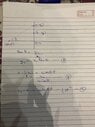
  • image.jpg
    image.jpg
    52.6 KB · Views: 141
  • #36
rudransh verma said:
@Doc Al Now what?
Again, it's a bit difficult to understand what you've written. Please type out your equations here, not handwritten on paper.

(A) Start here: In terms of the horizontal distance traveled (I'd call it "d") and the angle of the ball's initial velocity (θ) express the initial height of the can.

(B) Solve for the travel time for the shot to cover that horizontal distance. (In terms of those variables.)

(C) Write an expression for the height of the ball at that time. (Measured from ground level.)

(D) Write an expression for the height of the can at that time. (Measured from ground level -- that's where the initial height of the can is needed.)

Compare!
 
Last edited:
  • #37
Doc Al said:
D) Write an expression for the height of the can at that time. (Measured from ground level -- that's where the initial height of the can is needed.)
I have written 3. I don’t understand how to write 4th
@berkeman help!
 

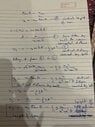
Attachments

  • image.jpg
    image.jpg
    39.9 KB · Views: 155
Last edited:
  • #38
rudransh verma said:
I have written 3. I don’t understand how to write 4th
@berkeman help!
So far, so good. For (C) you wrote the height as a function of time -- now plug in the time, which you found in step (B).

For (D), use the same approach but realize that you aren't starting from y = 0, but y = y2 (which you found in step (A)).
 
  • #39
For (D), use the most general form of the kinematic equation:
y = y0 + v0,y t + (1/2) a t2

You know y0; you found that in (A). You know the initial velocity of the can. And you know the acceleration due to gravity.
 
  • #40
Doc Al said:
For (D), use the same approach but realize that you aren't starting from y = 0, but y = y2 (which you found in step (A)).
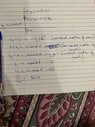
y3 in first box is vertical distance covered by ball whereas y3 in second box is the height of can after time t. For first y3 I took starting point as 0. For second y3 I took starting point as y2 and applied y3-y2= -1/2gt^2
But is it right to take final point as y3 and initial as y2 because y2>y3. Isn’t this negative displacement?
 

Attachments

  • image.jpg
    image.jpg
    51.1 KB · Views: 132
  • #41
rudransh verma said:
For second y3 I took starting point as y2 and applied y3-y2= -1/2gt^2
Good. Rearrange this to give the position of the can at time t: y3 = y2 -1/2gt^2

rudransh verma said:
But is it right to take final point as y3 and initial as y2 because y2>y3. Isn’t this negative displacement?
The can is falling, after all. So its displacement from the starting point is negative. So what?

Now find its position at the time you calculated in step (B). And compare that position to that of the ball, which you should have done for step (C).
 
  • #42
Doc Al said:
Now find its position at the time you calculated in step (B). And compare that position to that of the ball, which you should have done for step (C).
Already done it. It’s shown in image above in the boxes. Both y3s at time t are same.
So at the same time t both the y3 are same. This means position of the can and ball are same after time t from below and above. If both y3 had different values they would not have hit each other.
 
  • #43
Excellent.
 
  • Like
Likes   Reactions: rudransh verma
  • #44
Doc Al said:
Excellent.
So y2 and origin are fixed but y3 is not. To make it more clear I could have taken y31 and y32.
Thank you
But I have a question. We took the initial velocity of can to be zero. Why have we taken initial velocity of ball not zero?
 
  • #45
rudransh verma said:
Why have we taken initial velocity of ball not zero?
The ball is being shot at the can. If its initial velocity were zero, it would just sit there. (It's already on the ground.) On the other hand, the can is being dropped from rest.
 
  • #46
Doc Al said:
The ball is being shot at the can. If its initial velocity were zero, it would just sit there. (It's already on the ground.) On the other hand, the can is being dropped from rest.
So when we do something against gravity we take initial velocity as nonzero of the body but when we leave body in gravity we say it started from rest?
 
  • #47
rudransh verma said:
So when we do something against gravity we take initial velocity as nonzero of the body but when we leave body in gravity we say it started from rest?
It all depends on the problem you're trying to analyze. In this problem, we are shooting a projectile at a target that is dropped from rest.
 

Similar threads

  • · Replies 15 ·
Replies
15
Views
1K
  • · Replies 11 ·
Replies
11
Views
2K
  • · Replies 20 ·
Replies
20
Views
3K
Replies
8
Views
2K
  • · Replies 17 ·
Replies
17
Views
18K
Replies
22
Views
2K
  • · Replies 5 ·
Replies
5
Views
2K
Replies
12
Views
635
  • · Replies 2 ·
Replies
2
Views
1K
  • · Replies 10 ·
Replies
10
Views
753