Index of refraction when total internal reflection ceases

Click For Summary
The discussion focuses on solving a light refraction problem involving a 30°-60°-90° zircon block immersed in water, with an index of refraction of 1.923. The first part requires determining the exit angle of the light ray, which is calculated to be approximately 46.16 degrees. The second part addresses the conditions under which total internal reflection ceases, specifically identifying the necessary value of the water's index of refraction (n2). The critical angle is derived using Snell's law, indicating that total internal reflection occurs when the critical angle is smaller than the incident angle. The participants emphasize the importance of understanding the relationship between the angles and the indices of refraction to solve the problem accurately.
floridianfisher
Messages
27
Reaction score
0
light refractions problem

I don't even know where to start with this problem. Can someone please help me out?
As shown in Figure P22.49, a light ray is incident normal to on one face of a 30°-60°-90° block of zircon(n= 1.923) that is immersed in water.
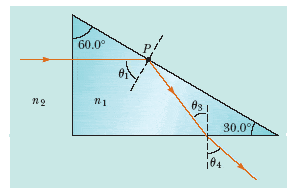

p22-49.gif

Figure P22.49
(a) Determine the exit angle 4 of the ray.
4 = wrong check mark°
(b) A substance is dissolved in the water to increase the index of refraction. At what value of n2 does total internal reflection cease at point P?
n2 =
 
Physics news on Phys.org
For (a) : The light beam obviously entered at a normal to the shortest side of the triangular block since there wasn't any refraction, so using the fact that a triangle in a plane has a sum of internal angles of one hundred and eighty degrees, \theta_1=60^\circ. And I suppose you know that in one single medium, for a reflection, incident angle equals reflected angle, using this, and Snell's law and the sum of internal angles for a triangle, you should be able to figure this out. Hope this helped.

For (b) : Total internal reflection occurs if critical angle is smaller than incident angle. Using Snell's law, the critical angle is the arcsine of \frac{n_2}{n_1}.
 
Last edited:
so using the sum of internal angles it looks like theta 3 would be 30 degrees? Because if you split the reflected ray there is a 30-60-90 triangle?
 

Homework Statement

As shown in Figure P22.49, a light ray is incident normal to on one face of a 30°-60°-90° block of zircon that is immersed in water.
p22-49.gif

(b) A substance is dissolved in the water to increase the index of refraction. At what value of n2 does total internal reflection cease at point P?


Homework Equations


theta critical= arcsin(n2/n1) and total internal reflection ceases when theta critical is less than theta incident


The Attempt at a Solution


theta 4 is 46.16. I used 59.9=arcsin(n2/1.333) and got n2=1.15 but that's not correct but i don't understand because that is when theta critical is less than theta incident. theta incident is 60
 
You need to consider total internal reflection at point P (at \theta _1).

Also n1 is for zirconium.
 
The book claims the answer is that all the magnitudes are the same because "the gravitational force on the penguin is the same". I'm having trouble understanding this. I thought the buoyant force was equal to the weight of the fluid displaced. Weight depends on mass which depends on density. Therefore, due to the differing densities the buoyant force will be different in each case? Is this incorrect?

Similar threads

  • · Replies 1 ·
Replies
1
Views
2K
  • · Replies 1 ·
Replies
1
Views
3K
Replies
4
Views
2K
  • · Replies 1 ·
Replies
1
Views
3K
  • · Replies 2 ·
Replies
2
Views
2K
  • · Replies 8 ·
Replies
8
Views
5K
  • · Replies 7 ·
Replies
7
Views
7K
Replies
4
Views
2K
Replies
2
Views
2K
Replies
3
Views
2K