Index of refraction when total internal reflection ceases

Click For Summary

Homework Help Overview

The discussion revolves around a light refraction problem involving a 30°-60°-90° block of zircon (n=1.923) immersed in water. Participants are exploring the conditions under which total internal reflection ceases at a specific point when the index of refraction of the surrounding medium is altered.

Discussion Character

  • Exploratory, Conceptual clarification, Assumption checking

Approaches and Questions Raised

  • Participants discuss the entry of light into the zircon block and the implications of the angles involved. There are attempts to apply Snell's law and the concept of critical angles to determine when total internal reflection ceases. Questions arise regarding the correct values for the incident angle and the index of refraction needed for this condition.

Discussion Status

The discussion is active, with participants providing insights into the geometry of the problem and the application of relevant equations. Some guidance has been offered regarding the use of Snell's law and the relationship between incident angles and critical angles, although there is no explicit consensus on the correct approach or values yet.

Contextual Notes

Participants are working under the constraints of a homework problem, which may limit the information available and the assumptions that can be made. There is a focus on understanding the conditions for total internal reflection and the implications of changing the index of refraction in the surrounding medium.

floridianfisher
Messages
27
Reaction score
0
light refractions problem

I don't even know where to start with this problem. Can someone please help me out?
As shown in Figure P22.49, a light ray is incident normal to on one face of a 30°-60°-90° block of zircon(n= 1.923) that is immersed in water.
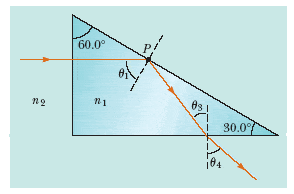

p22-49.gif

Figure P22.49
(a) Determine the exit angle 4 of the ray.
4 = wrong check mark°
(b) A substance is dissolved in the water to increase the index of refraction. At what value of n2 does total internal reflection cease at point P?
n2 =
 
Physics news on Phys.org
For (a) : The light beam obviously entered at a normal to the shortest side of the triangular block since there wasn't any refraction, so using the fact that a triangle in a plane has a sum of internal angles of one hundred and eighty degrees, \theta_1=60^\circ. And I suppose you know that in one single medium, for a reflection, incident angle equals reflected angle, using this, and Snell's law and the sum of internal angles for a triangle, you should be able to figure this out. Hope this helped.

For (b) : Total internal reflection occurs if critical angle is smaller than incident angle. Using Snell's law, the critical angle is the arcsine of \frac{n_2}{n_1}.
 
Last edited:
so using the sum of internal angles it looks like theta 3 would be 30 degrees? Because if you split the reflected ray there is a 30-60-90 triangle?
 

Homework Statement

As shown in Figure P22.49, a light ray is incident normal to on one face of a 30°-60°-90° block of zircon that is immersed in water.
p22-49.gif

(b) A substance is dissolved in the water to increase the index of refraction. At what value of n2 does total internal reflection cease at point P?


Homework Equations


theta critical= arcsin(n2/n1) and total internal reflection ceases when theta critical is less than theta incident


The Attempt at a Solution


theta 4 is 46.16. I used 59.9=arcsin(n2/1.333) and got n2=1.15 but that's not correct but i don't understand because that is when theta critical is less than theta incident. theta incident is 60
 
You need to consider total internal reflection at point P (at \theta _1).

Also n1 is for zirconium.
 

Similar threads

  • · Replies 1 ·
Replies
1
Views
2K
  • · Replies 1 ·
Replies
1
Views
3K
Replies
4
Views
2K
  • · Replies 1 ·
Replies
1
Views
3K
  • · Replies 2 ·
Replies
2
Views
2K
  • · Replies 8 ·
Replies
8
Views
6K
  • · Replies 7 ·
Replies
7
Views
7K
Replies
4
Views
2K
Replies
2
Views
2K
Replies
3
Views
2K