Induced EMF in a half vs. whole ferrite toroid

Click For Summary
SUMMARY

The discussion centers on the phenomenon of induced electromotive force (EMF) in ferrite toroids, specifically comparing a whole toroid to a half-toroid configuration. An experiment conducted with a ferrite toroid around a wire carrying 12 Amps RMS at 120V, 60 Hz resulted in a measured 90 mV RMS potential difference when intact, but nearly 0 mV when cut in half. This outcome is attributed to the principles of magnetic flux and the necessity of a complete magnetic circuit for effective induction, as highlighted by the participants' references to current transformers.

PREREQUISITES
  • Understanding of electromagnetic induction principles
  • Familiarity with ferrite materials and their magnetic properties
  • Knowledge of current transformers and their operational principles
  • Basic electrical circuit analysis skills
NEXT STEPS
  • Research the principles of current transformers and their design
  • Study the effects of magnetic circuit integrity on induced EMF
  • Explore the role of relative permeability in magnetic materials
  • Investigate practical applications of ferrite toroids in electrical engineering
USEFUL FOR

Electrical engineers, physics students, and anyone interested in the practical applications of magnetic materials and electromagnetic induction principles.

GaryLS
Messages
2
Reaction score
0
Hello all -

I've stumbled upon what seems to be a pretty basic magnetic materials question that's got me stumped. Maybe one of you can help me figure this out.

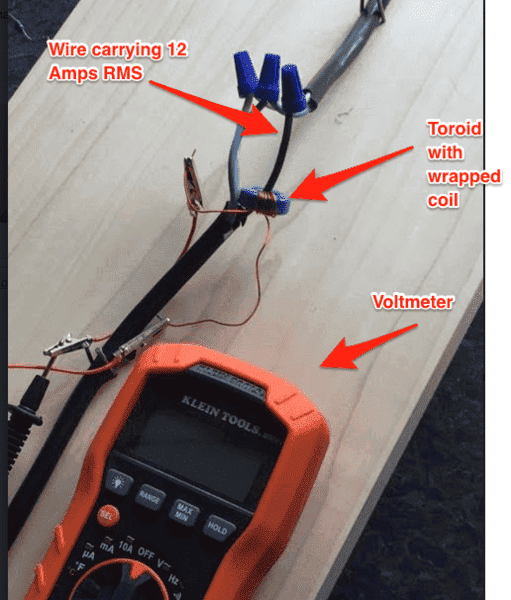
I did the following experiment (see figure below):
  • Put a ferrite toroid around a current carrying wire carrying 12 Amps RMS at 120V, 60 Hz.
  • Toroid has a wire coil around it that's wrapped around a small angular section of the toroid
  • Measured 90 mV RMS potential difference between the coil terminals on the voltmeter, which is about what I expected based on what I learned about this problem in college physics
  • Cut the toroid in half, and put the half-toroid with the coil around it right next to the current carrying wire, but in this case measured nearly 0 mV RMS potential difference between the coil terminals
Can anyone explain why I measured nearly zero mV when the toroid was cut in half? Even though the toroid is cut in half, it's still made of ferromagnetic material, so I would have expected the field strength to be boosted inside the half-toroid (by a factor of α, where α is the ferrite's relative permeability), and therefore would have expected to see a much higher induced voltage in the coil. I would have expected to see more like 50 mV RMS in the coil in this case, but not zero.

Thanks in advance for any insight you can provide!

Gary
upload_2017-4-14_15-23-58.png
 
Last edited:
Physics news on Phys.org
GaryLS said:
Hello all -
......
  • Cut the toroid in half, and put the half-toroid with the coil around it right next to the current carrying wire, but in this case measured nearly 0 mV RMS potential difference between the coil terminals
Can anyone explain why I measured nearly zero mV when the toroid was cut in half? Even though the toroid is cut in half, it's still made of ferromagnetic material, so I would have expected the field strength to be boosted inside the half-toroid (by a factor of α, where α is the ferrite's relative permeability), and therefore would have expected to see a much higher induced voltage in the coil. I would have expected to see more like 50 mV RMS in the coil in this case, but not zero.

Thanks in advance for any insight you can provide!

Gary

do some reading up of current transformers and how they work
here is a link or two to start you off

https://en.wikipedia.org/wiki/Current_transformer

https://www.quora.com/How-do-current-transformers-work

they will explain why you cannot have a broken or only a section od a coreDave
 
Last edited:

Similar threads

  • · Replies 16 ·
Replies
16
Views
4K
Replies
4
Views
2K
  • · Replies 3 ·
Replies
3
Views
2K
  • · Replies 8 ·
Replies
8
Views
2K
  • · Replies 4 ·
Replies
4
Views
2K
  • · Replies 14 ·
Replies
14
Views
5K
  • · Replies 1 ·
Replies
1
Views
2K
  • · Replies 1 ·
Replies
1
Views
2K
  • · Replies 13 ·
Replies
13
Views
9K
  • · Replies 4 ·
Replies
4
Views
7K