Inequality involving a reciprocal - where's the mistake?

Click For Summary

Homework Help Overview

The discussion revolves around solving the inequality \(\left( \dfrac{1}{3} \right)^x < 9\). Participants are exploring the properties of inequalities involving reciprocals and powers of fractions less than one.

Discussion Character

  • Exploratory, Conceptual clarification, Mathematical reasoning, Assumption checking

Approaches and Questions Raised

  • Participants discuss the implications of the base being a fraction less than one, questioning how this affects the inequality. Some suggest using logarithms to analyze the inequality, while others propose graphical methods. There are also inquiries about the relationship between exponents and the direction of inequalities when dealing with fractions.

Discussion Status

The discussion is active, with participants offering various approaches and insights. Some have identified errors in reasoning and are revising their understanding based on the feedback received. Multiple interpretations of the inequality are being explored, and productive guidance has been provided without reaching a consensus.

Contextual Notes

Participants are working within the constraints of a homework problem, which may limit the information available and the methods they can use. There is an emphasis on understanding the properties of exponents and inequalities rather than arriving at a final solution.

brotherbobby
Messages
766
Reaction score
171
Homework Statement
Solve the given inequality : ##\boldsymbol{\left( \dfrac{1}{3} \right)^x<9}##
Relevant Equations
1. If ##a>b>0\Rightarrow \frac{1}{a}<\frac{1}{b}##
2. If ##a<b<0\Rightarrow \frac{1}{a}>\frac{1}{b}##
3. If ##a<0<b\Rightarrow \frac{1}{a}<\frac{1}{b}##

(I am not sure how are these relevant. I cannot think of a known rule involving reciprocals and powers. I'd be grateful to be reminded of them).
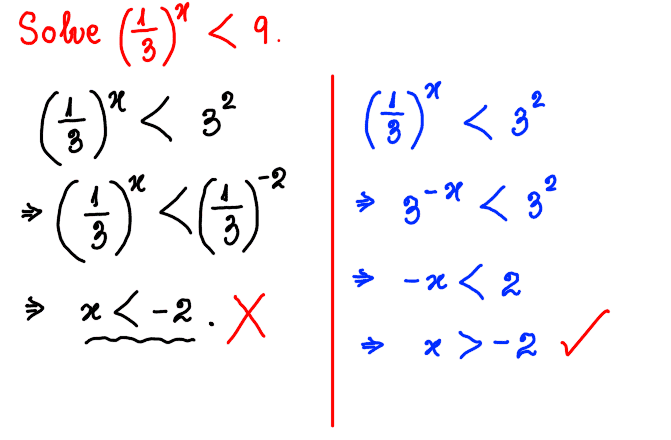
Problem Statement : Solve the inequality : ##\left( \dfrac{1}{3} \right)^x<9##.

Attempts: I copy and paste my attempt below using Autodesk Sketchbook##^{\circledR}##. The two attempts are shown in colours black and blue.
1665909962299.png

Issue : On checking, the first attempt in black turns out to be incorrect. But I don't understand why.

A hint would be welcome.
 
Physics news on Phys.org
Hi,
If ## 0<a<1## what can you say about ##x## and ##y## when you look at ## a^x## wrt ## a^y## ?

##\ ##
 
  • Like
Likes   Reactions: FactChecker
It seems you could try applying ln or other logs on both sides.
 
Alternative: plot ##{1\over 3}^x## :smile:
 
  • Like
Likes   Reactions: FactChecker
Powers of fractions less than 1 work differently. Which is larger, ##1/3## or ##1/3^2##?
 
BvU said:
Hi,
If ## 0<a<1## what can you say about ##x## and ##y## when you look at ## a^x## wrt ## a^y## ?

##\ ##
Let me take an example. Let ##a = \frac{1}{2}##, ##x=3## and ##y=4##. We have ##\left(\frac{1}{2}\right)^3 = \frac{1}{8}## and ##\left(\frac{1}{2}\right)^4=\frac{1}{16}##. Thus as ##x<y##, ##a^x>a^y##.
 
WWGD said:
It seems you could try applying ln or other logs on both sides.
Let me see.
1665918620359.png

It solves the problem but doesn't answer my doubt in post# 1 above.
 
FactChecker said:
Powers of fractions less than 1 work differently. Which is larger, ##1/3## or ##1/3^2##?
yes while ##3<3^2##, ##\frac{1}{3}>\frac{1}{3^2}##
 
BvU said:
Alternative: plot ##{1\over 3}^x## :smile:
Yes I can see where you getting at. I paste the graph below :

1665918852107.png
 
  • #10
I think I have spotted my error. Namely that if ##\left(\frac{1}{a}\right)^x<\left(\frac{1}{a}\right)^y\Rightarrow x>y\;\;\forall a>1##.
I correct my error back in post#1 writing below the black ink in green.

1665919382975.png
 
  • Like
Likes   Reactions: WWGD and FactChecker
  • #11
It might have been easier to do:
$$\big (\frac 1 3 \big )^x < 9 \Rightarrow \frac 1 {3^x} < 9 \Rightarrow 3^x > \frac 1 9 = 3^{-2} \Rightarrow x > -2$$Notes:
1) ##\forall x: 3^x > 0##.

2) ##3^x## is an increasing function.
 
  • #12
More succinctly, if a and b are positive,
##\frac 1 a < b \Rightarrow a > \frac 1 b##
Notice the change in direction of the inequality.
 
  • #13
To generalize what you, others have said, ##x>y## does not imply ##f(x)>f(y) ##.
 

Similar threads

  • · Replies 6 ·
Replies
6
Views
1K
  • · Replies 15 ·
Replies
15
Views
3K
  • · Replies 11 ·
Replies
11
Views
2K
  • · Replies 9 ·
Replies
9
Views
1K
Replies
7
Views
2K
Replies
1
Views
2K
Replies
3
Views
2K
  • · Replies 3 ·
Replies
3
Views
2K
Replies
7
Views
2K
  • · Replies 7 ·
Replies
7
Views
2K