SUMMARY
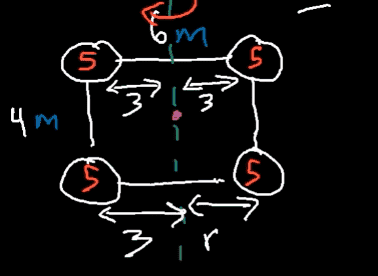
The inertia of a system with respect to a rotation axis through the center of mass (the pink dot) is calculated as 4(mr²). The discussion clarifies that the radius (r) is defined as the perpendicular distance from the mass to the axis of rotation, which is 3 (derived from 6 divided by 2), rather than sqrt(13), which incorrectly represents the distance from the mass to the center point. This distinction is crucial for accurate calculations of inertia in rotational dynamics.
PREREQUISITES
- Understanding of rotational dynamics and inertia
- Familiarity with the concept of center of mass
- Knowledge of geometric properties of rectangles
- Basic algebra for manipulating equations
NEXT STEPS
- Study the derivation of the moment of inertia for various shapes
- Learn about the parallel axis theorem in rotational dynamics
- Explore the implications of changing the axis of rotation on inertia calculations
- Investigate the relationship between mass distribution and inertia
USEFUL FOR
Students and professionals in physics, mechanical engineering, and robotics who are involved in analyzing rotational systems and calculating moments of inertia.