Inertia tensor of cone around its apex

Click For Summary
The discussion focuses on calculating the principal moments of inertia (Ixx, Iyy, Izz) for a cone using triple integration in cylindrical coordinates with MATLAB. The user initially encounters issues with the integration boundaries, particularly for the z-coordinate, where they mistakenly set the lower limit as r instead of the correct expression (H/R) * r. After feedback from other participants, the user acknowledges the error and clarifies that the textbook example used a cone with equal height and radius, which led to the confusion. The integration process involves symbolic variables for radius, height, and mass, and the user seeks confirmation on the correctness of their calculations. The conversation emphasizes the importance of accurately determining integration boundaries in mathematical modeling.
Noxuz
Messages
3
Reaction score
0
Thread moved from the technical forums, so no Homework Template is shown
Im trying to calculate the principals moments of inertia (Ixx Iyy Izz) for the inertia tensor by triple integration using cylindrical coordinates in MATLAB.
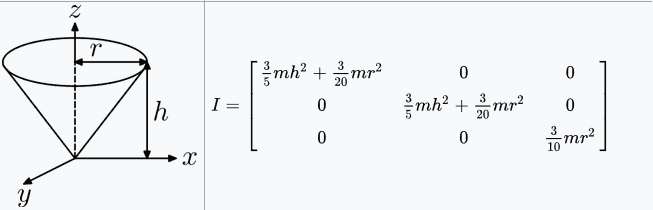
inertiatensor.png


Code:
% Symbolic variables
syms r z theta R h M; % R (Radius) h(height) M(Mass)  

% Ixx
unox = int((z^2+(r*sin(theta))^2)*r,z,r,h); % First integration
dosx = int(unox,r,0,R); % Second Integration
tresx = int(dosx,theta,0,2*pi); % Third integration

Ix = tresx / ((pi*R^2*h)/3); % Division by the volume of a cone (Mass since densitiy is 1)
Ix = Ix*M  % Setting up in terms of mass M

% Iyy
unoy = int((z^2+(r*cos(theta))^2)*r,z,r,h);
dosy = int(unoy,r,0,R);
tresy = int(dosy,theta,0,2*pi);

Iy = tresy / ((pi*R^2*h)/3);
Iy = Iy*M

% Izz
unoz = int(r^2*r,z,r,h);
dosz = int(unoz,r,0,R);
tresz = int(dosz,theta,0,2*pi);

Iz = tresz / ((pi*R^2*h)/3);
Iz = Iz*M

I plug in test values in both the formulas from the image and the code and they seem correct except from Iz in which the height (h) still appears and terms like 3h-2r instead of h appear, Am I missing something in the integrations? Thank you in advance.
 

Attachments

  • inertiatensor.png
    inertiatensor.png
    4.8 KB · Views: 4,110
Physics news on Phys.org
Did you try doing the integrals by hand? (They are not difficult.)

Please show your work in determining the integration boundaries.
 
  • Like
Likes vanhees71
Orodruin said:
Did you try doing the integrals by hand? (They are not difficult.)

Please show your work in determining the integration boundaries.

In cylindrical coordinates for a solid cone the only non-trivial boundarie would be on the first integration, since its a solid of revolution, theta goes grom 0 to 2*pi and r goes from 0 to R (radius of cone).
z would go from z = r (x^2 + y^2) to z = h (height of cone)
 
Noxuz said:
z would go from z = r (x^2 + y^2) to z = h (height of cone)
This is incorrect and you have not really provided an argument for why it should be the case. I suggest you take a second look at it.
 
  • Like
Likes Noxuz
Orodruin said:
This is incorrect and you have not really provided an argument for why it should be the case. I suggest you take a second look at it.

Thank you, I found the error, the inferior limit of the integral for z isn't r, its (H/R) * r, The textbook I was reading gives an example for a cone of equal heigth and radius so it ignored the slope in the integral.
 

Similar threads

  • · Replies 1 ·
Replies
1
Views
3K
  • · Replies 6 ·
Replies
6
Views
13K
  • · Replies 3 ·
Replies
3
Views
14K
  • · Replies 4 ·
Replies
4
Views
3K
Replies
1
Views
4K
  • · Replies 10 ·
Replies
10
Views
2K
  • · Replies 7 ·
Replies
7
Views
6K
Replies
4
Views
7K
  • · Replies 6 ·
Replies
6
Views
9K
Replies
2
Views
3K