Infinite square well, dimensionless Hamiltonian..

Click For Summary
SUMMARY

The discussion centers on the formulation of the infinite square well problem and the concept of a dimensionless Hamiltonian. The user expresses confusion regarding the boundary conditions of the well, specifically how to apply them when transitioning from a well defined from 0 to L to one defined from -b/2 to b/2. The suggestion is made to solve the problem using the variable transformation x' = x - b/2 to facilitate understanding and application of the boundary conditions.

PREREQUISITES
  • Understanding of quantum mechanics principles, particularly the infinite square well model.
  • Familiarity with Hamiltonian mechanics and the concept of a dimensionless Hamiltonian.
  • Knowledge of variable transformations in mathematical physics.
  • Basic grasp of boundary conditions in quantum systems.
NEXT STEPS
  • Study the derivation of the infinite square well solution in quantum mechanics.
  • Learn about dimensionless Hamiltonians and their applications in quantum systems.
  • Explore variable transformations and their impact on boundary conditions in physics.
  • Investigate the implications of different boundary conditions on wave functions in quantum mechanics.
USEFUL FOR

Students and professionals in physics, particularly those focusing on quantum mechanics, as well as educators seeking to clarify the infinite square well problem and its boundary conditions.

Cocoleia
Messages
293
Reaction score
4
Homework Statement
Electron with mass m* moves in a 1D quantum well with infinite barriers at x= -b/2 and
x=+b/2.
Assume mass of the electron to be m*=0.5 m where “m” is free electron mass.
a. Write Schrodinger equation and the Hamiltonian in dimensionless form
b. Solve stationary Schrodinger equation, find allowed energy levels, give explicit expression for 1st,2nd, and 3rd energy levels
d. give wavefunctions for the first three levels – plot them.
e. give 3 energy levels ,in meV, for a=4 nm
Relevant Equations
H phi = -hbar^2 / 2m d^2/dx phi(x) = E phi (x)
I have always seen this problem formulated in a well that goes from 0 to L

I am confused how to use this boundary, as well as unsure of what a dimensionless hamiltonian is.
This is as far as I have gotten
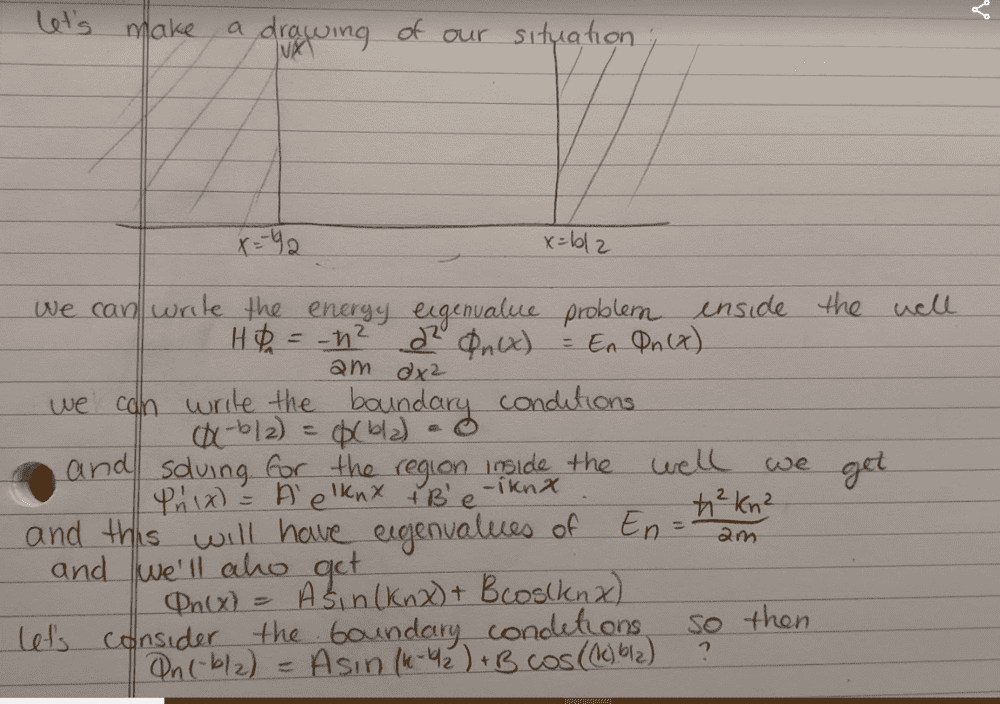
1572389128351.png
 
Physics news on Phys.org
What would keep you from solving it as if the well was from 0 to ##b## and then, once you had the solution, changing variables ##x' = x-\frac{b}{2}##?
 
  • Like
Likes   Reactions: Abhishek11235
Alternatively,put the boundary conditions at -b/2 and b/2 same as you did for [0,L]
 

Similar threads

  • · Replies 2 ·
Replies
2
Views
3K
  • · Replies 9 ·
Replies
9
Views
1K
  • · Replies 39 ·
2
Replies
39
Views
13K
  • · Replies 5 ·
Replies
5
Views
3K
  • · Replies 2 ·
Replies
2
Views
2K
  • · Replies 19 ·
Replies
19
Views
2K
  • · Replies 11 ·
Replies
11
Views
3K
Replies
7
Views
2K
  • · Replies 2 ·
Replies
2
Views
1K
Replies
7
Views
3K