Input-referred thermal noise voltage (Razavi exercise)

Click For Summary
SUMMARY

The discussion focuses on calculating input-referred thermal noise voltage as presented in problem 7.7 (c) of Behzad Razavi's "Design of Analog CMOS Integrated Circuits." The key elements of current noise include contributions from resistors and transistors, specifically: Rd, M1, M2, and Rs. The participant successfully identifies the current noise expressions but struggles with the correct resistance values needed to convert current noise to voltage noise. The proposed resistance calculations for M1 and M2 are based on their roles in amplification and active loading, while uncertainty remains regarding Rd and Rs.

PREREQUISITES
  • Understanding of thermal noise in electronic circuits
  • Familiarity with CMOS transistor operation and parameters
  • Knowledge of voltage gain calculations in amplifiers
  • Basic principles of noise analysis in analog circuits
NEXT STEPS
  • Study the derivation of input-referred noise in analog circuits
  • Learn about the role of output resistance in noise calculations
  • Explore the concept of transconductance (gm) in CMOS devices
  • Research methods for transforming current noise to voltage noise in circuit analysis
USEFUL FOR

Electrical engineers, analog circuit designers, and students studying CMOS technology who are looking to deepen their understanding of noise analysis in integrated circuits.

emdezla
Messages
11
Reaction score
0
Homework Statement
Calculate the input-referred thermal noise voltage of the circuit assuming lambda equal zero.
Relevant Equations
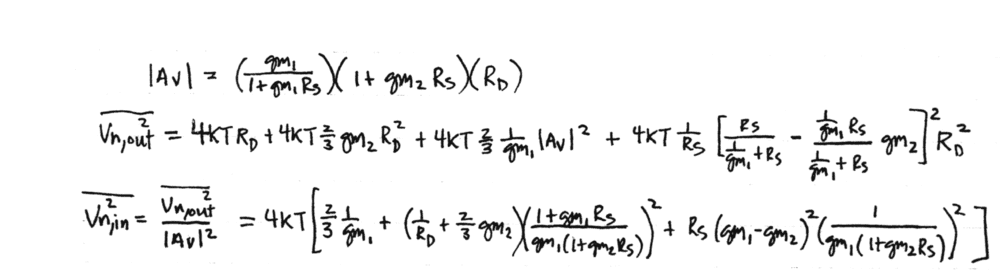
Both the equations and the solutions are attached
So this is a problem from the legendary Razavi book "Design of Analog CMOS Integrated Circuits" (Specifically, it is the problem 7.7 (c)). I got the solutions online but when I try to calculate the noise expression myself, I don't arrive at the same result. Lambda is assumed zero for neglecting Ro of the transistors
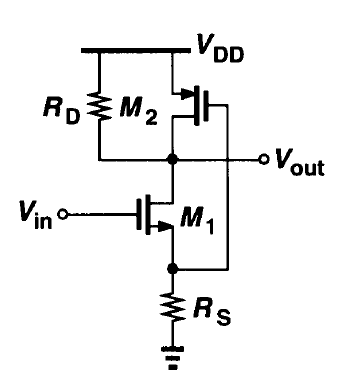
1574705965624.png

1574706093926.png


I know the circuit voltage gain Av=Vout/Vin has to be computed and I can to do that.
Then I know that every element of the circuit has to be assumed as a source of current noise. I also can do that, and for this case, we have the 4 following current noise:
  • Current noise from Rd = 4KT/Rd
  • Current noise from M1 = 4KT*(2/3)*gm_1
  • Current noise from M2 = 4KT*(2/3)*gm_2
  • Current noise from RS = 4KT/Rs
So far so good, but here is where the problem comes: I have to transform current noise into voltage noise by multiplying by a resistance (V^2 = R^2*I^2) And I don't really know what's the correct method or procedure to obtain the suitable resistance expression for the current noise of each circuit component. These are my guesses after doing many exercises so far:
  • Resistance for M1 noise: if this transistor is used for amplification then R = Av/gm_1
  • Resistance for M2 noise: if this transistor is used as an active load then R = Rout (output resistance of the whole circuit)
  • Resistance for Rd noise: no idea, but usually is R = Rd
  • Resistance for Rs noise: no idea at all
So yes, that is basically my question: how do we compute the resistance for transforming the current noise of a circuit component to a voltage noise. Thank you very much in advance!
 
Physics news on Phys.org
Thank you :rolleyes:
 

Similar threads

  • · Replies 4 ·
Replies
4
Views
2K
Replies
15
Views
2K
  • · Replies 1 ·
Replies
1
Views
2K
  • · Replies 10 ·
Replies
10
Views
4K
  • · Replies 7 ·
Replies
7
Views
3K
  • · Replies 45 ·
2
Replies
45
Views
9K
  • · Replies 1 ·
Replies
1
Views
2K
  • · Replies 5 ·
Replies
5
Views
2K
  • · Replies 13 ·
Replies
13
Views
3K
  • · Replies 6 ·
Replies
6
Views
2K