Integral of Logarithm: Find & Solve

  • Context: MHB 
  • Thread starter Thread starter alyafey22
  • Start date Start date
  • Tags Tags
    Integral Logarithm
Click For Summary

Discussion Overview

The discussion revolves around the evaluation of the integral $$\int^{\infty}_{0} \frac{\ln(x) }{x^2+a^2}\,dx$$. Participants explore various methods for solving this integral, including substitution techniques, differentiation under the integral sign, and complex analysis approaches. The scope includes mathematical reasoning and exploratory problem-solving.

Discussion Character

  • Mathematical reasoning
  • Exploratory
  • Technical explanation
  • Debate/contested

Main Points Raised

  • Some participants propose using substitution methods, such as letting $$u = \ln(x)$$, to transform the integral into a different form.
  • Another participant suggests a method involving the substitution $$\frac{x}{a}= t$$, leading to a series of integrals that include logarithmic terms.
  • One participant introduces a differentiation approach, defining $$F(b) = \int^{\infty}_0 \frac{x^b \ln(x) }{x^2+a^2} \, dx$$ and differentiating with respect to $$b$$ to relate it back to the original integral.
  • A later reply mentions a complex analysis approach, discussing the use of contour integration and residues, while noting the challenges posed by branch cuts in the logarithm function.
  • Another participant provides a detailed complex analysis method, outlining the steps to evaluate the integral using residues and comparing real and imaginary parts of the resulting expressions.

Areas of Agreement / Disagreement

Participants present multiple competing views and methods for evaluating the integral, with no consensus reached on a single approach or solution. The discussion remains unresolved as various techniques are explored without agreement on their effectiveness or correctness.

Contextual Notes

Some methods rely on specific assumptions about the variable $$a$$, such as assuming $$a > 0$$. The discussion also includes unresolved mathematical steps and transformations that may depend on the definitions used by participants.
alyafey22
Gold Member
MHB
Messages
1,556
Reaction score
2
Find the following integral :

$$\int^{\infty}_{0} \frac{\ln(x) }{x^2+a^2}\,dx$$
 
Last edited by a moderator:
Physics news on Phys.org
ZaidAlyafey said:
Find the following integral :

$$\int^{\infty}_{0} \frac{\ln(x) }{x^2+a^2}\,dx$$ <----- THERE IT IS!

Hope that helped :)
 
ZaidAlyafey said:
Find the following integral :

$$\int^{\infty}_{0} \frac{\ln(x) }{x^2+a^2}\,dx$$

I am sure that there's some nice little trick to all this, but here I go anyway...

u-substition:
$$
u = \ln(x);\; du = dx/x \rightarrow\\
\int^{\infty}_{0} \frac{\ln(x) }{x^2+a^2}\,dx=
\int^{\infty}_{-\infty} \frac{u}{e^{2u}+a^2}\,e^u du\\
=\int^{\infty}_{-\infty} \frac{u}{e^{u}+a^2e^{-u}}\, du
$$

Well, that's my stab at it for now. More on that when I'm less sleepy.
 
ZaidAlyafey said:
Find the following integral :

$$\int^{\infty}_{0} \frac{\ln(x) }{x^2+a^2}\,dx$$

Setting $\frac{x}{a}= t$ the integral becomes...

$$I= \frac{\ln a}{a}\ \int_{0}^{\infty} \frac{d t}{1 + t^{2}}\ dt + \frac{1}{a} \int_{0}^{\infty} \frac{\ln t}{1+ t^{2}}\ dt = \frac{\pi}{2}\ \frac{\ln a}{a} + \frac{1}{a} (\int_{0}^{1} \frac{\ln t}{1+ t^{2}}\ dt + \int_{1}^{\infty} \frac{\ln t}{1+ t^{2}}\ dt)\ (1)$$

... and setting in the last integral in (1) $\xi= \frac{1}{t}$ we obtain...

$$I= \frac{\pi}{2}\ \frac{\ln a}{a} + \frac{1}{a}\ (\int_{0}^{1} \frac{\ln t}{1+ t^{2}}\ dt - \int_{0}^{1} \frac{\ln \xi}{1+ \xi^{2}}\ d \xi) = \frac{\pi}{2}\ \frac{\ln a}{a}\ (2)$$

Kind regards

$\chi$ $\sigma$
 
Last edited:
$$F(b) = \int^{\infty}_0 \frac{x^b}{x^2+a^2}\, \, $$ ----(1)

$$F(b) = \frac{1}{a^2}\,\int^{\infty}_0 \frac{x^b}{\frac{x^2}{a^2}+1} \, dx$$

Let $$\frac{x^2}{a^2} = t$$

$$F(b) = \frac{a^b}{2|a|} \,\int^{\infty}_0 \frac{t^{\frac{b-1}{2}}}{t+1} \, dt = \frac{a^b \, \pi }{2|a| \sin\left( \pi \frac{b+1}{2}\right)}$$

$$F(b)=\frac{a^b \, \pi }{2|a| \sin\left( \pi \frac{b+1}{2}\right)}$$

Differentiate wrt to $b$

$$F'(b) = \frac{a^b \, \pi \, \ln|a| }{2|a| \sin\left( \pi \frac{b+1}{2}\right)} - \frac{a^b \, \pi^2 }{4|a| } \cot^2 \left(\pi \frac{b+1}{2}\right)$$

$$F'(0) = \frac{ \, \pi \, \ln|a| }{2|a|} $$

Differentiating (1) wrt to $$b$$ we get :

$$F(b) = \int^{\infty}_0 \frac{x^b \ln(x) }{x^2+a^2} \, dx$$

$$F'(0) = \int^{\infty}_0 \frac{\ln(x) }{x^2+a^2} \, dx\, \, $$ ----(2)

By (1) , (2) we get what we want $$\square$$ .
 
Last edited:
There is a complex analysis approach , if someone is interested . I will try to post it later .
 
Here is a complex approach

$$f(z) = \frac{\log_0^2(z)}{z^2+a^2}$$

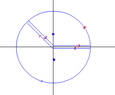
Where the logarithm has a branch cut on the positive real axis and the integration is along a circle with radius $$R$$.

We will divide the contour into two parts because the function is not analytic in the whole contour , so we can't apply the residue theory directly. We can easily prove that the sum of the integration along the two parts will eventually be $$2\pi i \, \text{Res}(f(z))$$ . The sum of integration along the two tilted lines will be equal to $0$.

View attachment 923

The picture shows two separated parts while there should be no distance between the two contours . So the two lines should be on the x-axis but I moved them a little bit for easy illustration and to identify direction .
Integration along the x-axis

$$\int^R_0 \frac{\ln^2(x)}{x^2+a^2}\, dx$$Integration along the x-axis ( opposite direction )

$$-\int^R_0 \frac{(\ln(x)+2\pi i)^2}{x^2+a^2}\, dx=-\int^R_0 \frac{\ln^2(x)+4\pi i \ln(x)-4\pi^2}{x^2+a^2}\, dx$$Integration along the Circle

$$\int_{C_R}\frac{\log_0 ^2(z)}{z^2+a^2}\, dz \leq 2 \pi R \frac{\ln^2|R|+ 2\pi \ln|R| +4\pi^2}{R^2-a^2} \to 0 \,\,\,, R \to \infty$$Sum of Residues Here we are assuming that $$a>0$$ to easily find the residues $$\text{Res}(f(z) ; ai) +\text{Res}(f(z) ; -ai) =\frac{\log_0^2(ai)}{2ai}-\frac{\log_0^2(-ai)}{2ai} $$$$\frac{\left(\ln(a)+\frac{\pi}{2}i \right)^2}{2ai}-\frac{\left(\ln(a)+\frac{3\pi}{2}i \right)^2}{2ai}= \frac{-2 \pi \ln(a)i +2\pi^2}{2ai}$$Now take $$R\to \infty$$ and sum the contours

$$-4\pi\text{P.V} \int^{\infty}_0 \frac{ \ln(x)}{x^2+a^2} \, dx -4\pi^2 \text{P.V} \int^{\infty}_0 \frac{dx}{x^2+a^2}\, dx = 2\pi i\left( \frac{-2 \pi \ln(a)i +2\pi^2}{2ai}\right)$$Comparing the imaginary parts


$$-4\pi\text{P.V} \int^{\infty}_0 \frac{ \ln(x)}{x^2+a^2} \, dx= -\frac{2 \pi ^2 \ln (a)}{a}$$$$\text{P.V}\int^{\infty}_0 \frac{ \ln(x)}{x^2+a^2}\, dx = \frac{\pi \ln (a)}{2a} \,\,\, a>0$$We also get by comparing the real part $$ 4\pi^2 \text{P.V} \int^{\infty}_0 \frac{dx}{x^2+a^2} = \frac{2\pi^3}{a}$$

$$\int^{\infty}_0 \frac{dx}{x^2+a^2} = \frac{\pi}{2a}$$
 

Attachments

  • contour2.PNG
    contour2.PNG
    2.1 KB · Views: 114
Last edited:

Similar threads

  • · Replies 14 ·
Replies
14
Views
4K
  • · Replies 14 ·
Replies
14
Views
3K
  • · Replies 27 ·
Replies
27
Views
2K
  • · Replies 15 ·
Replies
15
Views
4K
  • · Replies 3 ·
Replies
3
Views
2K
  • · Replies 4 ·
Replies
4
Views
3K
  • · Replies 10 ·
Replies
10
Views
2K
  • · Replies 8 ·
Replies
8
Views
3K
  • · Replies 12 ·
Replies
12
Views
2K
  • · Replies 19 ·
Replies
19
Views
5K