Integration by filaments or integration by strate?

  • Thread starter Amaelle
  • Start date
  • Tags Tags
    Integration
7 replies · 2K views · last reply
Amaelle
Messages
318
Reaction score
55
Homework Statement
look at the image
Relevant Equations
cylindrical coordinates
integration by strates
integration by filaments
Greetings
While solving the following exercice, ( the method used is the integration by filaments and I have no problem doing it this way)

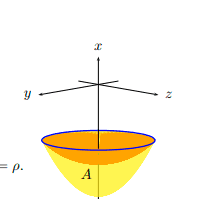
Triple integral over region A of x dx dy dz, where A = {(x, y, z) in R^3 : y^2 + z^2 - 2 <= x < -sqrt(2 - y^2 - z^2)}, with the instruction Use cylindrical coordinates.

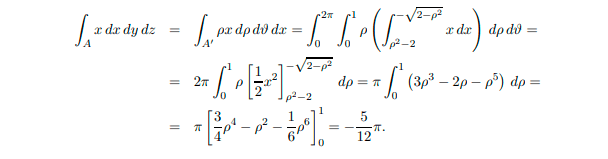
here is the solution
Worked triple-integral solution: integral over A of x dx dy dz equals integral over A' of rho x drho dtheta dx, converted to cylindrical limits, then evaluated step by step to the final result -5/12 pi.

3D sketch of a yellow paraboloid bowl opening upward along the x-axis, with an orange-shaded interior and a blue elliptical rim, labelled A, beside a coordinate frame with axes x, y and z.

My question is the following:
I want to do the integration by strate and here is my proposition
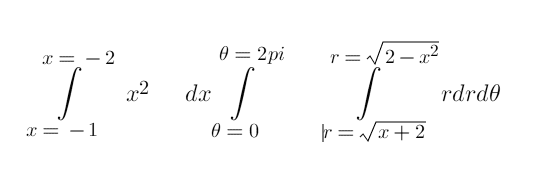
Three iterated integrals side by side: first, the integral from x = -1 to x = -2 of x^2 dx; second, the integral from theta = 0 to theta = 2pi of dx; third, the integral with limits r = sqrt(2 - x^2) and |r| = sqrt(x + 2) of r dr d theta.

is that even correct?
I would like to know if there is cases when switching between the two methods of integration is not possible?
thank you in advance!
 
  • Like
Likes   Reactions: Delta2
I've never heard of "integration by strate." Could you explain what this means?
 
  • Love
  • Like
Likes   Reactions: Delta2 and Amaelle
Certainly look at the image
3D diagram of a yellow solid of revolution shaped like a cone with its vertex at the bottom, with thin blue, red and yellow circular slices at different heights, axes labelled x, y and z, and A_z marked near the base.
it means doing the integration by rings and then integrating by height
 
Oh, okay. In the US, I think that technique is referred to as the disc method.
 
  • Like
Likes   Reactions: Delta2
You should be able to use that method, but you're going to have to break the integral up into two integrals, one from ##x=-2## to ##x=-\sqrt{2}## and one from ##x=-\sqrt{2}## to ##x=-1##.
 
  • Informative
  • Like
Likes   Reactions: Delta2 and BvU
thank you very much , indeed I used your insights to solve the question under the disk method
Graph on x and y axes of a blue parabola y = 2x^2 - 2 and a green curve g crossing at x = -1 and x = 1, with both labelled f and g.

but the only way I could find out was to
Two triple integral setups in cylindrical coordinates: over the paraboloid, x from -2 to -1, theta from 0 to 2pi, r from 0 to sqrt(x+2), integrand x r dr dtheta dx; over the sphere, x from -sqrt(2) to -1, theta from 0 to 2pi, r from 0 to sqrt(2-x^2), same integrand.


and then substructing the sphere from the paraboloid
I would be very grateful if you could elaborate more about the setting of your method and why you need to split the integration this way?
thank you!
 
  • Like
Likes   Reactions: Delta2
To keep it simple, I'm going to consider volume integrals but the same ideas apply to your problem.

When you do the integrals over ##r## and ##\theta##, you end up with an integral of the form
$$\int_{x_1}^{x_2} \pi r^2 \,dx$$ where we can identify ##\pi r^2## as the area of the disk and ##dV = \pi r^2\,dx## as the volume of the infinitesimal slice. In this particular problem, from ##x=-2## to ##x=-\sqrt{2}##, the volume is given by an integral of that form. However, from ##x=-\sqrt{2}## to ##x=-1##, you have a disk with a hole in the middle with area ##\pi(r_{\rm outer}^2-r_{\rm inner}^2)##. Hence, the volume of that portion is given by
$$\int_{x_1}^{x_2} \pi (r_{\rm outer}^2-r_{\rm inner}^2) \,dx.$$ Because you have two different integrands, you need to do the integrals for each range separately.

Note that you can manipulate your integrals similarly:
\begin{align*}
I &= \int_{-2}^{-1} \int_0^{2\pi} \int_0^{\sqrt{2-x^2}} xr\,dr\,d\theta\,dx
-\int_{-\sqrt 2}^{-1} \int_0^{2\pi} \int_0^{\sqrt{x+2}} xr\,dr\,d\theta\,dx \\
&= \int_{-2}^{-\sqrt{2}} \int_0^{2\pi} \int_0^{\sqrt{2-x^2}} xr\,dr\,d\theta\,dx
+\int_{-\sqrt{2}}^{-1} \int_0^{2\pi} \int_0^{\sqrt{2-x^2}} xr\,dr\,d\theta\,dx
-\int_{-\sqrt 2}^{-1} \int_0^{2\pi} \int_0^{\sqrt{x+2}} xr\,dr\,d\theta\,dx \\
&= \int_{-2}^{-\sqrt{2}} \int_0^{2\pi} \int_0^{\sqrt{2-x^2}} xr\,dr\,d\theta\,dx
+\int_{-\sqrt{2}}^{-1} \int_0^{2\pi} \int_{\sqrt{x+2}}^{\sqrt{2-x^2}} xr\,dr\,d\theta\,dx
\end{align*} The limits on the ##r## integral are different for ##x=-2## to ##x=-\sqrt{2}## and for ##x=-\sqrt{2}## to ##x=-1##.
 
  • Love
Likes   Reactions: Amaelle