Integration by Parts with Complex Exponentials

Click For Summary
SUMMARY

The discussion focuses on solving the integral ∫xe2x cos(2x)dx using integration by parts and Euler's formula. The user aims to derive the solution ¼e2x(x cos(2x) + x sin(2x) - ½sin(2x)) + C. The application of Euler's formula, cos(2x) = (e2ix + e-2ix)/2, is crucial for transforming the integral into a more manageable form involving complex exponentials.

PREREQUISITES
  • Understanding of integration by parts
  • Familiarity with Euler's formula
  • Knowledge of complex exponentials
  • Basic proficiency in calculus
NEXT STEPS
  • Study the method of integration by parts in depth
  • Learn about the application of Euler's formula in integrals
  • Explore complex analysis techniques for solving integrals
  • Practice solving integrals involving trigonometric functions and exponentials
USEFUL FOR

Students studying calculus, particularly those focusing on integration techniques, as well as educators looking for examples of applying Euler's formula in integral calculus.

abney317
Messages
1
Reaction score
0
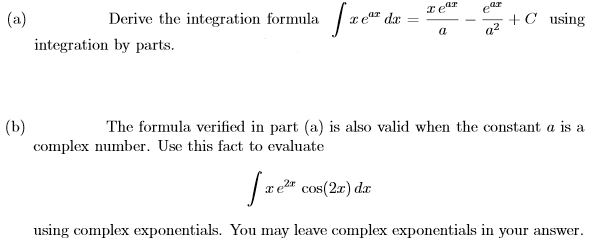
I'm looking at this problem here. (Exam practice, move to homework if you want...)
nZ4jRd1.png


First part is easy, but it's the second part that I can't quite figure out.


I'm trying to get from ∫xe2x cos(2x)dx to this answer:
¼e2x(x cos(2x) + x sin(2x) - ½sin(2x))+C
 
Physics news on Phys.org
Do you know Euler's formula?
 
[tex]cos(2x)= \frac{e^{2ix}+ e^{-2ix}}{2}[/tex]
so
[tex]\int xe^{2x} cos(2x)dx= \frac{1}{2}\int x(e^{2(1+ i)x}+ e^{2(1- i)x})dx[/tex]
 

Similar threads

  • · Replies 27 ·
Replies
27
Views
3K
  • · Replies 8 ·
Replies
8
Views
4K
  • · Replies 4 ·
Replies
4
Views
3K
  • · Replies 6 ·
Replies
6
Views
3K
  • · Replies 5 ·
Replies
5
Views
5K
  • · Replies 21 ·
Replies
21
Views
4K
  • · Replies 8 ·
Replies
8
Views
5K
  • · Replies 2 ·
Replies
2
Views
1K
  • · Replies 4 ·
Replies
4
Views
3K
  • · Replies 3 ·
Replies
3
Views
2K