Integration of partials, specifically Euler to Bernoulli Equation

Click For Summary
SUMMARY

The discussion focuses on the mathematical derivation from Euler's Equation to Bernoulli's Equation, specifically addressing the integration of partial derivatives. The key point is the application of the chain rule, where dp is expressed as dp = ∂p/∂x dx. Additionally, the term gH is clarified as a representation of the constant derived from boundary conditions, with H denoting "Head" measured in meters. This insight emphasizes the importance of understanding both the mathematical and physical interpretations in fluid dynamics.

PREREQUISITES
  • Understanding of partial derivatives and their integration
  • Familiarity with Euler's Equation in fluid dynamics
  • Knowledge of Bernoulli's Equation and its applications
  • Basic concepts of boundary conditions in physics
NEXT STEPS
  • Study the application of the chain rule in calculus
  • Explore the derivation of Bernoulli's Equation from first principles
  • Investigate the significance of boundary conditions in fluid mechanics
  • Learn about the physical interpretation of hydraulic head (H) in fluid systems
USEFUL FOR

Students and professionals in fluid dynamics, engineers working with hydraulic systems, and anyone interested in the mathematical foundations of fluid equations.

zuppi
Messages
5
Reaction score
0
Hi!

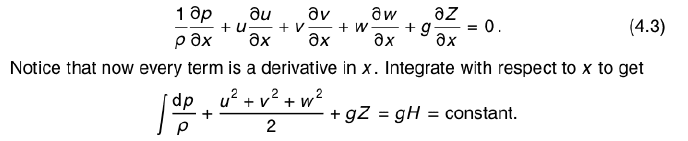
I am having trouble following the derivation from Euler's Equation to Bernoulli's Equation. The trouble lies in the math, not the physics part. Especially the step when partial derivatives are being integrated.
I have attached the relevant part as a screenshot.
Euler.PNG


How does the partial dp/dx change into dp? And where does gH come from?

Any help will be much appreciated!
 
Physics news on Phys.org
You can simply note that, by the chain rule dp=\frac{\partial p}{\partial x}dx. As far as gH is concerned, I think it should probably come from your boundary conditions. You need some information to determine the constant.
However, I don't know what H is so I can't really answer your question.
 
  • Like
Likes 1 person
Thanks, that makes sense, I forgot about the chain rule for partials.
Concerning gH I believe it is just another way of expressing the constant to give it a more physical meaning. With H being the "Head" measured in meters. They should have written ... = constant = g*H to make it more clear.
 
Sounds reasonable.
 
Relativistic Momentum, Mass, and Energy Momentum and mass (...), the classic equations for conserving momentum and energy are not adequate for the analysis of high-speed collisions. (...) The momentum of a particle moving with velocity ##v## is given by $$p=\cfrac{mv}{\sqrt{1-(v^2/c^2)}}\qquad{R-10}$$ ENERGY In relativistic mechanics, as in classic mechanics, the net force on a particle is equal to the time rate of change of the momentum of the particle. Considering one-dimensional...

Similar threads

  • · Replies 1 ·
Replies
1
Views
3K
  • · Replies 2 ·
Replies
2
Views
2K
  • · Replies 4 ·
Replies
4
Views
1K
Replies
2
Views
1K
Replies
1
Views
2K
  • · Replies 6 ·
Replies
6
Views
5K
  • · Replies 4 ·
Replies
4
Views
3K
  • · Replies 9 ·
Replies
9
Views
4K
  • · Replies 2 ·
Replies
2
Views
2K
  • · Replies 13 ·
Replies
13
Views
3K