Interference of Xrays from a salt crystal

Click For Summary
SUMMARY

The discussion centers on the interference of X-rays from a salt crystal, specifically addressing the equation for constructive interference, 2dsin(Θ) = mλ, derived from Serway's textbook. A participant questions whether the equation should account for a 180-degree phase shift due to the higher refractive index of the salt crystal compared to air, suggesting a modified equation of 2dsin(Θ) = (m + 1/2)λ. The conversation emphasizes the importance of understanding phase shifts in X-ray diffraction and their implications on reflection from crystal lattice planes.

PREREQUISITES
  • Understanding of X-ray diffraction principles
  • Familiarity with crystal lattice structures
  • Knowledge of phase shifts in wave mechanics
  • Basic concepts of constructive and destructive interference
NEXT STEPS
  • Research the derivation of Bragg's Law in X-ray diffraction
  • Explore the effects of refractive index on phase shifts in wave propagation
  • Study the properties of salt crystals and their impact on X-ray reflection
  • Learn about the role of crystal symmetry in diffraction patterns
USEFUL FOR

Students and professionals in physics, materials science, and crystallography, particularly those interested in X-ray diffraction and its applications in analyzing crystal structures.

user3
Messages
59
Reaction score
0
Hello,

In my textbook(Serway), Constructive interference of two rays hitting the first and the second planes , respectively, of a crystal lattice is derived as 2dsin(Θ)=mλ , where Θ is the angle shown in the picture.

My question is: shouldn't the equation be 2dsin(Θ) = (m+1/2 )λ instead? because the salt crystal is a "heavier" (larger refractive index) medium than air, so the first ray exhibits a 180 degrees phase shift.
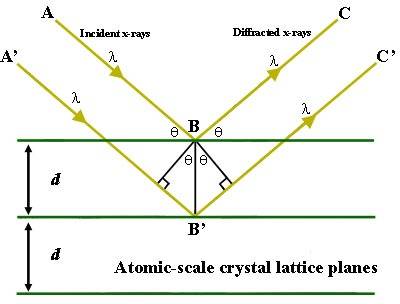


braggslaw.jpg
 
Physics news on Phys.org
Hi user3. Welcome to PF!

Here's one way to think about it. In x-ray diffraction you are considering reflection from successive planes in a family of planes which are oriented in the same way. How would you expect the lattice planes in the family to compare with one another in their reflective properties. In particular, if there is a phase shift of ø when the radiation reflects off one of the planes, what would you expect the phase shift to be when the radiation reflects off other planes in the family?
 
  • Like
Likes   Reactions: 1 person
I got it! Thank you.
 

Similar threads

  • · Replies 3 ·
Replies
3
Views
2K
  • · Replies 54 ·
2
Replies
54
Views
11K
  • · Replies 1 ·
Replies
1
Views
2K
Replies
3
Views
2K
  • · Replies 5 ·
Replies
5
Views
7K
  • · Replies 1 ·
Replies
1
Views
2K
Replies
7
Views
6K
  • · Replies 4 ·
Replies
4
Views
3K
  • · Replies 3 ·
Replies
3
Views
3K
  • · Replies 1 ·
Replies
1
Views
950