Undergrad Intermediate Value Theorem .... Browder, Theorem 3.16 .... ....

  • Thread starter Thread starter Math Amateur
  • Start date Start date
  • Tags Tags
    Theorem Value
Click For Summary
The discussion revolves around understanding the proof of Theorem 3.16 in Andrew Browder's "Mathematical Analysis: An Introduction," specifically regarding the continuity of a function at a point. The key question raised is how to rigorously demonstrate that if a function f is continuous at b and f(b) > y, then there exists a delta such that f(t) > y for t in the interval (b - delta, b]. The response emphasizes using the definition of continuity with an appropriate choice of epsilon, derived from the difference f(b) - y. The conversation also touches on the relationship between connectedness, compactness, and the Intermediate Value Theorem (IVT), noting that proofs often involve least upper bounds. Overall, the exchange highlights the complexities of continuity proofs and their implications in mathematical analysis.
Math Amateur
Gold Member
MHB
Messages
3,920
Reaction score
48
TL;DR
I need help with an aspect of the proof of the Intermediate Value Theorem ...
I am reading Andrew Browder's book: "Mathematical Analysis: An Introduction" ... ...

I am currently reading Chapter 3: Continuous Functions on Intervals and am currently focused on Section 3.1 Limits and Continuity ... ...

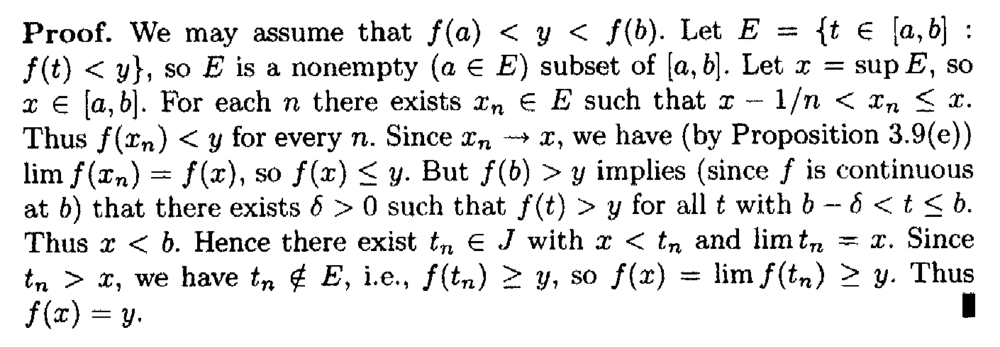
I need some help in understanding the proof of Theorem 3.16 ...Theorem 3.16 and its proof read as follows:

Browder - 1 -  Theorem 3.16 ... ... PART 1 ... .png

Browder - 2 -  Theorem 3.16 ... ... PART 2 .png

In the above proof by Andrew Browder we read the following:

" ... ... But ##f(b) \gt y## implies (since ##f## is continuous at ##b##) that there exists ##\delta \gt 0## such that ##f(t) \gt y## for all ##t## with ##b - \delta \lt t \leq b##. ... ... "My question is as follows:

How do we demonstrate explicitly and rigorously that since ##f## is continuous at ##b## and ##f(b) \gt y## therefore we have that there exists ##\delta \gt 0## such that ##f(t) \gt y## for all ##t## with ##b - \delta \lt t \leq b##. ... ...Help will be much appreciated ...

Peter

***NOTE***

The relevant definition of one-sided continuity for the above is as follows:

##f## is continuous from the left at ##b## implies that for every ##\epsilon \gt 0## there exists ##\delta \gt 0## such that for all ##x \in [a, b]## ...

we have that ##b - \delta \lt x \lt b \Longrightarrow \mid f(x) - f(b) \mid \lt \epsilon##
 
Physics news on Phys.org
I hate proofs like these. They obscure what's really happening. General topology and the notions of connectedness and compactness immediately imply your theorem.

However, the question you ask is very straightforward to anwer.

Since ##f(b)>y##, we have ##\epsilon:= f(b)-y>0##. Now use the definition of continuity with this choice of ##\epsilon##.

Draw a picture to see how I came up with this choice of ##\epsilon##.
 
Last edited by a moderator:
  • Like
Likes Math Amateur
Math_QED said:
I hate proofs like these. They obscure what's really happening. General topology and the notions of connectedness and compactness immediately imply your theorem.

However, the question you ask is very straightforward to anwer.

Since ##f(b)>y##, we have ##\epsilon:= f(b)-y>0##. Now use the definition of continuity with this choice of ##\epsilon##.

Draw a picture to see how I came up with this choice of ##\epsilon##.
Thank you for a most interesting and informative reply ...

Will now look at other proofs to see how concepts of compactness and connectedness imply theorem ...

Will also work on your suggestion ...

Thanks again,

Peter
 
It is of course easy to prove that the continuous image of a connected set is connected, but I think it is not so easy to prove an interval is connected without essentially the same argument using least upper bounds; indeed that fact is essentially equivalent to the intermediate value theorem. One of my favorite definitions of connectedness is that a set S is connected iff every continuous map S-->{0,1} is constant, where {0,1} is the two point set containing only 0 and 1. It is easy to show this special case is equivalent to the full intermediate value theorem. So I could be wrong but I am afraid you are stuck with some such proof using sups. i.e. least upper bounds.
 
Thanks for a very interesting post, mathwonk ...

Indeed, having consulted several texts on the IVT I have found, as you predict, that the proof involves sups in each case ...

Thanks again ...

Peter
 
We all know the definition of n-dimensional topological manifold uses open sets and homeomorphisms onto the image as open set in ##\mathbb R^n##. It should be possible to reformulate the definition of n-dimensional topological manifold using closed sets on the manifold's topology and on ##\mathbb R^n## ? I'm positive for this. Perhaps the definition of smooth manifold would be problematic, though.

Similar threads

  • · Replies 2 ·
Replies
2
Views
2K
  • · Replies 5 ·
Replies
5
Views
3K
  • · Replies 2 ·
Replies
2
Views
2K
Replies
2
Views
2K
  • · Replies 3 ·
Replies
3
Views
3K
  • · Replies 6 ·
Replies
6
Views
3K
Replies
2
Views
2K
  • · Replies 14 ·
Replies
14
Views
4K
Replies
2
Views
2K
Replies
3
Views
2K