Internal Forces Diagram: how to do this one?

Click For Summary
SUMMARY

The discussion centers on the methodology for creating internal forces diagrams in structural analysis, specifically addressing confusion regarding the treatment of internal forces in different sections of a structure. The participant highlights the need to analyze internal forces and moments at joints after determining reactions, emphasizing the importance of drawing shear and moment diagrams. It is established that for structures with joints in multiple directions, such as both x and y axes, separate diagrams for normal, shear, and moment forces must be created for each direction. This approach ensures a comprehensive understanding of internal forces throughout the structure.

PREREQUISITES
  • Understanding of structural analysis principles
  • Familiarity with shear and moment diagrams
  • Knowledge of internal forces and moments in structural members
  • Ability to identify and analyze joints in multi-directional structures
NEXT STEPS
  • Study the process of determining reactions in structural systems
  • Learn how to construct shear and moment diagrams for various loading conditions
  • Explore the analysis of internal forces in multi-directional structures
  • Review case studies involving internal forces diagrams in complex structures
USEFUL FOR

Structural engineers, civil engineering students, and professionals involved in analyzing and designing multi-directional structural systems will benefit from this discussion.

ramzerimar
Messages
178
Reaction score
23
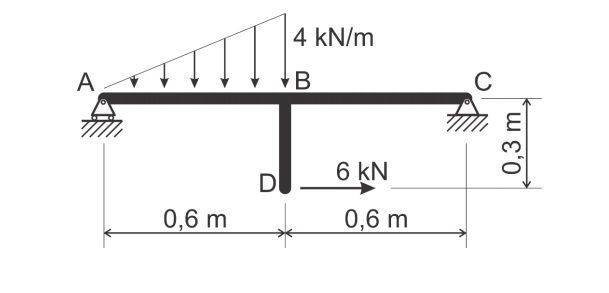
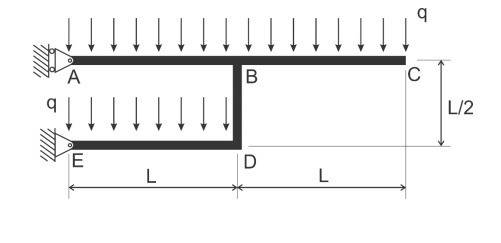
I'm wondering how should I do analysis on those problems below:
Figure 1:
structure1.jpg

Figure 2:
structure2.jpg

I mean, my professor, while doing an example very similar to Figure 2, he didn't do an imaginary cut in the region BD to find internal forces there, and the internal forces diagram that he drew only contained internal forces in sections AB and BC. I'm confused by it. When drawing internal forces diagrams, how should I handle those kinds of problems?
 
  • Like
Likes   Reactions: berkeman
Engineering news on Phys.org
After finding reactions, you should determine the internal forces and moments in all members at the joints. Then you can draw shear and moment diagrams to determine the internal forces and moments in between the joints.
 
PhanthomJay said:
After finding reactions, you should determine the internal forces and moments in all members at the joints. Then you can draw shear and moment diagrams to determine the internal forces and moments in between the joints.
Okay, so let's consider figure 2. When I draw shear and moment diagrams, I plot internal forces in function of x - where x is the distance related to the origin, let's say, point A. But the structure has joints in other directions - y direction, for instance. So, in this case, I have to draw six diagrams? Three for normal, shear and moment internal forces in the x structure, and another 3 for the joint in the y direction?
I'm confused.
 
Yes , if asked to do so, you'll need them for ABC and BD. Even more in figure 1.
 

Similar threads

Replies
2
Views
1K
  • · Replies 7 ·
Replies
7
Views
3K
Replies
11
Views
4K
  • · Replies 14 ·
Replies
14
Views
1K
Replies
4
Views
868
  • · Replies 3 ·
Replies
3
Views
2K
  • · Replies 18 ·
Replies
18
Views
6K
  • · Replies 12 ·
Replies
12
Views
5K
Replies
1
Views
1K
  • · Replies 2 ·
Replies
2
Views
2K