Internal reflection equation question

Click For Summary
SUMMARY

The discussion focuses on the application of Snell's Law in determining the refraction angle when transitioning from glass to a coating medium. Specifically, it addresses the necessity of subtracting 90° from the internal angle (x angle) of the glass to achieve a 90° refraction angle in the coating medium. This adjustment is essential to avoid negative values for the index of refraction, as angles are defined relative to the surface normal. The conversation emphasizes the importance of using the normal rather than the tangent due to the variability of tangents on aspherical surfaces.

PREREQUISITES
  • Understanding of Snell's Law and its application in optics
  • Familiarity with the concept of the angle of incidence and refraction
  • Knowledge of the relationship between angles and the surface normal
  • Basic principles of light refraction in different media
NEXT STEPS
  • Study the derivation and applications of Snell's Law in various optical scenarios
  • Explore the concept of the Critical Angle and its significance in optics
  • Investigate the effects of different indices of refraction on light behavior
  • Learn about the implications of using normals versus tangents in optical calculations
USEFUL FOR

Students and professionals in physics, optical engineering, and materials science who are interested in understanding light behavior at interfaces between different media.

GatoGordo
Messages
1
Reaction score
0
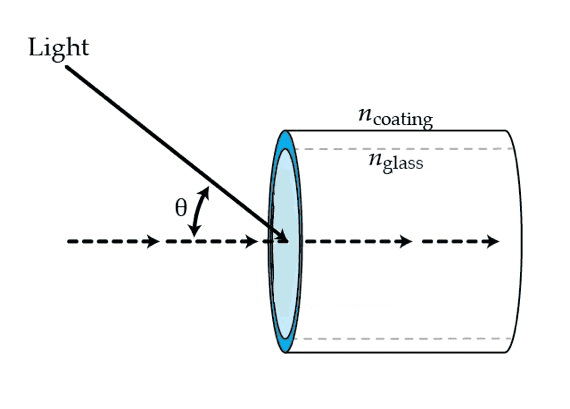
As you can see we have 3 media here. Only focus on the glass and coating medium. Assume an incident ray comes from the air medium and is refracted inside the glass and then it is refracted again in the coating medium. The x angle is the angle inside the glass medium. In this case, if the incident ray,from the air, enters the glass it will create a refracted ray with an angle. This is the x angle. Now, let's say I want the refraction angle of the coating medium to be 90°. Why do I have to subtract 90° from the x angle to achieve this?
nglasssin(90°−x)=ncoatingsin(90°)
1592650407214.png
 
Last edited by a moderator:
Science news on Phys.org
Look at your equation, without the 90^\circ shift, you'll have a negative answer, i.e. a negative index of refraction.
 
It's because of the way the angles are defined. Angle of incidence and angle of refraction are the angles relative to the surface normal. That picture defines ##\theta## as relative to the horizontal, which is tangent to the surface. The angle of incidence is ##90^\circ - \theta##.
 
GatoGordo said:
Summary:: Why do we subtract 90° from the incident angle when we want to find at which angle causes a refraction of 90° in a second medium?

Why do I have to subtract 90°
Your angle θ in the diagram needs to be modified to be the angle between the ray and the Normal to the surface (i.e. 90-θ ). It's the angle from the normal of the surface that is what's in the standard version of Snell's Law, which gives you the Critical Angle.
 
A thought:
Why do we use the normal and not the angle from the tangent?
There is only one Normal but there are any number of possible tangents for aspherical surfaces - so which tangent could you use? The Normal comes to the rescue.
 

Similar threads

  • · Replies 5 ·
Replies
5
Views
2K
  • · Replies 5 ·
Replies
5
Views
3K
  • · Replies 2 ·
Replies
2
Views
2K
Replies
2
Views
1K
  • · Replies 8 ·
Replies
8
Views
4K
  • · Replies 9 ·
Replies
9
Views
3K
  • · Replies 1 ·
Replies
1
Views
4K
  • · Replies 10 ·
Replies
10
Views
1K
  • · Replies 9 ·
Replies
9
Views
4K
  • · Replies 9 ·
Replies
9
Views
12K