Intersection between rotated & translated ellipse and line

Click For Summary
SUMMARY

This discussion focuses on finding the intersection points between a rotated and translated ellipse and a line segment defined by two points (x1, y1) and (x2, y2). The user initially attempted to use Wolfram Alpha for solving the equations but found it impractical for the rotated ellipse. Two suggested methods include substituting one variable from the line equation into the ellipse equation or transforming the ellipse into standard form and applying the same transformation to the line before solving the system of equations.

PREREQUISITES
  • Understanding of ellipse equations and their transformations
  • Familiarity with line equations in two-dimensional space
  • Basic algebraic manipulation skills for solving equations
  • Knowledge of coordinate transformations
NEXT STEPS
  • Learn about transforming ellipse equations into standard form
  • Study coordinate transformations and their applications in geometry
  • Explore algebraic methods for solving systems of equations
  • Investigate numerical methods for finding intersections in computational geometry
USEFUL FOR

Mathematicians, engineers, and computer scientists working on geometric computations, particularly those dealing with conic sections and their intersections.

piercazzo
Messages
1
Reaction score
0
I have a rotated ellipse, not centered at the origin, defined by x,y,a,b and angle.
Then I have a segment defined by two points x1,y1 and x2,y2
Is there a quick way to find the intersection points?

I used wolfram alpha equation solver, I tried to insert the equation of a line into the one of a standard non rotated, non translated ellipse,

10how40.gif


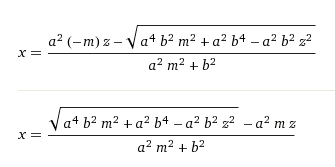
and resolving for x this is the result
15qw704.png


which is nice.

Then I took the equation of a rotated and translated ellipse

vngnwi.png


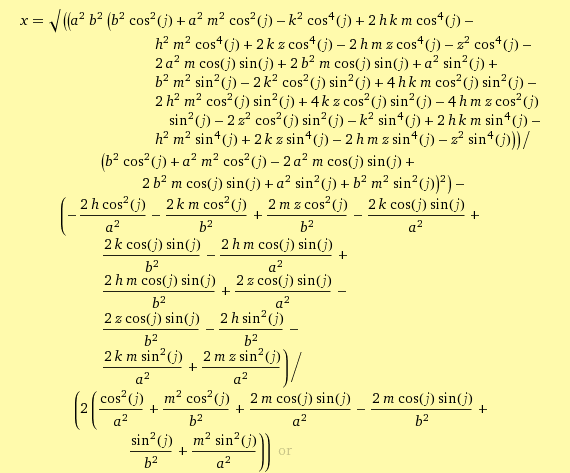
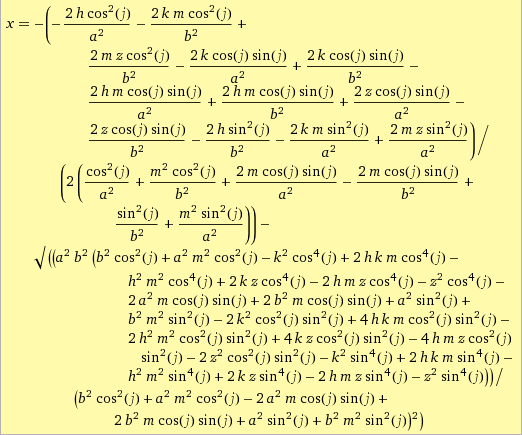
and this is the result

2rnzx1h.png

6p5bat.png


Which is obviously impractical, can anyone suggest a different method?
 
Mathematics news on Phys.org
Do it by hand rather than use the calculator.
You can either -
1. Solve for one variable in the line equation and sub into the ellipse equation - solve for the other coordinate ... you know: as usual.

2. transform the ellipse into standard form, apply the same transformation to the line, find solutions for the transformed system, apply the inverse transformation to the solution.
 

Similar threads

  • · Replies 4 ·
Replies
4
Views
2K
  • · Replies 1 ·
Replies
1
Views
1K
  • · Replies 1 ·
Replies
1
Views
1K
  • · Replies 2 ·
Replies
2
Views
4K
  • · Replies 3 ·
Replies
3
Views
2K
Replies
6
Views
6K
  • · Replies 2 ·
Replies
2
Views
2K
  • · Replies 3 ·
Replies
3
Views
5K
Replies
8
Views
5K
  • · Replies 1 ·
Replies
1
Views
2K