Intuitive meaning of Dot Product

Click For Summary
SUMMARY

The dot product of two vectors, denoted as ##\vec{A} \cdot \vec{B}##, is a scalar quantity that represents the angular relationship between the vectors. Specifically, it indicates whether the vectors are perpendicular (##\vec{A} \cdot \vec{B} = 0##), acute (##\vec{A} \cdot \vec{B} > 0##), or obtuse (##\vec{A} \cdot \vec{B} < 0##). The magnitude of the dot product can be interpreted as the projection of one vector onto another, multiplied by the magnitude of the second vector, expressed mathematically as (|A| cos θ)|B|. This concept is foundational in physics, particularly in understanding work done by a force.

PREREQUISITES
  • Understanding of vector operations, specifically dot and cross products.
  • Familiarity with trigonometric functions, particularly cosine.
  • Basic knowledge of physics concepts, especially work and energy.
  • Ability to interpret geometric representations of vectors.
NEXT STEPS
  • Study the geometric interpretation of the dot product in vector analysis.
  • Learn about the application of the dot product in calculating work done by a force in physics.
  • Explore the relationship between the dot product and projections in higher-dimensional spaces.
  • Investigate the differences and applications of dot product versus cross product in vector calculus.
USEFUL FOR

This discussion is beneficial for physics students, mathematicians, and anyone interested in understanding vector mathematics and its applications in real-world scenarios, particularly in physics and engineering contexts.

22990atinesh
Messages
143
Reaction score
1
I know intuitively that the Cross Product of two vectors ##\vec{A}## and ##\vec{B}## represents another vector ##\vec{A \times B}## perpendicular to it. In study of physics we come across this situation a lot. Hence I can visualize some applications of it
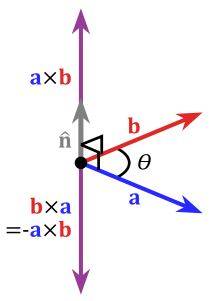
Capture.jpg


I know that the dot product of two vectors ##\vec{A}## and ##\vec{B}## is scalar quantity and also that it represents angular relationship between ##\vec{A}## and ##\vec{B}## .i.e.

  • If ##\vec{A}##.##\vec{B} = 0##. Then ##\vec{A}## and ##\vec{B}## are perpendicular.
  • If ##\vec{A}##.##\vec{B} > 0## (Positive). Then the angle between ##\vec{A}## and ##\vec{B}## are less than ##90^o##.
  • If ##\vec{A}##.##\vec{B} < 0## (Negative). Then the angle between ##\vec{A}## and ##\vec{B}## are greater than ##90^o##.

But I won't be able to understand intuitively, What does the dot product represents. What does the magnitude of the dot product of two vectors represents.
 
Physics news on Phys.org
It represents the component or projection of one vector along the other one, times the magnitude of the other one. This diagram shows it using the projection of A along B: (|A| cos θ)|B|.

200px-Dot_Product.svg.png


You can also do it the other way, using the projection of B along A, and get the same result: (|B| cos θ)|A|.
 
Last edited:
22990atinesh said:
I know intuitively that the Cross Product of two vectors ##\vec{A}## and ##\vec{B}## represents another vector ##\vec{A \times B}## perpendicular to it.
But that's not all. The magnitude of the cross product also has a geometrical interpretation:

720px-Cross_product_parallelogram.svg.png


22990atinesh said:
But I won't be able to understand intuitively, What does the dot product represents. What does the magnitude of the dot product of two vectors represents.
What baffles me, is that you obviously found the wiki page on the cross product (and posted the picture from it), but couldn't find the page on the dot product with the picture jtbell posted.
 
jtbell said:
It represents the component or projection of one vector along the other one, times the magnitude of the other one. This diagram shows it using the projection of A along B: (|A| cos θ)|B|.

200px-Dot_Product.svg.png


You can also do it the other way, using the projection of B along A, and get the same result: (|B| cos θ)|A|.

A.T. said:
But that's not all. The magnitude of the cross product also has a geometrical interpretation:

...

What baffles me, is that you obviously found the wiki page on the cross product (and posted the picture from it), but couldn't find the page on the dot product with the picture jtbell posted.

I've read that article. I understand that the multiplication of the projection of ##\vec{a}## onto ##\vec{b}## (|##\vec{a}##|cos θ) with |##\vec{b}##| gives the dot product of vectors ##\vec{a}## and ##\vec{b}##. But my doubt is that, what does this quantity represents. Whats the application of it. :smile:
 
Have you studied the concept of "work" in physics yet? That's the first application of the dot product that most physics students see.
 

Similar threads

  • · Replies 14 ·
Replies
14
Views
4K
  • · Replies 17 ·
Replies
17
Views
2K
  • · Replies 3 ·
Replies
3
Views
2K
  • · Replies 12 ·
Replies
12
Views
3K
  • · Replies 58 ·
2
Replies
58
Views
5K
  • · Replies 9 ·
Replies
9
Views
2K
Replies
26
Views
2K
  • · Replies 5 ·
Replies
5
Views
2K
Replies
5
Views
2K
Replies
3
Views
3K