Intuitive meaning of Dot Product

Click For Summary

Discussion Overview

The discussion revolves around the intuitive understanding of the dot product of two vectors, its geometric interpretation, and its applications, particularly in physics. Participants explore the nature of the dot product in contrast to the cross product, focusing on the meaning of the scalar result obtained from the dot product.

Discussion Character

  • Exploratory
  • Technical explanation
  • Conceptual clarification

Main Points Raised

  • Some participants assert that the dot product represents the angular relationship between two vectors, indicating conditions for perpendicularity and the angle between them.
  • Others propose that the dot product can be understood as the projection of one vector onto another, multiplied by the magnitude of the second vector.
  • A participant expresses confusion about the intuitive meaning of the dot product and its applications, despite understanding its mathematical formulation.
  • Another participant suggests that the concept of "work" in physics is a primary application of the dot product, implying a practical context for its use.

Areas of Agreement / Disagreement

Participants generally agree on the mathematical properties of the dot product and its relationship to vector projections. However, there remains uncertainty regarding its intuitive meaning and specific applications, with no consensus reached on a definitive interpretation.

Contextual Notes

Some participants reference diagrams and external resources to illustrate their points, but there is a noted lack of clarity on the intuitive significance of the dot product, suggesting that further exploration may be needed to fully understand its implications.

22990atinesh
Messages
143
Reaction score
1
I know intuitively that the Cross Product of two vectors ##\vec{A}## and ##\vec{B}## represents another vector ##\vec{A \times B}## perpendicular to it. In study of physics we come across this situation a lot. Hence I can visualize some applications of it
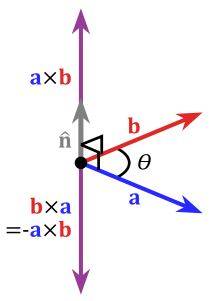
Capture.jpg


I know that the dot product of two vectors ##\vec{A}## and ##\vec{B}## is scalar quantity and also that it represents angular relationship between ##\vec{A}## and ##\vec{B}## .i.e.

  • If ##\vec{A}##.##\vec{B} = 0##. Then ##\vec{A}## and ##\vec{B}## are perpendicular.
  • If ##\vec{A}##.##\vec{B} > 0## (Positive). Then the angle between ##\vec{A}## and ##\vec{B}## are less than ##90^o##.
  • If ##\vec{A}##.##\vec{B} < 0## (Negative). Then the angle between ##\vec{A}## and ##\vec{B}## are greater than ##90^o##.

But I won't be able to understand intuitively, What does the dot product represents. What does the magnitude of the dot product of two vectors represents.
 
Physics news on Phys.org
It represents the component or projection of one vector along the other one, times the magnitude of the other one. This diagram shows it using the projection of A along B: (|A| cos θ)|B|.

200px-Dot_Product.svg.png


You can also do it the other way, using the projection of B along A, and get the same result: (|B| cos θ)|A|.
 
Last edited:
22990atinesh said:
I know intuitively that the Cross Product of two vectors ##\vec{A}## and ##\vec{B}## represents another vector ##\vec{A \times B}## perpendicular to it.
But that's not all. The magnitude of the cross product also has a geometrical interpretation:

720px-Cross_product_parallelogram.svg.png


22990atinesh said:
But I won't be able to understand intuitively, What does the dot product represents. What does the magnitude of the dot product of two vectors represents.
What baffles me, is that you obviously found the wiki page on the cross product (and posted the picture from it), but couldn't find the page on the dot product with the picture jtbell posted.
 
jtbell said:
It represents the component or projection of one vector along the other one, times the magnitude of the other one. This diagram shows it using the projection of A along B: (|A| cos θ)|B|.

200px-Dot_Product.svg.png


You can also do it the other way, using the projection of B along A, and get the same result: (|B| cos θ)|A|.

A.T. said:
But that's not all. The magnitude of the cross product also has a geometrical interpretation:

...

What baffles me, is that you obviously found the wiki page on the cross product (and posted the picture from it), but couldn't find the page on the dot product with the picture jtbell posted.

I've read that article. I understand that the multiplication of the projection of ##\vec{a}## onto ##\vec{b}## (|##\vec{a}##|cos θ) with |##\vec{b}##| gives the dot product of vectors ##\vec{a}## and ##\vec{b}##. But my doubt is that, what does this quantity represents. Whats the application of it. :smile:
 
Have you studied the concept of "work" in physics yet? That's the first application of the dot product that most physics students see.
 

Similar threads

  • · Replies 9 ·
Replies
9
Views
857
  • · Replies 20 ·
Replies
20
Views
3K
  • · Replies 1 ·
Replies
1
Views
2K
Replies
6
Views
2K
  • · Replies 12 ·
Replies
12
Views
4K
  • · Replies 14 ·
Replies
14
Views
4K
  • · Replies 17 ·
Replies
17
Views
3K
  • · Replies 2 ·
Replies
2
Views
1K
  • · Replies 35 ·
2
Replies
35
Views
5K
  • · Replies 12 ·
Replies
12
Views
3K