Irreducibles and Primes in Integral Domains ....

Click For Summary
SUMMARY

This discussion centers on the concepts of irreducibility and associates in integral domains, specifically referencing Example 1.4.1 from "Introductory Algebraic Number Theory" by Saban Alaca and Kenneth S. Williams. The irreducibility of the integer 2 in the ring ##\mathbb{Z} + \mathbb{Z} \sqrt{-5}## implies that any element ##\alpha## dividing 2 must be either a unit or associated with 1 or 2. The conversation also explores the implications of Euclidean rings and principal ideal domains in relation to the existence of infinitely many primes within infinite rings.

PREREQUISITES
  • Understanding of integral domains and their properties
  • Familiarity with the concept of irreducibility in algebraic structures
  • Knowledge of associates and their significance in number theory
  • Basic comprehension of Euclidean rings and principal ideal domains
NEXT STEPS
  • Study the definitions and properties of irreducible elements in integral domains
  • Learn about the structure and characteristics of Euclidean rings
  • Explore the concept of principal ideal domains and their relation to unique factorization
  • Investigate the proof techniques for the existence of infinitely many primes in various algebraic structures
USEFUL FOR

Mathematicians, students of algebraic number theory, and anyone interested in the properties of integral domains and their applications in number theory.

Math Amateur
Gold Member
MHB
Messages
3,920
Reaction score
48
I am reading "Introductory Algebraic Number Theory"by Saban Alaca and Kenneth S. Williams ... and am currently focused on Chapter 1: Integral Domains ...

I need some help with understanding Example 1.4.1 ...

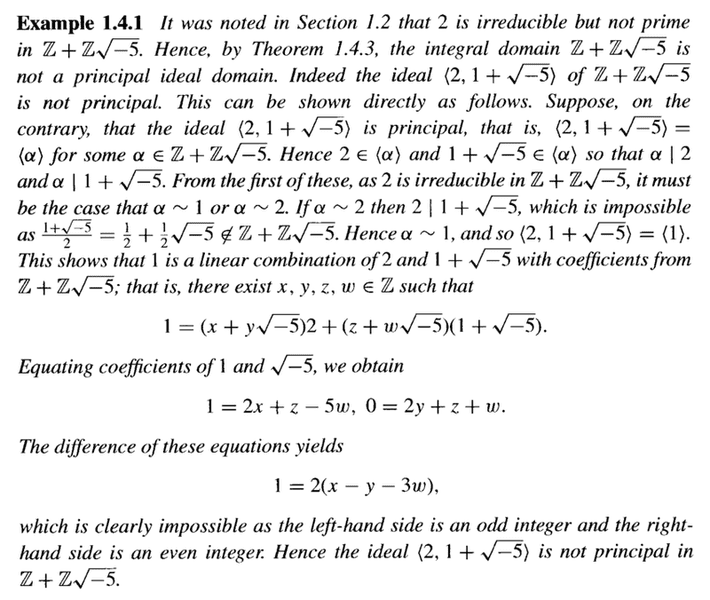
Example 1.4.1 reads as follows:
?temp_hash=d57e0fe7fa044114b40957202f2e6a5a.png


In the above text by Alaca and Williams we read the following:

"... ... From the first of these, as ##2## is irreducible in ##\mathbb{Z} + \mathbb{Z} \sqrt{ -5 }##, it must be the case that ##\alpha \sim 1## or ##\alpha \sim 2##. ... ...
My question is as follows ... how does ##2## being irreducible imply that ##\alpha \sim 1## or ##\alpha \sim 2##. ... ...?
Hope someone can help ...

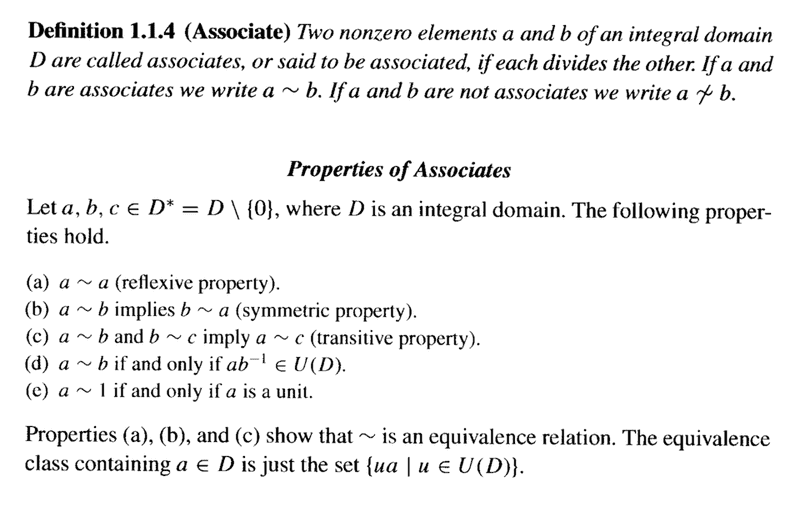
Peter================================================================================NOTEThe notation ##\alpha \sim 1## is Alaca and Williams notation for ##\alpha## and ##1## being associates ...

Alaca's and Williams' definition of and properties of associates in an integral domain are as follows:
?temp_hash=d57e0fe7fa044114b40957202f2e6a5a.png
 

Attachments

  • A&W - Example 1.4.1 ... ....png
    A&W - Example 1.4.1 ... ....png
    67.2 KB · Views: 533
  • A&W - Defn and Properties of Associates ... ....png
    A&W - Defn and Properties of Associates ... ....png
    29.3 KB · Views: 641
Physics news on Phys.org
Math Amateur said:
My question is as follows ... how does ##2## being irreducible imply that##\alpha \sim 1## or ##\alpha \sim 2##. ... ...?
##\alpha \mid 2## means ## \alpha \cdot q=2## for some ##q##. Now irreducibility of ##2## implies either ##\alpha ## or ##q## is a unit. If ##\alpha ## is a unit, then ##\langle 2, 1+\sqrt{-5} \rangle = \langle \alpha \rangle = \mathbb{Z}+ \mathbb{Z}\sqrt{-5}## which is wrong since it doesn't contain, e.g. ##3##. Now if ##q## is a unit, then ##\alpha = 2 \cdot q^{-1} \mid 1+\sqrt{-5}## which means ##2 \mid 1+\sqrt{-5}## which is also wrong.

It is simply the definitions that are used. You should try to find those things by yourself. It's always a matter of practice. If you will have done it several times, you will start to "see" things more quickly. As a general advice: always try to use what's given, here that ##\alpha \mid 2## and ##2## cannot properly be written as ##2=a\cdot b##. Part of the fun reading those books is to read them as a book of riddles where you're supposed to solve them. A bit like solving crosswords if you like.
 
  • Like
Likes   Reactions: lavinia and Math Amateur
Does every infinite ring (meaning infinite as a set) have infinitely-many primes?
 
WWGD said:
Does every infinite ring (meaning infinite as a set) have infinitely-many primes?
I guess you're not satisfied by ##R := (\mathbb{Z}; x\cdot y = 0 \;\forall \; x,y \in \mathbb{Z})## or ##R := \mathbb{R}##.
 
fresh_42 said:
I guess you're not satisfied by ##R := (\mathbb{Z}; x\cdot y = 0 \;\forall \; x,y \in \mathbb{Z})## or ##R := \mathbb{R}##.
Yes, I would prefer a non-trivial multiplication. Ah, I see, good point with the Reals, I guess we need to EDIT exclude certain types of multiplication actions ( non-transitive?).EDIT 2: Maybe it is more meaningful to work with Euclidean rings here?
 
WWGD said:
Yes, I would prefer a non-trivial multiplication. Ah, I see, good point with the Reals, I guess we need to EDIT exclude certain types of multiplication actions ( non-transitive?).EDIT 2: Maybe it is more meaningful to work with Euclidean rings here?
I think fields are already an example. Also matrix rings might do.

But let's see how Euclidean rings work. Since Euclidean rings are principal ideal domains, which are unique factorization domains, and we are only allowed a finite number of primes, all elements have to look like ##\varepsilon \cdot p^{m_1}_1 \ldots p^{m_n}_n## with a unit ##\varepsilon## and ##(m_1 ,\ldots , m_n) \in \mathbb{N}_0^n##. I guess ##n=1## is a reasonable assumption here to start a search for an example. So all elements are of the form ##\varepsilon \cdot p^m## which I think is impossible in an integral domain with unit. (Just scratched a few lines with ##1+1=p^k\, , \,1+1+1=p^l## etc.). Maybe there's an induction argument to rule out the cases ##n>1##, too. And this without using the full advantages of a Euclidean ring. So my guess is, it's impossible, but I don't have a slim argument at hand.
 
  • Like
Likes   Reactions: WWGD
How about the usual proof that there are inifnitely many primes: Multiply all (if finite), add ##1## and all primes are units. This leaves us with rings without any primes, e.g. fields.
 

Similar threads

  • · Replies 2 ·
Replies
2
Views
2K
  • · Replies 5 ·
Replies
5
Views
2K
  • · Replies 2 ·
Replies
2
Views
2K
  • · Replies 17 ·
Replies
17
Views
2K
  • · Replies 6 ·
Replies
6
Views
4K
Replies
48
Views
5K
  • · Replies 1 ·
Replies
1
Views
1K
  • · Replies 84 ·
3
Replies
84
Views
11K
  • · Replies 5 ·
Replies
5
Views
1K
Replies
1
Views
2K