Is arcsec = 1 divided by arccos ? Arcsec = 1/arccos

  • Context: Undergrad 
  • Thread starter Thread starter Vividly
  • Start date Start date
Click For Summary
SUMMARY

The discussion clarifies that arcsec(x) is not equal to 1/arccos(x). Participants demonstrate that these functions have different domains and properties, leading to errors when evaluated under certain conditions. The correct relationship is established as arccos(x) = arcsec(1/x), which holds true for x in the appropriate range. The conversation emphasizes the importance of understanding the distinctions between inverse and reciprocal trigonometric functions.

PREREQUISITES
  • Understanding of trigonometric functions, specifically arcsec and arccos.
  • Familiarity with the concepts of inverse and reciprocal functions.
  • Basic knowledge of calculus, particularly differentiation of inverse functions.
  • Ability to use calculators or software for evaluating trigonometric functions.
NEXT STEPS
  • Study the properties and graphs of arcsec and arccos functions.
  • Learn how to differentiate inverse trigonometric functions using the chain rule.
  • Explore the domains and ranges of trigonometric functions to avoid errors in calculations.
  • Practice solving trigonometric identities involving arcsec and arccos with real values.
USEFUL FOR

Students of mathematics, educators teaching trigonometry, and anyone involved in calculus or advanced mathematics who seeks to clarify the relationships between inverse trigonometric functions.

  • #31
Vividly said:
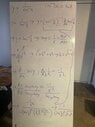
Its completely different. Not sure what I am doing wrong. Unless arccos(x) ≠arcsec(1/x) like I stated at the top right of the board.
If you insist on your own idiosynchratic approach to trig identities, then I think the onus is on you to sort out the problems. I would encourage you to study this derivation. Let ##x = \cos y##, with ##y \in [0, \pi]## :
$$\arccos(x) = \arccos(\cos y) = y$$ $$arcsec(\frac 1 x) = arcsec(\sec y) = y$$ QED
 
  • Like
Likes   Reactions: Vividly
Mathematics news on Phys.org
  • #32
Vividly said:
Its completely different. Not sure what I am doing wrong. Unless arccos(x) ≠arcsec(1/x) like I stated at the top right of the board.
I think I know what I did wrong. I redid the problem and got the right answer. I just don’t understand how when you put values in the calculator for arccosx and arcsec(1/x) you get and error for one and a number for the other.
 

Attachments

  • image.jpg
    image.jpg
    36.1 KB · Views: 197
  • #33
Vividly said:
I think I know what I did wrong. I redid the problem and got the right answer. I just don’t understand how when you put values in the calculator for arccosx and arcsec(1/x) you get and error for one and a number for the other.
The calculator on my phone doesn't have an option for ##arcsec##; nor does excel (it seems); nor does ##arcsec## exist in Latex. None of that matters in light of post #31.
 
  • #34
PeroK said:
The calculator on my phone doesn't have an option for ##arcsec##; nor does excel (it seems); nor does ##arcsec## exist in Latex. None of that matters in light of post #31.
This youtube video teaches you how to put it in the calculator.

 
  • #35
I like that equation:$$\sec^{-1}(-2) = \cos^{-1}(-\frac 1 2) = \frac {2\pi}{3}$$
 
  • Like
Likes   Reactions: Vividly

Similar threads

  • · Replies 7 ·
Replies
7
Views
2K
  • · Replies 2 ·
Replies
2
Views
3K
  • · Replies 12 ·
Replies
12
Views
3K
  • · Replies 6 ·
Replies
6
Views
2K
  • · Replies 25 ·
Replies
25
Views
971
  • · Replies 13 ·
Replies
13
Views
1K
  • · Replies 2 ·
Replies
2
Views
2K
  • · Replies 6 ·
Replies
6
Views
2K
  • · Replies 7 ·
Replies
7
Views
1K
  • · Replies 34 ·
2
Replies
34
Views
2K