I Is energy really conserved?

  • Thread starter Thread starter Ben tesoriero
  • Start date Start date
Ben tesoriero
Messages
8
Reaction score
0
TL;DR
Do gyroscopic forces allow energy to be destroyed.
I built a device designed to brake angular velocity which seems to work based on below, i used a flexible shaft that could bow up and down so i could visually see what was happening for the prototypes.

If you spin two wheels in opposite directions each with a magnitude of angular momentum L on a rigid shaft (equal magnitude opposite directions), then rotate the shaft at 90 degrees to the momentum vectors at constant angular velocity omega, then the resulting torques oppose each other causing a defection but no steady state angular velocity in the direction of the resulting torques..

You have energy in, 2 x L x omega^2, but you have no energy out as the resulting torques at steady state have no velocity.. (use the equation/ videos demonstrating gyroscopic precession to understand this). Ignoring any incidental friction losses, The magnitude of angular momentum of the wheels stays constant.

If you wish to test this more simply than i did, bolt two angle grinders back to back using a reasonable length of threaded bar with the heaviest discs you can find. When you try and turn them when running you will feel the resistance to rotation and hopefully see the deflection in the handles, using a less rigid shaft may assist in seeing this, or use two gyroscopic precession demonstration wheels, joined by a spring, hung centrally.

Does this not meet the definition of energy being destroyed?
 
Physics news on Phys.org
The experiment you propose is not clear from your description. It's not clear to me why you think energy is lost from a system of two spinning discs.
 
Gyroscopic forces do not do work. Just by definition because the gyroscopic forces are ##Q_j=\omega_{ij}(t,x)\dot x^i,## where ##\omega_{ij}=-\omega_{ji}## and ##x=(x^1,\ldots,x^m)## are the generalized coordinates
 
Last edited:
  • Like
Likes Demystifier
Ben tesoriero said:
If you spin two wheels in opposite directions each with a magnitude of angular momentum L on a rigid shaft (equal magnitude opposite directions) ...

When you try and turn them when running you will feel the resistance to rotation
Why should there be resistance to rotation, if the total angular momentum of both wheels together is zero?
 
Last edited:
A.T. said:
Why should there be resistance to rotation, if the total angular momentum of both wheels together is zero?
There is resistance to from each wheel being forced to turn, the resulting torques oppose as angular momentum of each is opposite. Same way as if you do an angular procession demonstration changing the wheel spin direction changes the direction of precession
 
Ben tesoriero said:
Same way as if you do an angular procession demonstration changing the wheel spin direction changes the direction of precession
But with two counter rotating wheels (equal but opposite angular momentum) there is no precession and no "resistance" to reorienting their common spin axis. So how is it the same?

As @PeroK said above, your description is very unclear.
 
Last edited:
A.T. said:
But with two counter rotating wheels (equal but opposite angular momentum) there is no precession and no "resistance" to reorienting their common spin axis. So how is it the same?

As @PeroK said above, your description is very unclear.
You are driving the precession so to speak, producing opposing torques.
 
Ben tesoriero said:
You are driving the precession so to speak, producing opposing torques.
Can you provide a clear diagram of your experiment? Or post a video of it?
 
Ben tesoriero said:
You are driving the precession so to speak, producing opposing torques.
If you balanced a double gyroscope about its centre, then a) if the wheels are not spinning, the system will balance; b) if the wheels are spinning, there is no torque and no precession.

The torque on a gyroscope comes from the downward force of gravity on the centre of mass, which would usually cause an object to fall, effectively rotating vertically about the pivot point. The angular momentum of the spinning gyroscope prevents rotation in this direction and leads to precession instead. The spinning wheels themselves do not produce a torque by their rotation. The torque is provided by gravity.
 
  • #10
PeroK said:
If you balanced a double gyroscope about its centre, then a) if the wheels are not spinning, the system will balance; b) if the wheels are spinning, there is no torque and no precession.

The torque on a gyroscope comes from the downward force of gravity on the centre of mass, which would usually cause an object to fall, effectively rotating vertically about the pivot point. The angular momentum of the spinning gyroscope prevents rotation in this direction and leads to precession instead. The spinning wheels themselves do not produce a torque by their rotation. The torque is provided by gravity.
True, but if you drive rotation you generate torque ie the precession equation holds true
 
  • #11
A.T. said:
Can you provide a clear diagram of your experiment? Or post a video of it?
Will do in about 24 hours
 
  • #12
(Thread prefix changed A-->I)
 
  • #13
Ben tesoriero said:
TL;DR: Do gyroscopic forces allow energy to be destroyed.

Does this not meet the definition of energy being destroyed?
Your question would be better stated in terms of. "I know that energy isn't destroyed so where have I gone wrong in my reasoning and where would any loss occur"? :smile:
 
  • Like
  • Agree
Likes weirdoguy, russ_watters and DaveC426913
  • #14
Ive been trained that energy is conserved, but this appears to disprove it. The prototypes ive built appear to confirm my maths, ive had rather skilled person check it, no one has been able to fault it so far. Hence the reach out to this forum. Id love to know where the energy is going as everything points to it being destroyed.
 
  • #15
Ben tesoriero said:
Ive been trained that energy is conserved, but this appears to disprove it. The prototypes ive built appear to confirm my maths, ive had rather skilled person check it, no one has been able to fault it so far. Hence the reach out to this forum. Id love to know where the energy is going as everything points to it being destroyed.
Yes, I read your posts but the tone is the you (seem to) think you have disproved something that's pretty rock solid. That doesn't elicit the 'sympathy' that you need for a solution from PF. Galileo tried the same thing and was even 'shown the instruments of torture' but he was pretty brilliant and lived in a time of massive ignorance so he won in the end.

I guess my point would also be that, without a pretty full description of your experiment, it's unlikely that PF would spot something that you have already missed. You've been asked for more information with a diagram. With that, you could well get an answer. Rotary motion is one of the really hard topics in mechanics but the conservation laws still apply.
Ben tesoriero said:
everything points to it being destroyed
everything that you can think of. Lol. Keep digging in there.
 
  • Like
Likes russ_watters
  • #16
Ben tesoriero said:
no one has been able to fault it so far
That could also mean, that nobody was even able to make sense of what you are talking about.
 
  • Like
Likes russ_watters, PeroK, weirdoguy and 1 other person
  • #17
Ben tesoriero said:
Ive been trained that energy is conserved, but this appears to disprove it. The prototypes ive built appear to confirm my maths,
I don't believe there's a prototype.
Ben tesoriero said:
ive had rather skilled person check it,
I don't believe this either.
Ben tesoriero said:
no one has been able to fault it so far. Hence the reach out to this forum. Id love to know where the energy is going as everything points to it being destroyed.
Let's see this prototype in action.
 
  • Like
Likes AlexB23, russ_watters and berkeman
  • #18
Ben tesoriero said:
Ive been trained that energy is conserved, but this appears to disprove it.
Perhaps there's a hole in your pocket. Where money's involved, that's my usual excuse.
 
  • Like
Likes russ_watters
  • #19
If anyone wishes to examine the mechanism without waiting for the OP to demonstrate or diagram it, they have offered a simple, repeatable setup that works and demonstrates the principle:

If the OP's error in analysis can be rooted out here, then problem solved, right?
Ben tesoriero said:
If you wish to test this more simply than i did, bolt two angle grinders back to back using a reasonable length of threaded bar with the heaviest discs you can find. When you try and turn them when running you will feel the resistance to rotation and hopefully see the deflection in the handles, using a less rigid shaft may assist in seeing this, or use two gyroscopic precession demonstration wheels, joined by a spring, hung centrally.
 
  • #20
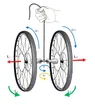
I think this is roughly the apparatus OP has in mind.
sketch1764697309382.webp

The two green discs are identical and counter-rotate about the blue axle with equal and opposite angular velocity (red arrows). OP can apply a torque to the dark grey suspension (blue arrow) to rotate the system in the horizontal plane.

I think that the analysis of this is that, ideally, there are no external forces here except the torque used to start the system rotating horizontally. However, there are internal forces when the system is rotating. The two green discs will attempt to precess in opposite directions, leading to no net force on the system but twisting forces between the discs and the blue axle. Ideally that doesn't matter, but in reality it will lead to increased friction in the bearings (and deformation of the axle if it isn't ideally rigid), which will brake the discs. It'll probably also cause twisting forces on the dark grey mount, at least as transients when the torque is applied to the mount.

So an idealised analysis shows no net forces in any case, but in a more realistic analysis there's very likely more friction when the system is rotating in the horizontal plane. So the system will brake faster when it is rotating, and careful calorimetry would find the "missing" energy dissipated as heat and vibration.
 
  • Informative
  • Like
Likes russ_watters, berkeman and PeroK
  • #21
Ibix said:
I think this is roughly the apparatus OP has in mind.
View attachment 367871
The two green discs are identical and counter-rotate about the blue axle with equal and opposite angular velocity (red arrows). OP can apply a torque to the dark grey suspension (blue arrow) to rotate the system in the horizontal plane.

I think that the analysis of this is that, ideally, there are no external forces here except the torque used to start the system rotating horizontally. However, there are internal forces when the system is rotating. The two green discs will attempt to precess in opposite directions, leading to no net force on the system but twisting forces between the discs and the blue axle. Ideally that doesn't matter, but in reality it will lead to increased friction in the bearings (and deformation of the axle if it isn't ideally rigid), which will brake the discs. It'll probably also cause twisting forces on the dark grey mount, at least as transients when the torque is applied to the mount.

So an idealised analysis shows no net forces in any case, but in a more realistic analysis there's very likely more friction when the system is rotating in the horizontal plane. So the system will brake faster when it is rotating, and careful calorimetry would find the "missing" energy dissipated as heat and vibration.
Sorry i didnt get to post the set up yesterday. Thank you, that is the system.
 
  • #22
Ben tesoriero said:
Thank you, that is the system.
OK, and where is energy "destroyed" here (aside of dissipation by friction)?
 
  • Like
Likes russ_watters, PeroK, weirdoguy and 1 other person
  • #23
Ben tesoriero said:
Does this not meet the definition of energy being destroyed?
No. One of the great unifications in physics was the discovery that there is an equivalence between mechanical and thermal energy. Mechanical energy is converted to thermal energy, it's not "destroyed".
 
  • Like
Likes sophiecentaur, Ibix, russ_watters and 2 others
  • #25
Ben tesoriero said:
TL;DR: Do gyroscopic forces allow energy to be destroyed.

Ignoring any incidental friction losses
If you ignore where energy goes then of course you will think that energy is not conserved.
 
  • Haha
  • Like
Likes PeroK and russ_watters
  • #26
Herman Trivilino said:
No. One of the great unifications in physics was the discovery that there is an equivalence between mechanical and thermal energy. Mechanical energy is converted to thermal energy, it's not "destroyed".
I like to think of a/the core pursuit in mechanical engineering as a game of "follow the energy". It's very common for your energy to go missing, but you must, must accept as a starting premise that energy is always conserved and if it's missing you just haven't figured out where it went. OP lost his energy and assumed it was destroyed instead of just misplaced.

...and yeah, the answer is almost always that your misplaced energy was converted to heat/thermal energy.
 
  • #27
A.T. said:
OK, and where is energy "destroyed" here (aside of dissipation by friction)?

Not sure if I’ve represented the resulting torques correctly, you apply a torque to create angular rotation omega, the change in angular momentum directions create opposing torques restrained by the shaft thickness, at steady state there is no motion in the direction of the resulting torques. So you have torque and rotation in, but no rotation out in the direction of the resulting torques. Torque in is the sum of the resulting torques magnitudes.
 

Attachments

  • image001.webp
    image001.webp
    32.9 KB · Views: 1
  • #28
Ben tesoriero said:
Not sure if I’ve represented the resulting torques correctly, you apply a torque to create angular rotation omega, the change in angular momentum directions create opposing torques restrained by the shaft thickness, at steady state there is no motion in the direction of the resulting torques. So you have torque and rotation in, but no rotation out in the direction of the resulting torques. Torque in is the sum of the resulting torques magnitudes.
That's not a prototype. That's a diagram.
 
  • #29
Ben tesoriero said:
at steady state there is no motion in the direction of the resulting torques.
What is "steady state", "no motion", and "resulting torques"? Since you have posted a labeled diagram, why don't you use those symbols in your text?

Can you write down the formulas for energy input, energy output and stored energy using the symbols you have defined? Where is the maths that you already have had checked by someone?

Also, what does actually happen in your experiment? And how did you ensure that the two wheels have exactly equal but opposite angular momentum?
 
Last edited:
  • #30
Ben tesoriero said:
TL;DR: Do gyroscopic forces allow energy to be destroyed.

Does this not meet the definition of energy being destroyed?
In face-to-face communication I would first ask to write down the formula of kinetic energy of a rigid body and then to provide definitions of objects that stand in this formula:)
 

Similar threads

Replies
2
Views
3K
Replies
4
Views
2K
  • · Replies 0 ·
Replies
0
Views
1K
  • · Replies 60 ·
3
Replies
60
Views
5K
  • · Replies 10 ·
Replies
10
Views
2K
  • · Replies 10 ·
Replies
10
Views
479
  • · Replies 1 ·
Replies
1
Views
2K
  • · Replies 3 ·
Replies
3
Views
3K
Replies
7
Views
1K
  • · Replies 20 ·
Replies
20
Views
2K