Reaction torque in a traction system

Click For Summary

Discussion Overview

The discussion revolves around the calculation of angular acceleration in a traction assembly for a self-balancing robot, specifically focusing on the relationship between applied torque, reaction torque, and the resulting angular accelerations of the motor stator and wheel assembly. Participants explore the implications of Newton's third law in the context of torques and the effects of various parameters such as mass, friction, and RPM on the system's behavior.

Discussion Character

  • Exploratory
  • Technical explanation
  • Debate/contested
  • Mathematical reasoning

Main Points Raised

  • One participant questions whether the reaction torque is equal and opposite to the generated torque, suggesting that Newton's third law might apply to torques.
  • Another participant agrees that Newton's third law can be applied to torques, but the implications for angular acceleration are debated.
  • Concerns are raised about the constancy of torque during practical testing, especially when the motion of the wheel is impeded.
  • Participants discuss the relationship between the stator's angular acceleration and the reference frame used for measurement, noting that different frames can yield different observations.
  • There is a suggestion that the angular accelerations of the stator and wheel depend on their moments of inertia and external forces acting on the system.
  • One participant proposes that changes in mass or friction should affect the torque experienced by the stator primarily through changes in RPM.
  • Another participant introduces the idea that linear forces can also create torque, complicating the relationship between reaction torque and angular acceleration.
  • There is a discussion about the possibility of adding angular accelerations due to different sources of torque, including reaction torque and torques from linear forces.

Areas of Agreement / Disagreement

Participants express differing views on the application of Newton's third law to torques and the implications for angular acceleration. There is no consensus on whether the reaction torque is equal and opposite to the applied torque, nor on how various factors influence the system's behavior. The discussion remains unresolved with multiple competing viewpoints.

Contextual Notes

Participants acknowledge that the relationship between torque, angular acceleration, and external forces is complex and may depend on specific system parameters such as mass distribution and friction. The discussion highlights the need for careful consideration of reference frames and the effects of changing conditions on torque and acceleration.

PhysicoRaj
Gold Member
Messages
538
Reaction score
49
Hello PF,

I am building a traction assembly for a self balancing bot project and I am having some conflict with my intuition and practical testing results. The setup consists of a motor mounted to a chassis, the shaft coupled to a wheel that rests on a surface with non-zero friction. Below image should give some idea.
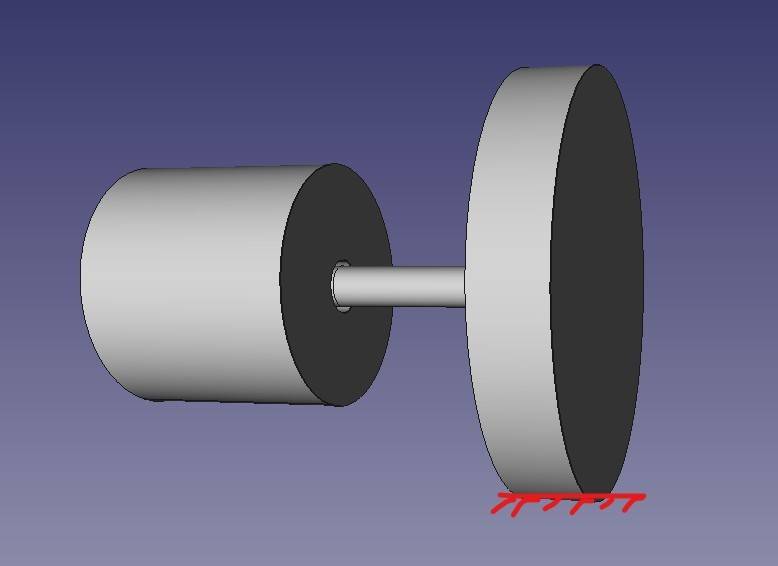
tract.jpg


Now for convenience here, the motor, or, the stator more precisely, is not mounted to any chassis, let's assume that it stays in the air just like that and is free to rotate relative to the rotor/shaft. The wheel does not slip.

I apply a torque T from the motor by applying some voltage V. This torque generated tries to rotate the wheel and the wheel rolls forward. My intuition (and also Newton's 3rd law?) tells me that when the rotor+shaft+wheels are applied with a torque the stator will experience an equal and opposite torque (reaction torque?).

Now I have go about calculating the angular acceleration of the motor body / stator (opposite in direction to angular acceleration of the wheel), if I know what torque I am generating (from the voltage applied). Assume we know every property of the system here, mass, frictions, moments of inertia etc.

But before that,

1) Is the reaction torque equal and opposite to the generated torque? In other words, can Newton's third law be directly applied to torques instead of forces?
2) If (1) is true, isn't the angular acceleration of the stator unrelated to properties of the rotor+shaft+wheels+ground part of the system?
3) If (2) is true, why do I see (by practical testing) that the angular acceleration of the stator is more when I impede the motion of the wheel on purpose? (like trying to stall).
4) If (1) is wrong (and thus (2)), how do I go about applying the laws and math to this in that case?

Thanks in advance.
 
Physics news on Phys.org
I am not sure that completely understand everything so I answer only the part I understand

PhysicoRaj said:
Summary:: How to claculate the angular acceleration of a body that experiences reaction torque

In other words, can Newton's third law be directly applied to torques instead of forces?
yes
 
  • Like
Likes   Reactions: PhysicoRaj
PhysicoRaj said:
3) If (2) is true, why do I see (by practical testing) that the angular acceleration of the stator is more when I impede the motion of the wheel on purpose? (like trying to stall).
I'm guessing you are measuring your stator acceleration with respect to the axle? If that is the case, when the axle rolls in the opposite direction, the relative stator acceleration is less compared to when the axle is stopped.
 
  • Like
Likes   Reactions: Lnewqban
PhysicoRaj said:
3) If (2) is true, why do I see (by practical testing) that the angular acceleration of the stator is more when I impede the motion of the wheel on purpose? (like trying to stall).
Are you sure the torque is the same in both cases? Usually the torque of a motor depends on the RPM.
 
  • Like
Likes   Reactions: PhysicoRaj
A.T. said:
Are you sure the torque is the same in both cases? Usually the torque of a motor depends on the RPM.
Great point. Is your opinion then that the effect I saw in testing was due to a change in torque and if I corrected that (I know the motor parameters and the rpm at a certain time so I could modulate the voltage to keep torque constant), the stator acceleration should remain same all the time?
 
jack action said:
I'm guessing you are measuring your stator acceleration with respect to the axle? If that is the case, when the axle rolls in the opposite direction, the relative stator acceleration is less compared to when the axle is stopped.
I am measuring the stator acceleration with respect to a frame of reference which is fixed with respect to the ground/surface. Its not relative to the axle/wheel.

Also, the stator acceleration should be more w.r.t the axle and less with a fixed reference right?
 
If I understand your rig:
  1. The motor will generate a certain torque (determined by the controller).
  2. That torgue and its Newtonian opposite will be applied to the stator assembly and the wheel assembly respectively.
  3. The angular accelerations of each will depend on their moments of inertia and additionally, for the wheel, the external force (as torque) from the table providing linear acceleration of the whole..
 
hutchphd said:
If I understand your rig:
  1. The motor will generate a certain torque (determined by the controller).
  2. That torgue and its Newtonian opposite will be applied to the stator assembly and the wheel assembly respectively.
  3. The angular accelerations of each will depend on their moments of inertia and additionally, for the wheel, the external force (as torque) from the table providing linear acceleration of the whole..
Thanks. That is how I would like to think too. So if I were to change either the mass of the wheel or the friction it experiences, the change in torque experienced by the stator should be solely from the effect of change in RPM.
 
  • Like
Likes   Reactions: hutchphd
PhysicoRaj said:
Thanks. That is how I would like to think too. So if I were to change either the mass of the wheel or the friction it experiences, the change in torque experienced by the stator should be solely from the effect of change in RPM.
Depending on where the center of mass of the stator (and the rest of the bot attached to it) is, linear forces at the axis can also create a torque, additionally to the reaction torque: The vertical support force and if the whole thing is accelerating along the ground a horizontal force on the stator.
 
Last edited:
  • #10
A.T. said:
Depending on where the center of mass of the stator (and the rest of the bot attached to it) is, linear forces at the axis can also create a torque, additionally to the reaction torque: The vertical support force and if the whole thing is accelerating along the ground a horizontal force on the stator.
Yes, I get that. My intention was to add up angular acceleration due to reaction torque and angular acceleration due to linear forces (like gravity on CoG and forward acceleration) creating a moment about the axle together. Can I do like this? Because Torques can be added, I guess accelerations can be added to find the net acceleration too. (Newton's 2nd law).
 
  • #11
PhysicoRaj said:
Yes, I get that. My intention was to add up angular acceleration due to reaction torque and angular acceleration due to linear forces (like gravity on CoG and forward acceleration) creating a moment about the axle together. Can I do like this?
Yes, but I prefer to take the torques of the linear froces around the CoG. Gravity has no lever arm here, just the force at the axle has. You can sill add these torques to the torque moment around the axle.
 
  • Like
Likes   Reactions: PhysicoRaj and Lnewqban

Similar threads

  • · Replies 10 ·
Replies
10
Views
4K
  • · Replies 39 ·
2
Replies
39
Views
4K
  • · Replies 30 ·
2
Replies
30
Views
3K
  • · Replies 60 ·
3
Replies
60
Views
7K
  • · Replies 5 ·
Replies
5
Views
1K
  • · Replies 9 ·
Replies
9
Views
2K
  • · Replies 16 ·
Replies
16
Views
4K
  • · Replies 22 ·
Replies
22
Views
2K
  • · Replies 0 ·
Replies
0
Views
1K
  • · Replies 1 ·
Replies
1
Views
2K