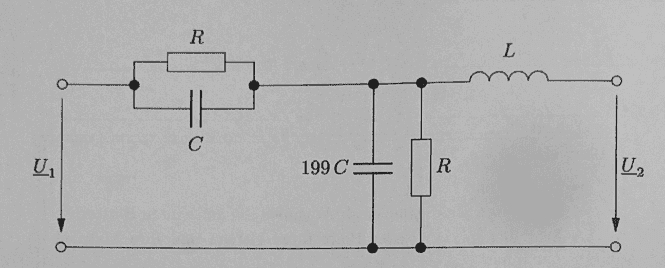
Is it possible for a low pass filter to have such a transfer function?

Click For Summary
SUMMARY

This discussion centers on the analysis of a low pass filter's transfer function, specifically the expression T(Ω) = (1 + jΩ) / (jΩ200 + 2). The participants clarify that the circuit's behavior deviates from classical low pass filters, particularly in terms of its response at low frequencies and the impact of inductance. The conversation highlights the importance of considering load impedance and the order of the filter, which can change based on the presence of inductors and resistive terminations. Ultimately, the participants conclude that the transfer function is valid, but the circuit's characteristics require careful interpretation.

PREREQUISITES
  • Understanding of transfer functions in electrical engineering
  • Familiarity with impedance calculations (Z1 and Z2)
  • Knowledge of filter types (low pass, high pass)
  • Basic concepts of circuit theory, including inductance and resistance
NEXT STEPS
  • Study the characteristics of low pass filters and their transfer functions
  • Learn about the effects of load impedance on filter behavior
  • Explore the concept of filter order and its implications on frequency response
  • Investigate the role of inductors in filter circuits and their impact on performance
USEFUL FOR

Electrical engineers, students studying circuit theory, and anyone involved in designing or analyzing filter circuits will benefit from this discussion.

arhzz
Messages
284
Reaction score
58
Homework Statement
Find the transfer function
Relevant Equations
Circuit analysis
Hello!

Snimka zaslona 2022-06-19 133540.png


Consider this filter,and that I have to find the transfer function U2/U1 with the norm Ω= ωRC (also double fractions are not allowed)

Now I can see that that the resistor and capacitor left as well as right are parallel to each other. So simplifying that

## Z_1 = \frac{R}{jωRC +1} ## Where Z1 is the Impedance on the left.
## Z_2 = \frac{R}{jωR199C +1} ## Where Z2 the impedance on the middle, L is irrelevant since no current is flowing there ( the circuit is open)

Now I can simplify with the norm and use the voltage divider to find the transfer function (T)

## T(Ω) = \frac{Z_2}{Z_1+Z_2} ## Inputting this gives me a double fraction

Now since I cannot have a double fraction I multiply everything by jΩ199 +1 and I am left with this

##\frac{R}{\frac{Rj199Ω+R }{jΩ+1 }+R } ## Now I multiply by jΩ +1 and I am left with this

##\frac{R(jΩ +1)}{R(jΩ199+1)+R(jΩ +1)} ##

So the final soultion should be ## \frac{1+jΩ}{jΩ200 +2}##

Now I am not so sure that this is correct.The reason why is because the next part of the problem they want me to find out how the transfer function looks like when Ω = 0,and what type of filter this is(low pass high pass etc..). I get that it should be 1/2 but I am not so sure that this is valid.I think I am susposed to get 1,because a low pass filter has transfer function 1 (ideally) for when the frequency is really low (hence really close to 0).I am not familiar with a filter that has a transfer function 1/2 at Ω = 0. Is it possible that I made a mistake somewhere in the transfer function; I've checked it thorughly and I think its okay,that would mean that I am missing something.

Any insights? Thanks
 
Last edited:
  • Like
Likes   Reactions: Delta2
Physics news on Phys.org
Of course, there are lowpaas filters with a DC values smaller than 0 dB (or even larger in case of active devices).
But note, that your circuit (a) is not a "classical" lowpass approaching zero amplitudes for very large frequencies and (b) will have another response with a resistive termination (due to the inductance, which has no influence without such a termination).
 
arhzz said:
Any insights? Thanks
Ignoring the capacitors. At low frequencies, the output will be R/(R+R) = 1/2 of the input.
Ignoring the resistors. At high frequencies, the capacitive divider will output about 1/200 of the input.
 
  • Informative
  • Like
Likes   Reactions: Jody and Delta2
LvW said:
Of course, there are lowpaas filters with a DC values smaller than 0 dB (or even larger in case of active devices).
But note, that your circuit (a) is not a "classical" lowpass approaching zero amplitudes for very large frequencies and (b) will have another response with a resistive termination (due to the inductance, which has no influence without such a termination).
Huh I did not know that such filter existed. So you would say that the transfer function is correct? And for b) I did not quite get what you meant with resistive termination? I know what it is but what has the inductance to do with it since the inductance should play no role,since there is no current there.Are you trying to say that the "behaviour" of the lowpass will be diffreent from the "classic" (that for very low frequencies,approaching 0 that it will have transfer function 0)?
 
arhzz said:
I did not quite get what you meant with resistive termination? I know what it is but what has the inductance to do with it since the inductance should play no role,since there is no current there.
What is the purpose of a filter?
Answer: To process an incoming signal in a certain way - and to deliver the result to another device.
This device will have - in most cases - a finite input resistance which will allow a current through the inductor.
What else should be the reason to have such an inductor in the ciruit?
In your case it is just an open circuit - not very realistic.
That was the background of my remark.
The inductor - together with any resistive termination - will change the order of your circuit from n=2 to n=3; and the last stage (L-R) will cause the signal to go down to zero for very large frequencies.
 
  • Like
Likes   Reactions: berkeman
LvW said:
What is the purpose of a filter?
Answer: To process an incoming signal in a certain way - and to deliver the result to another device.
This device will have - in most cases - a finite input resistance which will allow a current through the inductor.
What else should be the reason to have such an inductor in the ciruit?
In your case it is just an open circuit - not very realistic.
That was the background of my remark.
The inductor - together with any resistive termination - will change the order of your circuit from n=2 to n=3; and the last stage (L-R) will cause the signal to go down to zero for very large frequencies.
Okay I see now. But here is the other thing. I have tried calculating the cutoff frequency of this filter (with this transfer function) and I get it is negative. That should be impossible,to have negative cutoff frequency.

Since I'm pretty sure that is wrong,where could the error be?

EDIT: Nevermind I made a calculation error. I get 0,01
 
arhzz said:
EDIT: Nevermind I made a calculation error. I get 0,01

* OK - I see: You have calculated the normalized quantity Ω
* And HOW did you calculate ? Which definition did you apply?
 
Last edited:
  • Like
Likes   Reactions: berkeman
What does L do in the case we connect an output device to this filter so that current flows through L?
 
Delta2 said:
What does L do in the case we connect an output device to this filter so that current flows through L?
LvW said:
The inductor - together with any resistive termination - will change the order of your circuit from n=2 to n=3; and the last stage (L-R) will cause the signal to go down to zero for very large frequencies.
 
  • Informative
Likes   Reactions: Delta2
  • #10
Ok partially understood except from the "change the order of your circuit from n=2 to n=3" . Does it refer to the maximum order of the ODEs that describe the circuit?
 
  • #12
LvW said:
* OK - I see: You have calculated the normalized quantity Ω
* And HOW did you calculate ? Which definition did you apply?
Okay since Tmax is 1/2 I've used this definition ## |T(\Omega )| = \frac{Tmax}{\sqrt{2}} ## Now my Tmax is 1/2 plug in;

##T(\Omega ) = \sqrt{\frac{1+\Omega ^2}{2+200\Omega^2}} = \frac{1}{2\sqrt{2} } ##

And solve for omega gives us the solution.
 
  • #13
Delta2 said:
Ok partially understood except from the "change the order of your circuit from n=2 to n=3".
Each delay element in a filter increases the order by one. A delay element is, each capacitor or inductor in an analogue filter, or each Z-1 delay in a digital filter. As more delay elements are included, the slope of the transfer function increases. The maximum slope is achieved by optimising the application of the delay elements.

In this example, the inductor initially had no effect on the filter. When an output impedance was realized, the order rose from 2 to 3, as the inductor became an effective part of the filter.
 
  • Like
Likes   Reactions: DaveE
  • #14
Delta2 said:
What does L do in the case we connect an output device to this filter so that current flows through L?
Correct me if I'm wrong, but the OP didn't specify any load on this circuit.

arhzz said:
L is irrelevant since no current is flowing there ( the circuit is open)

So L is irrelevant, as is your question about what would happen if there was a load. What if the load was a capacitor? Another inductor? A capacitor and an inductor with a shunt resistor?

Just answer the OP's question, don't make it unnecessarily complicated unless they ask you too. The potential complexity is unlimited. You don't get extra points for confusing students. I doubt that he was asking for an online quiz about what the question could have been. If I'm wrong he can ask another question.
 
  • #15
DaveE said:
Correct me if I'm wrong, but the OP didn't specify any load on this circuit.
The OP assumed that the load impedance was infinite. But normal practice, and the presence of the inductor, indicate that a finite load impedance should have been specified.

The OP will not be the only reader of this thread, so we need to make the alternative interpretation clear. After all, if the OP was to be the only reader, then we would ask them to delete the thread once they were happy with the answers. We do not want to confuse the future readers.
 
  • Like
Likes   Reactions: Delta2
  • #16
Baluncore said:
We do not want to confuse the future readers.
IMO, it is more confusing for future readers to change the problem at hand. New problem → new thread. Although once the discussion about the loaded version of the circuit has been started, it may be reasonable to clear up confusion by discussing the additional poles etc.

If the OP is confused about a 2nd order filter, don't turn it into a 3rd order filter problem. Other readers can ask their questions, perhaps in another thread.
 
Last edited:
  • #17
DaveE said:
Although once the discussion about the loaded version of the circuit has been started, it may be reasonable to clear up confusion by discussing the additional poles etc.
That is exactly what we were doing.

Including this unnecessary discussion about how best to help a member, is not helpful when included in the original question thread. Learn from other's mistakes, and try to avoid telling other respondents what they must, or must not, do.
 

Similar threads

  • · Replies 3 ·
Replies
3
Views
3K
  • · Replies 4 ·
Replies
4
Views
832
  • · Replies 9 ·
Replies
9
Views
4K
  • · Replies 11 ·
Replies
11
Views
4K
  • · Replies 10 ·
Replies
10
Views
3K
  • · Replies 14 ·
Replies
14
Views
2K
  • · Replies 2 ·
Replies
2
Views
8K
  • · Replies 9 ·
Replies
9
Views
35K
  • · Replies 3 ·
Replies
3
Views
4K
  • · Replies 6 ·
Replies
6
Views
3K