Is My Double Integral Solution Correct?

  • Context: MHB 
  • Thread starter Thread starter harpazo
  • Start date Start date
  • Tags Tags
    Integrals
Click For Summary
SUMMARY

The discussion centers on evaluating a double integral defined by the limits of integration for x as (4y/3) to sqrt{25 - y^2} and for y from 0 to 3. The user initially calculated the integral and arrived at 225/8, while the textbook solution is 25. The correct evaluation of the integral is confirmed through a detailed breakdown, showing that the integral simplifies to 25. The conversation also highlights the importance of understanding the region of integration when switching between dydx and dxdy orders.

PREREQUISITES
  • Understanding of double integrals and their evaluation
  • Familiarity with the concepts of limits of integration
  • Knowledge of integration techniques, including substitution and area under curves
  • Ability to sketch regions defined by inequalities for integration
NEXT STEPS
  • Learn how to set up double integrals for various regions
  • Study the process of switching between dydx and dxdy orders of integration
  • Explore advanced integration techniques, such as polar coordinates for circular regions
  • Practice evaluating double integrals with different limits of integration
USEFUL FOR

Students and educators in calculus, particularly those focusing on multivariable calculus, as well as anyone looking to improve their skills in evaluating double integrals and understanding integration limits.

harpazo
Messages
208
Reaction score
16
I must evaluate the following double integral over the region R. I do not understand the limits of integration given the following equations.

Let S S = double integral symbol

S S x dx dy

Limits of integration for x:

From (4y/3) to sqrt{25 - y^2}.

Note: Why is the variable y in the radicand? Shouldn't it be sqrt{25 - x^2}?

Limits of integration for y:

From 0 to 3.

I was able to reduced the double integral to a single integral S.

S [(25 - y^2)y]/2 - [(8y^2)/9]y dy from 0 to 3.

My answer is 225/8.

The textbook answer is simply 25.

Is the textbook answer correct? If so, why?
 
Physics news on Phys.org
This is how I would evaluate the given integral:

$$I=\int_0^3 \int_{\frac{4}{3}y}^{\sqrt{25-y^2}} x\,dx\,dy$$

$$I=\frac{1}{2}\int_0^3 (25-y^2)-\left(\frac{16}{9}y^2\right)\,dy$$

$$I=\frac{25}{18}\int_0^3 9-y^2\,dy$$

$$I=\frac{25}{54}\left[27y-y^3\right]_0^3=\frac{25}{54}\cdot54=25$$
 
MarkFL said:
This is how I would evaluate the given integral:

$$I=\int_0^3 \int_{\frac{4}{3}y}^{\sqrt{25-y^2}} x\,dx\,dy$$

$$I=\frac{1}{2}\int_0^3 (25-y^2)-\left(\frac{16}{9}y^2\right)\,dy$$

$$I=\frac{25}{18}\int_0^3 9-y^2\,dy$$

$$I=\frac{25}{54}\left[27y-y^3\right]_0^3=\frac{25}{54}\cdot54=25$$

Can you show me how to integrate this same function over dydx?
 
Harpazo said:
Can you show me how to integrate this same function over dydx?

Sure, so what we need to do here is examine the region $D$ over which we are integrating...which can be expressed by the inequalities:

$$0\le y\le3$$

$$\frac{4}{3}y\le x\le\sqrt{25-y^2}$$

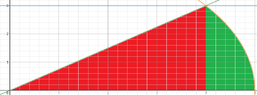
Now, in order to reverse the order in integration, we will have to break $D$ up into two regions as follows:

View attachment 6548

$$I=\int_0^4 x\int_0^{\frac{3}{4}x}\,dy\,dx+\int_4^5 x\int_0^{\sqrt{25-x^2}}\,dy\,dx$$

$$I=\frac{3}{4}\int_0^4 x^2\,dx+\int_4^5 x\sqrt{25-x^2}\,dx$$

$$I=\frac{1}{4}\left[x^3\right]_0^4+\frac{1}{2}\int_0^9 u^{\frac{1}{2}}\,du$$

$$I=16+\frac{1}{3}9^{\frac{3}{2}}=16+9=25$$
 

Attachments

  • double_integral.png
    double_integral.png
    4.8 KB · Views: 137
MarkFL said:
Sure, so what we need to do here is examine the region $D$ over which we are integrating...which can be expressed by the inequalities:

$$0\le y\le3$$

$$\frac{4}{3}y\le x\le\sqrt{25-y^2}$$

Now, in order to reverse the order in integration, we will have to break $D$ up into two regions as follows:
$$I=\int_0^4 x\int_0^{\frac{3}{4}x}\,dy\,dx+\int_4^5 x\int_0^{\sqrt{25-x^2}}\,dy\,dx$$

$$I=\frac{3}{4}\int_0^4 x^2\,dx+\int_4^5 x\sqrt{25-x^2}\,dx$$

$$I=\frac{1}{4}\left[x^3\right]_0^4+\frac{1}{2}\int_0^9 u^{\frac{1}{2}}\,du$$

$$I=16+\frac{1}{3}9^{\frac{3}{2}}=16+9=25$$

Brilliantly done! Why two integrals for dydx and not dxdy?
 
Harpazo said:
Brilliantly done! Why two integrals for dydx and not dxdy?

Well, if you look at the region $D$, you can see that integrating in the original order (with horizontal segments), the left and right bounds of each segment are along the same curves all the way up from $y=0$ to $y=3$, but reversing the order and using vertical segments, we have the same bottom boundary from $x=0$ to $x=5$, but the upper boundary is one curve on $0\le x\le4$ and another curve from $4\le x\le 5$. And so to integrate in that order, we must use 2 integrals. :D
 
MarkFL said:
Well, if you look at the region $D$, you can see that integrating in the original order (with horizontal segments), the left and right bounds of each segment are along the same curves all the way up from $y=0$ to $y=3$, but reversing the order and using vertical segments, we have the same bottom boundary from $x=0$ to $x=5$, but the upper boundary is one curve on $0\le x\le4$ and another curve from $4\le x\le 5$. And so to integrate in that order, we must use 2 integrals. :D

I thank you for your great help with the set up. I will be posting more double integrals. I have trouble deciding if dxdy is better to use or dydx for certain questions.

In fact, I am having trouble finding the limits of integration for double integrals. I am also having trouble setting up the integrals. I will post 3 questions that involve setting up the double integrals. No need to integrate the double integral just the set up.
 
Harpazo said:
I thank you for your great help with the set up. I will be posting more double integrals. I have trouble deciding if dxdy is better to use or dydx for certain questions.

In fact, I am having trouble finding the limits of integration for double integrals. I am also having trouble setting up the integrals. I will post 3 questions that involve setting up the double integrals. No need to integrate the double integral just the set up.

To decide, do a sketch of your region, and draw in both horizontal and vertical strips. If one way can be done without the lower and upper boundaries changing, then choose that one.
 
Thank you everyone.
 

Similar threads

  • · Replies 11 ·
Replies
11
Views
3K
  • · Replies 4 ·
Replies
4
Views
2K
  • · Replies 6 ·
Replies
6
Views
3K
  • · Replies 2 ·
Replies
2
Views
3K
  • · Replies 13 ·
Replies
13
Views
2K
  • · Replies 2 ·
Replies
2
Views
3K
  • · Replies 4 ·
Replies
4
Views
2K
  • · Replies 1 ·
Replies
1
Views
3K
  • · Replies 8 ·
Replies
8
Views
3K
Replies
5
Views
2K