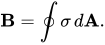
Is Newton's 3rd law sufficient to explain buoyancy force?

Click For Summary
SUMMARY

The discussion centers on the inadequacy of Newton's Third Law to fully explain the buoyancy force experienced by floating objects. While students correctly identified that the object exerts a downward force on the water, the explanation fails to account for the pressure differential caused by variable depth in a gravitational field. This pressure differential is essential for understanding buoyancy, as it leads to a net upward force on the submerged object. The conversation emphasizes the importance of integrating the stress tensor over the submerged surface to calculate the buoyant force accurately.

PREREQUISITES
  • Understanding of Newton's Third Law of Motion
  • Knowledge of hydrostatic pressure principles
  • Familiarity with fluid mechanics concepts
  • Ability to perform surface and volume integrals in physics
NEXT STEPS
  • Study the principles of hydrostatic pressure and its role in buoyancy
  • Learn how to calculate buoyant force using the stress tensor integration
  • Explore the Gauss theorem and its applications in fluid mechanics
  • Review the differences between force pairs in Newton's Third Law and forces in equilibrium
USEFUL FOR

Physics students, educators, and anyone interested in understanding the mechanics of buoyancy and fluid dynamics.

PhysicsNowApple
Messages
4
Reaction score
0
I assigned a question: Explain the physics mechanism that results in the buoyancy force.

Some students replied: The floating object is interacting with the water. Therefore it exerts a downward force on the water. The water then exerts an upward force on the object due to Newton's Third Law. This force balances the weight of the object. I was looking for the standard: variable depth pressure causes a pressure differential that results in the buoyancy force.

Now I feel that their explanation is not sufficient but I was wondering how to go about addressing their answer because I feel like if I am not careful I might obfuscate their understanding of Newton's 3rd Law.Thank you,

 
Physics news on Phys.org
The 3rd law just states that the force of the water on the object is the negative of the force of the object on the water. To actually explain buoyancy you need the pressure differential, which in turn results from assuming a hydrostatic situation in a gravitational field.
 
  • Like
Likes   Reactions: Daniel Sellers
Orodruin said:
The 3rd law just states that the force of the water on the object is the negative of the force of the object on the water. To actually explain buoyancy you need the pressure differential, which in turn results from assuming a hydrostatic situation in a gravitational field.

Hmmm, so perhaps to address this I should point out that technically the water is exerting a force along all points on the object, so using Newton's third law I cannot find a net force upward. Only by using the pressure differential, do we see that the forces exerted on the top of the object are not as large as the forces exerted on the bottom of the object and then we are able to get a net buoyant force?
 
https://en.wikipedia.org/wiki/Buoyancy said:
The buoyancy force exerted on a body can now be calculated easily, since the internal pressure of the fluid is known. The force exerted on the body can be calculated by integrating the stress tensor over the surface of the body which is in contact with the fluid:

d53e8b6668b8f0850ba54ec5999a6b04d8256cb4

The surface integral can be transformed into a volume integral with the help of the Gauss theorem:

59aa810e63b67d23daabe691fbd06e8879d425b5

where V is the measure of the volume in contact with the fluid, that is the volume of the submerged part of the body.
 
PhysicsNowApple said:
The water then exerts an upward force on the object due to Newton's Third Law.
It is vital not to confuse the idea of third law pairs and Forces in Equilibrium (which is a special case).
 

Similar threads

  • · Replies 3 ·
Replies
3
Views
2K
Replies
5
Views
2K
  • · Replies 17 ·
Replies
17
Views
2K
  • · Replies 14 ·
Replies
14
Views
2K
  • · Replies 5 ·
Replies
5
Views
2K
  • · Replies 11 ·
Replies
11
Views
2K
  • · Replies 14 ·
Replies
14
Views
10K
  • · Replies 13 ·
Replies
13
Views
17K
  • · Replies 24 ·
Replies
24
Views
2K
  • · Replies 9 ·
Replies
9
Views
2K