Is that field conservative? If yes, why is the work not null?

  • Thread starter Thread starter Amaelle
  • Start date Start date
  • Tags Tags
    Field Work
Click For Summary
The discussion centers on the conditions for a vector field to be considered conservative, particularly in relation to work done around closed paths. Although the vector field appears conservative based on partial derivatives, it is not defined at the origin, which affects its conservativeness. Stokes' theorem indicates that the path integral is zero only if the curl is zero throughout the region, which is not the case here due to the singularity at the origin. Additionally, applying the divergence theorem requires the field to be defined and continuously differentiable throughout the region of interest. Therefore, the presence of a singularity invalidates the assumption of the field being conservative.
Amaelle
Messages
309
Reaction score
54
Homework Statement
calculate the closed path integral of the vector field
F(x,y)=(y/(2x^2+y^2) ; -x/(2x^2+y^2)) along the ellipse of equation
{(x, y) ∈ R2: 2x^2 + y^2 = 1} run in clockwise direction
Relevant Equations
x=cos(theta) /sqrt(2)
y=sin(theta)
my problem is the following: this vector field is conservative ( i checked the partial derivative) means the work around a closed path must be zero!√but still the solution says otherwise: any hints?
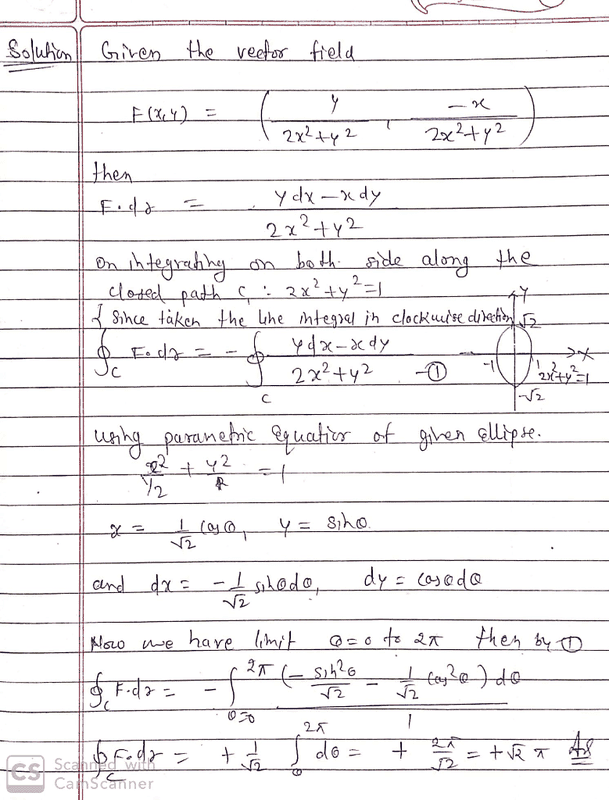
exercice math vector field solution.png
explanation? thanks a lot!

exercice math vector field solution.png
 
Physics news on Phys.org
Is your vector field defined everywhere inside the ellipse?
 
  • Like
Likes FactChecker
yes I guess
 
So what is F(0,0)?
 
  • Like
Likes Amaelle
Yes you are right it's not defined there, does this mean that this field is not conservative?
 
Do we need continuity condition to assume conservative field?
 
Stokes' theorem guarantees the path integral around a closed loop is 0 if the curl vanishes everywhere in region bounded by the loop. In this case, the curl doesn't vanish everywhere inside the loop because the field isn't defined at the origin. There's no guarantee, therefore, that the path integral is 0.
 
Last edited:
  • Like
  • Love
Likes Amaelle, FactChecker and etotheipi
Thanks a lot for your precious answer, and for the divergence theorem (gauss theorem) do we need to check the same condition to apply it? (the field must be defined everywhere)?
 
When I have questions like this, I look up a precise statement of the theorem, something a mathematician would write, because it will state all the conditions that must be satisfied. My calculus book, for example, says the components of the vector field need to be continuously differentiable. Consequently, if there's a singularity in the region of interest, you shouldn't expect to be able to use the theorem.
 
  • Like
Likes Amaelle

Similar threads

  • · Replies 3 ·
Replies
3
Views
2K
Replies
8
Views
2K
  • · Replies 14 ·
Replies
14
Views
3K
  • · Replies 3 ·
Replies
3
Views
2K
  • · Replies 3 ·
Replies
3
Views
3K
  • · Replies 2 ·
Replies
2
Views
1K
  • · Replies 9 ·
Replies
9
Views
2K
  • · Replies 1 ·
Replies
1
Views
2K
  • · Replies 6 ·
Replies
6
Views
3K