Is the Angular Velocity of Pinned Rods Calculated Correctly?

Join the discussion
Registration is free. Ask a follow-up in this thread, or start your own.
5 replies · 2K views
DrNG
Messages
2
Reaction score
0
Homework Statement
As shown in the figure, two rods PQ and QR, pinned at Q and rod QR is hinged at R. P moves with a velocity v0 and acceleration a0 along the incline. We are required to find the angular velocities of P and Q, angular acceleration of PQ as well as QR.
Relevant Equations
ωPQ=v⊥/ℓ
My line of thinking is as follows:

[tex]\omega_{PQ} = \frac{v_{\perp}}{\ell} = \frac v\ell \frac{\sqrt3}{2}[/tex]

Similarly for rod ##QR##

[tex]\omega_{QR} = \frac{v_{\perp}}{\ell} = \frac v\ell \frac{\sqrt3}{2}[/tex]

Is my reasoning correct?
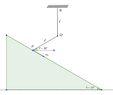
 

Attachments

  • 4arZm.png
    4arZm.png
    5.7 KB · Views: 157
Physics news on Phys.org
haruspex said:
Your first equation appears to ignore that Q will move.
Say P is moving up the plane. Then Q moves closer to the plane, increasing the rate at which the rod rotates.
Thanks for your reply!

I get it now.
Can you please suggest on which lines should I attempt further.. I'm not so comfy with rotating frames...
 
DrNG said:
Thanks for your reply!

I get it now.
Can you please suggest on which lines should I attempt further.. I'm not so comfy with rotating frames...
I would consider QR rotated through an angle ##\phi## and find expressions for the position of P and the angle of PQ in terms of that. Could be messy, though.
If it were only the angular velocity that is required, you could take ##\phi## as small and make suitable approximations, but the acceleration is a bit harder.
 
For the instantaneous position of the mechanism, I would first try to calculate the tangential velocity and acceleration of Q (both horizontal vectors), which depend on Vo and ao.
You will need to create a system of coordinates aligned in a form that makes calculations easier.
Q is a common point for links RQ and PQ; therefore, you will have velocity values and directions for both ends of link QP and could calculate its center of rotation and angular velocity and acceleration.