Is the change in internal energy really a state function?

Click For Summary

Homework Help Overview

The discussion revolves around the concept of internal energy as a state function in thermodynamics, specifically in the context of two different processes (A and B) involving a gas. Participants are examining the implications of the first law of thermodynamics and the calculations related to heat transfer and work done during these processes.

Discussion Character

  • Conceptual clarification, Mathematical reasoning, Assumption checking

Approaches and Questions Raised

  • Participants explore the relationship between heat transfer (Q) and work (W) in the context of internal energy changes. There is a focus on whether the change in internal energy can be considered the same for both processes despite differing heat transfers and work done. Questions arise about the signs of the variables involved, particularly the change in volume (ΔV).

Discussion Status

The discussion is active, with participants providing calculations to support their claims about the heat transferred in each process. Some participants have clarified their understanding of the signs associated with heat transfer, leading to a resolution of apparent contradictions regarding the state function nature of internal energy.

Contextual Notes

There is an emphasis on the calculations involving specific heat capacities and the ideal gas law, with participants considering the implications of their assumptions about the processes being isobaric and isochoric. The discussion reflects on the conditions under which the first law of thermodynamics applies.

msw1
Messages
5
Reaction score
2
Homework Statement
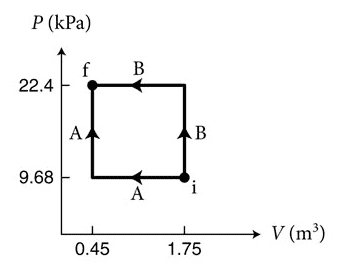
(Figure 1) shows two processes, A and B, for moving 3.45 × 10^22 particles of a monatomic ideal gas from state i to state f. Which process requires a smaller magnitude of the energy Q transferred thermally to the gas?
Relevant Equations
$$\Delta E=W+Q$$
$$PV=Nk_BT$$
$$Q=\tfrac{d}{2}Nk_BT \text{ (isochoric process)}$$
$$Q=NC_p\Delta T \text{ (isobaric process) }$$
Here is the figure:
1597791821634.png

The answer is $$Q_A<Q_B$$ which I can show by calculation using the above equations. What's confusing to me is I thought that the change in internal energy was a state function. Which would mean since the initial and final points are the same, $$\Delta E_A=\Delta E_B$$ or by the 1st law of thermodynamics $$W_A+Q_A=W_B+Q_B$$ Since W is the area under the curve (and positive in this case since the gas is being compressed), $$W_A<W_B$$ So the work done on the gas in process A is less than in process B, and the energy transferred thermally to the gas in process A is less than in process B. Which, since all values are positive, seems like it contradicts the original assumption that the change in internal energy was a state function, since it seems like the change in internal energy has to be less in process A. What am I missing here?
 
Physics news on Phys.org
msw1 said:
The answer is ##Q_A<Q_B## which I can show by calculation using the above equations.
Can you show that calculation? There is heat involved in both parts of both transitions.
 
mfb said:
Can you show that calculation? There is heat involved in both parts of both transitions.
Sure, energy transferred thermally in the isobaric processes is
$$Q=NC_p\Delta T$$
$$Q=N\left(\tfrac{d}{2}+1\right)k_b\Delta T$$
And ##\Delta T = \frac{P\Delta V}{Nk_B}## by the ideal gas law so
$$Q=P\Delta V\left(\tfrac{d}{2}+1\right)$$
And then for the isochoric processes
$$Q=\tfrac{d}{2}Nk_B\Delta T$$
And ##\Delta T = \frac{\Delta P V}{Nk_B}## so
$$Q = \tfrac{d}{2}(\Delta P)V$$
So the overall energy transferred thermally in each process is
$$P\Delta V\left(\tfrac{d}{2}+1\right)+\tfrac{d}{2}(\Delta P)V$$
Taking d to be 3 since this is a monatomic gas, the energy transferred thermally in process A is then
$$9680\cdot1.3(\tfrac{3}{2}+1)+\tfrac{3}{2}\cdot12720\cdot0.45=40046J$$
And then the energy transferred thermally in process B is
$$22400\cdot1.3(\tfrac{3}{2}+1)+\tfrac{3}{2}\cdot12720\cdot1.75=106190J$$
So ##Q_A<Q_B##, which my homework grader says is correct.
 
What is the sign of ##\Delta V##?
 
  • Like
Likes   Reactions: Chestermiller
mfb said:
What is the sign of ##\Delta V##?
Oh, that was it! So ##|Q_A|<|Q_B|## like the question asked, but ##Q_A>Q_B##, and so there is no contradiction. Thanks!
 
  • Like
Likes   Reactions: mfb and Chestermiller

Similar threads

  • · Replies 1 ·
Replies
1
Views
2K
Replies
15
Views
2K
  • · Replies 4 ·
Replies
4
Views
3K
Replies
12
Views
2K
  • · Replies 5 ·
Replies
5
Views
1K
  • · Replies 8 ·
Replies
8
Views
2K
  • · Replies 1 ·
Replies
1
Views
1K
  • · Replies 8 ·
Replies
8
Views
2K
Replies
49
Views
4K
Replies
18
Views
3K