Is the Indicatrix a Volume Chart or an Ellipsoid for Crystal Optical Properties?

  • Context: Undergrad 
  • Thread starter Thread starter nomadreid
  • Start date Start date
  • Tags Tags
    Crystals Optics
Click For Summary
SUMMARY

The discussion clarifies the term "indicatrix" in the context of crystal optical properties, distinguishing between its use as a 3D rendering and its traditional representation as an ellipsoid. The confusion arose from a translation issue, where "volume chart" refers to a 3D image rather than a conventional chart. The indicatrix is confirmed to be an ellipsoid in optical contexts, but can exhibit more complexity, especially in electron scattering scenarios. The conversation also highlights the distinction between optical indicatrices and scattering indicatrices, emphasizing their different applications in physics.

PREREQUISITES
  • Understanding of optical properties of crystals
  • Familiarity with the concept of indicatrix in optics
  • Knowledge of electron scattering principles
  • Experience with 3D modeling tools like MathCad
NEXT STEPS
  • Research the differences between optical indicatrix and scattering indicatrix
  • Explore the mathematical representation of indicatrices in crystal optics
  • Learn about the impact of crystal symmetry on optical properties
  • Investigate the role of electron scattering in materials science
USEFUL FOR

Physicists, materials scientists, and optical engineers interested in the optical properties of crystals and the implications of indicatrix in both light and electron scattering contexts.

nomadreid
Gold Member
Messages
1,765
Reaction score
250
Trying to work through a paper which includes a discussion of the optical properties of crystal, and the author uses the term "indicatrix", at one point referring to it as a diagram, which makes sense, but another place referring to it as a "volume chart", which I haven't figured out. Could someone tell me what is meant by "volume chart" for the indicatrix, or whether it doesn't apply? Maybe something gets lost in translation? (The paper is in Russian; I'm translating literally.) That is my first question.
Second question: Even more puzzling is that I thought that an indicatrix was an ellipsoid, but the diagram in the paper (attached below), done on MathCad, looks nothing like an ellipsoid. Is it possible for an indicatrix for a crystal to not be an ellipsoid?
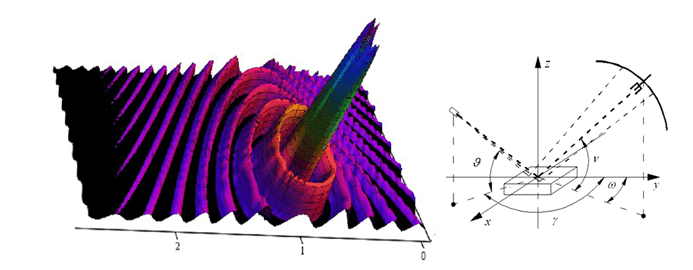
indicatrix.PNG

A couple more details: the caption for this diagram is

Fig. 4. Diagram (indicatrix) of particle (electron) scattering through 1940 layers of sinusoidal equipotential surfaces of a crystal, ...https://www.physicsforums.com/file:///C:\Users\DAVIDM~1\AppData\Local\Temp\msohtmlclip1\01\clip_image002.jpg https://www.physicsforums.com/file:///C:\Users\DAVIDM~1\AppData\Local\Temp\msohtmlclip1\01\clip_image003.jpg
 
Last edited by a moderator:
  • Like
Likes   Reactions: Logical Dog
Science news on Phys.org
nomadreid said:
Trying to work through a paper which includes a discussion of the optical properties of crystal, and the author uses the term "indicatrix", at one point referring to it as a diagram, which makes sense, but another place referring to it as a "volume chart", which I haven't figured out. Could someone tell me what is meant by "volume chart" for the indicatrix, or whether it doesn't apply? Maybe something gets lost in translation? (The paper is in Russian; I'm translating literally.) That is my first question.
Second question: Even more puzzling is that I thought that an indicatrix was an ellipsoid, but the diagram in the paper (attached below), done on MathCad, looks nothing like an ellipsoid. Is it possible for an indicatrix for a crystal to not be an ellipsoid?
View attachment 110892
A couple more details: the caption for this diagram is

Fig. 4. Diagram (indicatrix) of particle (electron) scattering through 1940 layers of sinusoidal equipotential surfaces of a crystal, ...https://www.physicsforums.com/file:///C:\Users\DAVIDM~1\AppData\Local\Temp\msohtmlclip1\01\clip_image002.jpg https://www.physicsforums.com/file:///C:\Users\DAVIDM~1\AppData\Local\Temp\msohtmlclip1\01\clip_image003.jpg

Definitely something is getting lost in translation. I believe "volume chart" must just mean a 3D rendering. The indicatrix is usually an ellipsoid. Taking a cross section perpendicular to the direction of propagation gives an ellipse. The ellipse shows the index of refraction as a function of the direction of the electric field polarization. The slice is easy to draw in 2D, but if you want to picture the whole 3D indicatrix you have to make a 3D rendering on the page. I don't know any Russian, but I could easily imagine a translation of the Russian for a 3D graph coming out to "volume chart". Heck, that's practically the best way to say it in English if you think about it.

I can't explain the chart. That certainly doesn't look like any indicatrix I've ever seen. On the other hand I'm used to thinking in terms of light, and not electrons. I can say that for light the indicatrix can be more complicated than an ellipse. For example I worked designing lithography machines when we were trying to move to 157nm light. The optics were to be made out of CaF2. CaF2 is cubic and the polarizability should be centrosymmetric. For lower energy light the indicatrix is uniform. There is no birefringence. It was discovered that 157nm light was energetic enough to have a nonlinear interaction with the polarizability of the crystal matrix. The result was a complicated idicatrix which had the cubic symmetry of the crystal.
 
Last edited by a moderator:
  • Like
Likes   Reactions: nomadreid
Thanks very much, Cutter Ketch.
First, you get the Russian-guesser prize of the year. You were right, the phrase that came out as "volume chart" did indeed mean a 3-D image. I checked with a Russian whether your guess was correct, and she corroborated it.
Second, you are saying that while the diagram is unusual, it is not for all that necessarily wrong. That's encouraging. The formula he is using is:
form for ind.PNG
 
Like I mentioned, I don't know about what would be called an indicatrix for electron scattering. I've only ever heard that as an optical term. Also, while an indicatrix can be more complicated than an ellipse I've never seen anything like the complexity of that ripple structure. Finally, looking at your equation that just looks like an electron scattering probability to me. Are you sure the word indicatrix was associated with this calculation?
 
  • Like
Likes   Reactions: nomadreid
Ahh. I think I begiin to understand. Searching the internet I am learning that for light there are unrelated things called indicatrix ... es. (Indicatrices??). There is an optical indicatrix which is the dependence of the index of refraction on propagation direction and polarization. That is the one with which I am familiar. Then there is something completely different called the scattering indicatrix which is the dependence of scattering probability on incident direction, scattered direction, and I suppose polarization.

This suggests that "indicatrix" is the 3D directional dependence of just about anything including, in this case, the dependence of electron scattering probability on incidence direction and scattering direction.

Well, that is new terminology to me, but in any case I think what you are looking at in the diagram is the electron scattering probability as a function of incidence and scattering angles. The scattering material is postulated to be layers, so the scattering probability has symmetric rings at higher and higher scattering angle as higher and higher orders of the Bragg condition are reached.
 
  • Like
Likes   Reactions: nomadreid
Cutter Ketch said:
Ahh. I think I begiin to understand. Searching the internet I am learning that for light there are unrelated things called indicatrix ... es. (Indicatrices??). There is an optical indicatrix which is the dependence of the index of refraction on propagation direction and polarization. That is the one with which I am familiar. Then there is something completely different called the scattering indicatrix which is the dependence of scattering probability on incident direction, scattered direction, and I suppose polarization.

This suggests that "indicatrix" is the 3D directional dependence of just about anything including, in this case, the dependence of electron scattering probability on incidence direction and scattering direction.

Well, that is new terminology to me, but in any case I think what you are looking at in the diagram is the electron scattering probability as a function of incidence and scattering angles. The scattering material is postulated to be layers, so the scattering probability has symmetric rings at higher and higher scattering angle as higher and higher orders of the Bragg condition are reached.

Excellent. Thanks very much, Cutter Ketch. It now makes sense. The information and analysis are very much appreciated.
 
nomadreid said:
Excellent. Thanks very much, Cutter Ketch. It now makes sense. The information and analysis are very much appreciated.
You are quite welcome
 

Similar threads

  • · Replies 13 ·
Replies
13
Views
4K
  • · Replies 1 ·
Replies
1
Views
2K
Replies
6
Views
2K
  • · Replies 1 ·
Replies
1
Views
2K
  • · Replies 24 ·
Replies
24
Views
3K
  • · Replies 1 ·
Replies
1
Views
3K
Replies
8
Views
3K
  • · Replies 1 ·
Replies
1
Views
3K
  • · Replies 9 ·
Replies
9
Views
3K
  • · Replies 11 ·
Replies
11
Views
2K