Is the trajectory parabolic or elliptical?

  • Context: Undergrad 
  • Thread starter Thread starter farolero
  • Start date Start date
  • Tags Tags
    Trajectory
Click For Summary
SUMMARY

The discussion centers on the distinction between parabolic and elliptical trajectories in the context of projectile motion. Parabolic shooting is defined as an orbit interrupted by the ground, which assumes a uniform gravitational force. In contrast, elliptical trajectories arise from central forces, indicating that a parabolic path is merely a segment of an ellipse. The conversation emphasizes the importance of understanding these fundamental differences when calculating projectile speeds and applying the laws of motion.

PREREQUISITES
  • Understanding of projectile motion principles
  • Familiarity with gravitational forces and their effects
  • Knowledge of angular momentum conservation
  • Basic geometry of conic sections, particularly ellipses and parabolas
NEXT STEPS
  • Research the laws of motion for projectiles in a uniform gravitational field
  • Study the properties of elliptical orbits and their mathematical representations
  • Explore the conservation of angular momentum in various physical systems
  • Learn about the differences between central forces and uniform forces in physics
USEFUL FOR

Physics students, educators, and anyone interested in the dynamics of projectile motion and orbital mechanics will benefit from this discussion.
farolero
Messages
166
Reaction score
10
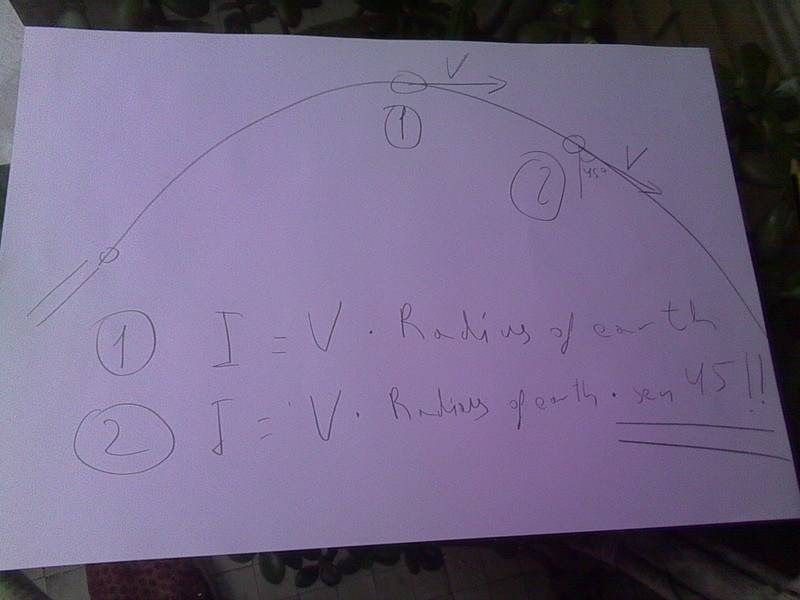
Parabolic shooting is a kind of orbit interrupted by the ground.

So I was wondering if I could calculate speeds of the bullet accounting for conservation of angular momentum.

Would this diagram be correct?

IMG_20161214_143014_zpsoqhx1v9p.jpg
 
Last edited:
Physics news on Phys.org
Why don't you try yourself to see if the result is compatible with the one obtained by using the laws of motion for projectile in uniform field?
 
  • Like
Likes   Reactions: farolero
farolero said:
Parabolic shooting is a kind of orbit interrupted by the ground
Not really. A parabola comes from assuming a uniform gravitational force. When you talk about orbits you are talking instead about a central force. It would be the tip of an ellipse, not a parabola.

Edit: sorry @nasu I basically fed him the info you were trying to get him to discover.
 
  • Like
Likes   Reactions: farolero

Similar threads

  • · Replies 7 ·
Replies
7
Views
2K
  • · Replies 6 ·
Replies
6
Views
2K
  • · Replies 6 ·
Replies
6
Views
2K
  • · Replies 11 ·
Replies
11
Views
2K
  • · Replies 28 ·
Replies
28
Views
3K
  • · Replies 14 ·
Replies
14
Views
4K
  • · Replies 10 ·
Replies
10
Views
4K
  • · Replies 3 ·
Replies
3
Views
3K
  • · Replies 10 ·
Replies
10
Views
779
  • · Replies 3 ·
Replies
3
Views
8K