pejsek
- 3
- 2
- TL;DR
- Calculate α so that the red and blue objects meet using the given parameters
Hello,
I ask you for your aid in the solution of the following problem. Please see the attached illustration.
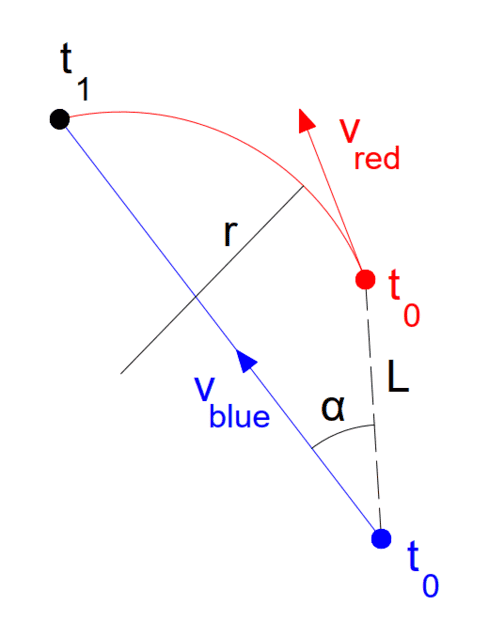
Two objects (red and blue) are moving in the vicinity of each other. The red object is moving along a closed circle and the blue object is moving along a line. Our objective is to make the two objects collide. We cannot touch the red object, however, we can change the direction of the movement of the blue object by changing the angle α. The goal is to calculate the angle α so that the two objects meet.
Here is what is known:
L ... distance between the two objects at time = 0
r ... radius of the trajectory of the red object
v_red ... magnitude of the tangential velocity of the red object
v_blue ... magnitude of the velocity of the blue object
Magnitudes of both velocities are constant (there is no acceleration except for the centripetal acceleration of the red object).
This problem comes from my idea of calculating the angle at which fighter planes have to fire their guns when shooting down an enemy aircraft in a turn.
Thank you very much indeed for your help,
pejsek
I ask you for your aid in the solution of the following problem. Please see the attached illustration.
Two objects (red and blue) are moving in the vicinity of each other. The red object is moving along a closed circle and the blue object is moving along a line. Our objective is to make the two objects collide. We cannot touch the red object, however, we can change the direction of the movement of the blue object by changing the angle α. The goal is to calculate the angle α so that the two objects meet.
Here is what is known:
L ... distance between the two objects at time = 0
r ... radius of the trajectory of the red object
v_red ... magnitude of the tangential velocity of the red object
v_blue ... magnitude of the velocity of the blue object
Magnitudes of both velocities are constant (there is no acceleration except for the centripetal acceleration of the red object).
This problem comes from my idea of calculating the angle at which fighter planes have to fire their guns when shooting down an enemy aircraft in a turn.
Thank you very much indeed for your help,
pejsek
Last edited: