Undergrad Is there an equivalent form for arctan?

Click For Summary
The discussion revolves around finding an equivalent form for arctan, particularly in the context of an integral involving epsilon. Participants explore the substitution of variables and the manipulation of the integral to clarify the role of epsilon in the arctan function. There is confusion regarding how epsilon fits into the argument of arctan, with some suggesting it may be misleading. Ultimately, while the final result is deemed correct, the presence of epsilon in the intermediate steps raises questions about notation and clarity. The conversation highlights the importance of precise mathematical expressions in understanding integrals involving inverse trigonometric functions.
Aristotle
Messages
169
Reaction score
1
Hi, I was just looking at an example for a certain problem and noticed that in the second step they went to arctan(epsilon). I know there's a form that is equal to arctan but am a little unsure.
I've come across formulas on the web such as
arctan(x) = ∫(dt)/(a2+t2)
but nothing else that would get to arctan.

Can somebody please direct me to the correct formula?
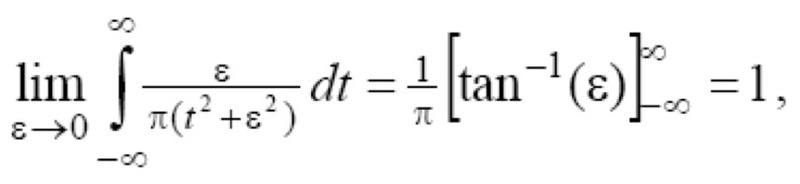
CnCbra6.jpg
 
Physics news on Phys.org
I think the ##\varepsilon## in the term with ##\tan^{-1}## is misleading. What if you substitute ##u := \frac{t}{\varepsilon}## and solve the integral?
 
fresh_42 said:
I think the ##\varepsilon## in the term with ##\tan^{-1}## is misleading. What if you substitute ##u := \frac{t}{\varepsilon}## and solve the integral?
If you don't mind me asking, where did you get t/ε from?
 
For the integral, ##\varepsilon## is only a disturbing constant as ##\pi## is. I simply tried to get the integral in the form ##\int \frac{1}{1+x^2} dx## which means to pull out ##\varepsilon^2## in the denominator.
 
fresh_42 said:
For the integral, ##\varepsilon## is only a disturbing constant as ##\pi## is. I simply tried to get the integral in the form ##\int \frac{1}{1+x^2} dx## which means to pull out ##\varepsilon^2## in the denominator.
The only way I see taking ε2 out of the denominator is dividing that number by itself for numerator and denominator.
But you would get ∫(1/ε)⋅( (dt) / ( (t22)+1) )
 
Yes, and now substitute ##u := \frac{t}{\varepsilon}## and replace ##dt## by ##du##.
 
fresh_42 said:
Yes, and now substitute ##u := \frac{t}{\varepsilon}## and replace ##dt## by ##du##.
Wouldn't that get you arctan(t) and not arctan(ε)?
 
##\arctan u## as I see it. I don't understand how the ##\varepsilon## get's into the argument of ##\arctan##. As such it is the variable where the ##\pm \infty## apply to, not the ##\varepsilon## from the limit. I said I find the notation misleading. But it's only a temporary result anyway, so I didn't bother too much.
 
  • Like
Likes Aristotle
  • #10
fresh_42 said:
##\arctan u## as I see it. I don't understand how the ##\varepsilon## get's into the argument of ##\arctan##. As such it is the variable where the ##\pm \infty## apply to, not the ##\varepsilon## from the limit. I said I find the notation misleading. But it's only a temporary result anyway, so I didn't bother too much.
Thank you so much for your help! I also got the same. Possibly their answer is incorrect...
 
  • #11
Aristotle said:
Thank you so much for your help! I also got the same. Possibly their answer is incorrect...
Why? It's ##1## in the end, so the result is correct, only the ##\varepsilon## in between is odd.
 
  • #12
fresh_42 said:
Why? It's ##1## in the end, so the result is correct, only the ##\varepsilon## in between is odd.
Woops didnt mean to say the answer was wrong. ?:)
But yeah the ε in the arctan in that step is odd. Think they forgot a 't' in the numerator.
 

Similar threads

  • · Replies 5 ·
Replies
5
Views
9K
  • · Replies 2 ·
Replies
2
Views
5K
  • · Replies 62 ·
3
Replies
62
Views
11K
Replies
16
Views
4K
  • · Replies 1 ·
Replies
1
Views
3K
  • · Replies 34 ·
2
Replies
34
Views
6K
  • · Replies 11 ·
Replies
11
Views
5K
Replies
5
Views
3K
  • · Replies 13 ·
Replies
13
Views
3K
  • · Replies 10 ·
Replies
10
Views
4K