Is there an equivalent form for arctan?

Click For Summary

Discussion Overview

The discussion revolves around the equivalent forms of the arctangent function, particularly in the context of an integral representation. Participants explore various mathematical manipulations and substitutions related to the arctan function, specifically addressing the role of the variable epsilon (ε) in these expressions.

Discussion Character

  • Technical explanation
  • Mathematical reasoning
  • Debate/contested

Main Points Raised

  • One participant mentions a formula for arctan as an integral, specifically arctan(x) = ∫(dt)/(a²+t²), and seeks clarification on its correctness.
  • Another participant provides a link to an article that contains various forms of inverse trigonometric functions, including arctan.
  • Some participants express concern that the use of ε in the context of arctan may be misleading and propose substituting variables to clarify the integral.
  • There is a suggestion to manipulate the integral to achieve a standard form, specifically ∫(1/(1+x²)) dx, by factoring out ε² from the denominator.
  • Participants discuss the implications of substituting u := t/ε and how it affects the argument of arctan, questioning how ε relates to the limits of the function.
  • One participant notes that the notation involving ε is confusing but considers it a temporary result, indicating a lack of consensus on its appropriateness.
  • There is a discussion about the correctness of the final result being 1, while some participants find the presence of ε in the calculations odd or potentially erroneous.

Areas of Agreement / Disagreement

Participants do not reach a consensus on the appropriateness of using ε in the context of arctan, with some finding it misleading while others focus on the correctness of the final result. The discussion remains unresolved regarding the clarity and correctness of the integral manipulations.

Contextual Notes

There are unresolved questions regarding the assumptions made about the variable ε and its role in the integral representation of arctan. The discussion also highlights potential ambiguities in notation and variable substitution.

Aristotle
Messages
169
Reaction score
1
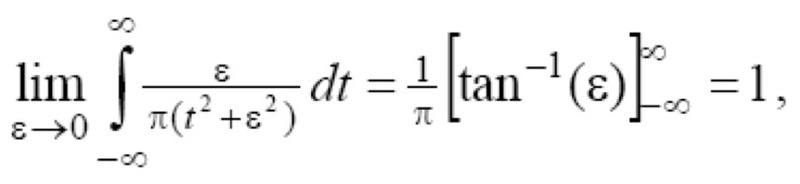
Hi, I was just looking at an example for a certain problem and noticed that in the second step they went to arctan(epsilon). I know there's a form that is equal to arctan but am a little unsure.
I've come across formulas on the web such as
arctan(x) = ∫(dt)/(a2+t2)
but nothing else that would get to arctan.

Can somebody please direct me to the correct formula?
CnCbra6.jpg
 
Physics news on Phys.org
I think the ##\varepsilon## in the term with ##\tan^{-1}## is misleading. What if you substitute ##u := \frac{t}{\varepsilon}## and solve the integral?
 
fresh_42 said:
I think the ##\varepsilon## in the term with ##\tan^{-1}## is misleading. What if you substitute ##u := \frac{t}{\varepsilon}## and solve the integral?
If you don't mind me asking, where did you get t/ε from?
 
For the integral, ##\varepsilon## is only a disturbing constant as ##\pi## is. I simply tried to get the integral in the form ##\int \frac{1}{1+x^2} dx## which means to pull out ##\varepsilon^2## in the denominator.
 
fresh_42 said:
For the integral, ##\varepsilon## is only a disturbing constant as ##\pi## is. I simply tried to get the integral in the form ##\int \frac{1}{1+x^2} dx## which means to pull out ##\varepsilon^2## in the denominator.
The only way I see taking ε2 out of the denominator is dividing that number by itself for numerator and denominator.
But you would get ∫(1/ε)⋅( (dt) / ( (t22)+1) )
 
Yes, and now substitute ##u := \frac{t}{\varepsilon}## and replace ##dt## by ##du##.
 
fresh_42 said:
Yes, and now substitute ##u := \frac{t}{\varepsilon}## and replace ##dt## by ##du##.
Wouldn't that get you arctan(t) and not arctan(ε)?
 
##\arctan u## as I see it. I don't understand how the ##\varepsilon## get's into the argument of ##\arctan##. As such it is the variable where the ##\pm \infty## apply to, not the ##\varepsilon## from the limit. I said I find the notation misleading. But it's only a temporary result anyway, so I didn't bother too much.
 
  • Like
Likes   Reactions: Aristotle
  • #10
fresh_42 said:
##\arctan u## as I see it. I don't understand how the ##\varepsilon## get's into the argument of ##\arctan##. As such it is the variable where the ##\pm \infty## apply to, not the ##\varepsilon## from the limit. I said I find the notation misleading. But it's only a temporary result anyway, so I didn't bother too much.
Thank you so much for your help! I also got the same. Possibly their answer is incorrect...
 
  • #11
Aristotle said:
Thank you so much for your help! I also got the same. Possibly their answer is incorrect...
Why? It's ##1## in the end, so the result is correct, only the ##\varepsilon## in between is odd.
 
  • #12
fresh_42 said:
Why? It's ##1## in the end, so the result is correct, only the ##\varepsilon## in between is odd.
Woops didnt mean to say the answer was wrong. ?:)
But yeah the ε in the arctan in that step is odd. Think they forgot a 't' in the numerator.
 

Similar threads

  • · Replies 3 ·
Replies
3
Views
2K
  • · Replies 5 ·
Replies
5
Views
9K
  • · Replies 2 ·
Replies
2
Views
5K
  • · Replies 1 ·
Replies
1
Views
3K
  • · Replies 21 ·
Replies
21
Views
3K
  • · Replies 16 ·
Replies
16
Views
4K
  • · Replies 62 ·
3
Replies
62
Views
11K
  • · Replies 4 ·
Replies
4
Views
5K
  • · Replies 75 ·
3
Replies
75
Views
7K
  • · Replies 34 ·
2
Replies
34
Views
6K