Is this a parallel circuit with non-parallel resistors?

  • Thread starter Thread starter Coco12
  • Start date Start date
  • Tags Tags
    Parallel
Click For Summary
SUMMARY

The discussion centers on the definition of a parallel circuit, specifically addressing the configuration of resistors within such a circuit. Participants clarify that a parallel circuit is defined by the electrical connections between components rather than their physical orientation. The consensus is that resistors are in parallel if they are connected to the same two nodes, allowing multiple pathways for current flow. The distinction between parallel and series configurations is emphasized, particularly in relation to how resistors are connected in the provided diagrams.

PREREQUISITES
  • Understanding of basic electrical circuit concepts
  • Familiarity with resistor configurations (parallel vs. series)
  • Knowledge of electrical nodes and current flow
  • Ability to interpret circuit diagrams
NEXT STEPS
  • Study the principles of circuit analysis using Kirchhoff's laws
  • Learn about the implications of resistor configurations on circuit behavior
  • Explore practical applications of parallel circuits in electronics
  • Investigate the effects of varying resistance values in parallel circuits
USEFUL FOR

Electrical engineering students, hobbyists building circuits, educators teaching circuit theory, and anyone interested in understanding the fundamentals of electrical connections in circuits.

Coco12
Messages
272
Reaction score
0
Question:
Is this a parallel circurt?
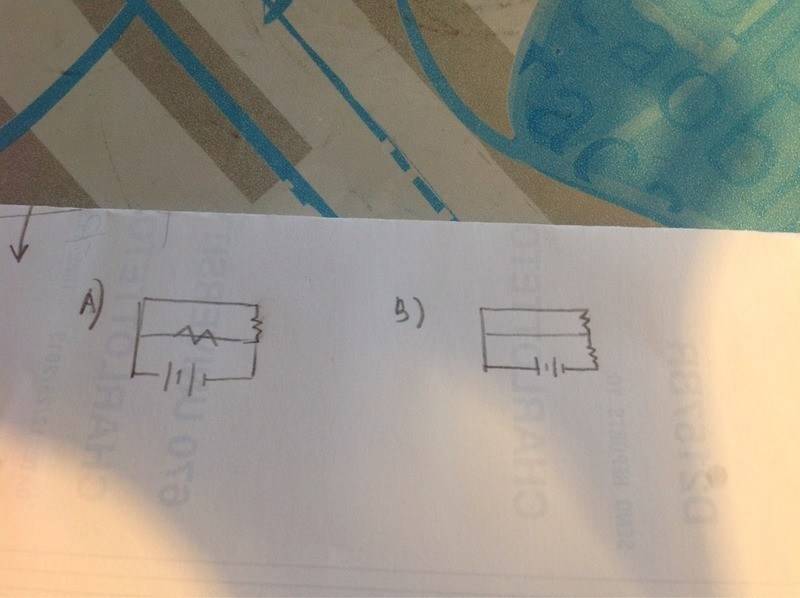
ImageUploadedByPhysics Forums1389730789.854754.jpg

Revelant equations:
None required

Attempt at solution:
I know that a parallel circurt has more than one pathway for the current to flow and has resistors parallel to each other. However in both of the pictures shown, there are two parallel paths but the resistors are not parallel. Is that still considered a parallel circurt then?
 
Physics news on Phys.org
Coco12 said:
Question:
Is this a parallel circurt?

View attachment 65611
Relevant equations:
None required

Attempt at solution:
I know that a parallel circuit has more than one pathway for the current to flow and has resistors parallel to each other. However in both of the pictures shown, there are two parallel paths but the resistors are not parallel. Is that still considered a parallel circuit then?
Why would the physical orientation of the resistors matter? It's the electrical connections that matter.
 
SammyS said:
Why would the physical orientation of the resistors matter? It's the electrical connections that matter.
It doesn't matter? Then in the 2 pictures, which one would not be?
 
Coco12 said:
It doesn't matter? Then in the 2 pictures, which one would not be?
Do you have a more explicit definition for two resistors to be in parallel -- or in series, for that matter?
 
You're supposed to tell us that. If two resistors are in parallel, they're connected to the same two nodes in the circuit. For which of the circuits does this hold true?
 
vela said:
You're supposed to tell us that. If two resistors are in parallel, they're connected to the same two nodes in the circuit. For which of the circuits does this hold true?
Same two nodes...
 
Coco12 said:
Same two nodes...
I think maybe it would be the first one because the second has resistors in the same line, which would be similar to a series?
 
As SammyS said, it's the electrical connections that matter, not how the resistors are drawn.
 
vela said:
As SammyS said, it's the electrical connections that matter, not how the resistors are drawn.
I'm not sure I know what you mean by that.
 
  • #10
vela said:
As SammyS said, it's the electrical connections that matter, not how the resistors are drawn.
Nodes means the point where the current splits right? In the first diagram, the the resistor shares one node with the other. The second one also shares one node.
 
  • #11
vela said:
As SammyS said, it's the electrical connections that matter, not how the resistors are drawn.
Is it that in order for it to be a parallel circurt, the electrons from a branch cannot meet the load from the other, therefore the second diagram is not parallel
 
  • #12
Circuit B is definitely interesting in the way its drawn, but what if you were to draw a resister in Circuit B where the resistor is in Circuit A, and label it 0 Ohms. Does that help change your understanding of the circuit? Can an electron find a way to move from the voltage source through both resistors and back in Circuit B? Circuit A?
 

Similar threads

Replies
8
Views
2K
Replies
20
Views
2K
  • · Replies 14 ·
Replies
14
Views
1K
  • · Replies 1 ·
Replies
1
Views
1K
  • · Replies 3 ·
Replies
3
Views
1K
Replies
3
Views
2K
  • · Replies 5 ·
Replies
5
Views
2K
Replies
4
Views
2K
Replies
2
Views
6K
  • · Replies 3 ·
Replies
3
Views
2K