Issue with angles in torque problem?

  • Thread starter Thread starter fightboy
  • Start date Start date
  • Tags Tags
    Angles Torque
Click For Summary
The discussion revolves around calculating net torque using angles from a diagram, specifically addressing confusion over the angles used in the solutions for cases b) and c). The original poster notes discrepancies between the angles shown (25° and 70°) and the angles used in the solutions (sin(115°) and sin(160°)). It is suggested that using the cosine function is more typical for these calculations, and clarification is provided on the use of sine in relation to complementary angles. Additionally, there is mention of vector cross products and the importance of considering only the force component perpendicular to the arm in torque calculations. Understanding these concepts is essential for accurately solving the torque problem.
fightboy
Messages
25
Reaction score
0
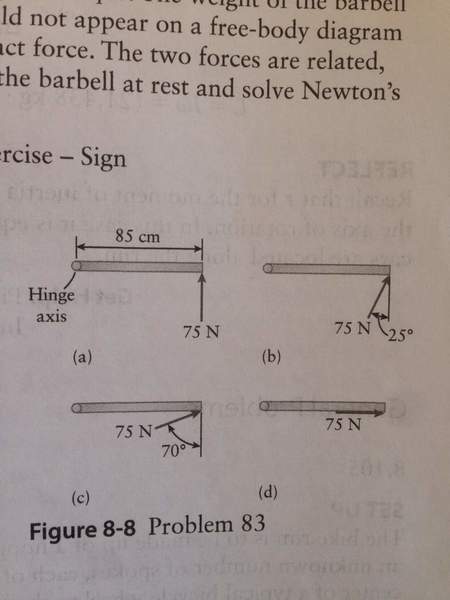
Ok so for this example you have to calculate the net torque about an axis that passes through the hinges in each of the following cases in the image:
chapter 8 physics problem.jpg


a) and c) were fairly straightforward to calculate but i had issues with b) and c). The solution listed the angle for b) as sin(115°) and for c) as sin(160°). I'm confused on where the 115° and 160° came from when the picture showed the angles as 25° and 70° respectively. Am I missing something? Thanks!
 
Physics news on Phys.org
fightboy said:
Ok so for this example you have to calculate the net torque about an axis that passes through the hinges in each of the following cases in the image:
View attachment 73087

a) and c) were fairly straightforward to calculate but i had issues with b) and c). The solution listed the angle for b) as sin(115°) and for c) as sin(160°). I'm confused on where the 115° and 160° came from when the picture showed the angles as 25° and 70° respectively. Am I missing something? Thanks!

There's a small typo in your text above. I believe you mean that a) and d) are easy, and b) and c) are confusing you. :smile:

It is indeed a bit strange to use sin() to calculate the torque and show those angles, but it can be done of course. It's much more normal to use the cos() function, given the angles listed in the diagrams. Are you familar with the dot product?

Also, are you familiar with using the vector cross product to calculate the vector torque (it has magnitude and direction)? If you haven't gotten there yet, don't worry about it for now. If you have seen it, then you know that the sin() is used in it, but for the complementary angle to the one shown in your problem's diagrams.

Does that make sense?
 
All four look equally easy to me as log as you keep in mind that it only the force perpendicular to the arm that is relevant. If the given force makes angle \theta with the vertical, then the component that is perpendicular to the arm is F cos(\theta).
 
Oh, I think you must post the entire problem not just the diagram.
 

Similar threads

  • · Replies 42 ·
2
Replies
42
Views
4K
  • · Replies 11 ·
Replies
11
Views
1K
  • · Replies 1 ·
Replies
1
Views
1K
  • · Replies 14 ·
Replies
14
Views
4K
  • · Replies 6 ·
Replies
6
Views
3K
  • · Replies 9 ·
Replies
9
Views
1K
Replies
6
Views
2K
  • · Replies 1 ·
Replies
1
Views
2K
Replies
8
Views
6K
  • · Replies 7 ·
Replies
7
Views
2K