Will a Jet-Powered Rigid Link Reach a Steady State?

  • Context: Graduate 
  • Thread starter Thread starter DrBwts
  • Start date Start date
  • Tags Tags
    Jet Link
Click For Summary
SUMMARY

The discussion centers on the dynamics of a jet-powered rigid link system, specifically whether it will reach a steady state with constant angular velocity or continue to accelerate indefinitely. It is established that in the absence of air resistance and friction, angular acceleration remains constant, leading to an unbounded increase in angular velocity. However, when air resistance is considered, a steady state can be achieved as the drag force counteracts the thrust, analogous to terminal velocity in free-fall scenarios. A simulation conducted in CAD software demonstrated that the system reached a steady state after an initial increase in velocity.

PREREQUISITES
  • Understanding of angular motion and dynamics
  • Familiarity with forces acting on rigid bodies
  • Knowledge of air resistance and its effects on motion
  • Experience with CAD software for simulations
NEXT STEPS
  • Explore the principles of angular momentum and torque
  • Study the effects of drag force on moving objects
  • Learn about terminal velocity in fluid dynamics
  • Investigate advanced simulation techniques in CAD software
USEFUL FOR

This discussion is beneficial for physics students, engineers working with mechanical systems, and anyone interested in the dynamics of motion under varying forces.

DrBwts
Messages
22
Reaction score
0
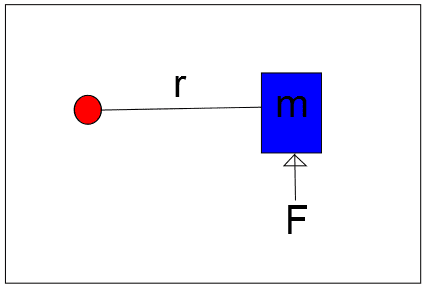
I have a mass (m) at the end of a rigid link of length r, pivoted at the red circle (below).

m is acted on by a force (F) which is always normal to the surface shown (thrust from a jet say).

My question is will this system reach a steady state, ie will it have constant angular velocity or will the angular acceleration just carry on increasing?

Thx Nic
vHf4XOp.png
 
Physics news on Phys.org
Here's a thought: the gravitational field at the surface of the Earth is nearly constant - so if you drop a rock does it continue to gain speed as it falls?

Note that if air resistance is to be taken into account you there is a terminal velocity.
 
DrBwts said:
My question is will this system reach a steady state, ie will it have constant angular velocity or will the angular acceleration just carry on increasing?

Angular acceleration and angular velocity are different things. If we ignore air resistance and friction at the pivot, the angular acceleration will be constant and the angular velocity will keep on increasing without limit until something breaks.

If you consider air resistance, it is possible that the system will reach a steady state before something breaks. That force increases with speed, so as the speed increases will eventually be striping enough to counteract the applied force. (as UltrafastPED points out, this situation is analogous to the terminal velocity reached by a falling object in air).
 
OK thanks both. This is what I thought (sorry about the velocity/acceleration mix up).

Puzzling thing was, I ran this simulation in a well known CAD software & after an initial transitory increase in velocity it hit a steady state with no further acceleration!
 

Similar threads

Replies
1
Views
2K
Replies
17
Views
3K
  • · Replies 1 ·
Replies
1
Views
9K
  • · Replies 8 ·
Replies
8
Views
940
  • · Replies 29 ·
Replies
29
Views
4K
  • · Replies 17 ·
Replies
17
Views
4K
Replies
1
Views
3K
Replies
1
Views
2K
  • · Replies 1 ·
Replies
1
Views
26K
Replies
3
Views
5K