Just starting with friction, question

  • Thread starter Thread starter CollegeStudent
  • Start date Start date
  • Tags Tags
    Friction
Click For Summary

Homework Help Overview

The problem involves determining the equilibrium of a block on an inclined surface, specifically analyzing the forces acting on it, including friction, when given certain parameters like angle and applied force. The subject area is friction in the context of statics and dynamics.

Discussion Character

  • Exploratory, Assumption checking, Mathematical reasoning

Approaches and Questions Raised

  • Participants discuss the equations of motion for the block, focusing on the normal force and frictional force calculations. There are attempts to derive the normal force using trigonometric relationships and the forces acting on the block. Some participants question the correctness of the derived equations and suggest alternative approaches, such as aligning the coordinate system with the surface.

Discussion Status

The discussion is ongoing, with participants providing feedback on the calculations presented. Some guidance has been offered regarding simplifying the computation of the normal force and questioning the accuracy of the initial calculations. There is no explicit consensus yet on the correct approach or solution.

Contextual Notes

Participants note the complexity of the problem due to the angle of inclination and the forces involved. There is mention of potential confusion regarding the direction of the friction force and the need for a clearer coordinate system. The original poster expresses uncertainty about their calculations and seeks clarification.

CollegeStudent
Messages
109
Reaction score
0
1. Homework Statement

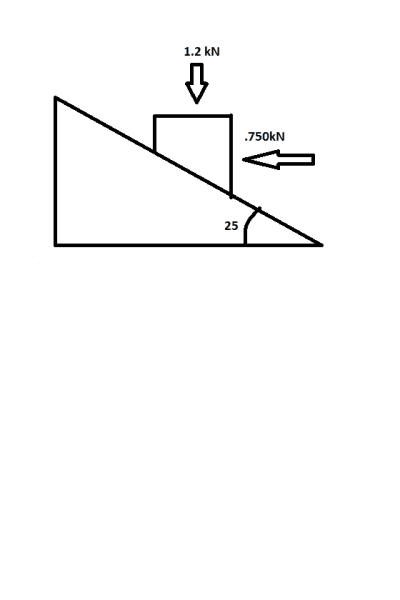
Determine whether the block shown is in equilibrium and find the magnitude and direction of the friction force when θ = 25° and P = 750N

μs[\SUB] = .35
μk[\SUB] = .25

Part 1.png
Part 2.png

2. Homework Equations

Fs = μs * N
Fk = μk * N
3. The Attempt at a Solution

Attachment 1 up there is the drawing of the scenario.
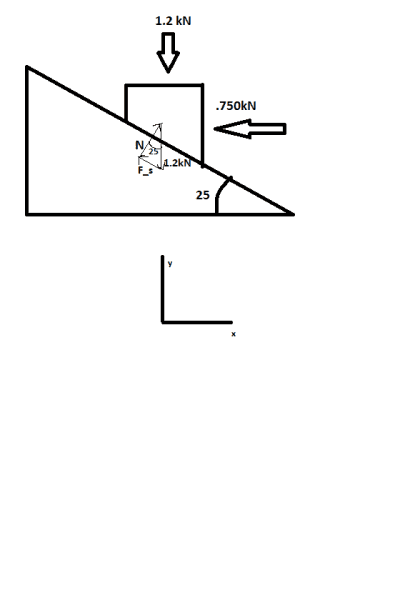
Attachment 2 is my addition to it to solve this problem.

Using the axis shown, I have

ΣFy = Ncosθ - Fssinθ - 1.2kN = 0
and apparently
ΣFx = Nsinθ - Fscosθ - .750kN = 0

otherwise that similar triangle I drew there wouldn't make sense, just odd to think of the force of friction acting in the SAME direction as the force...regardless, continuing...

Solving Top equation for Fs[\SUB] I get

Fs[\SUB] = (Ncosθ - 1.2kN)/(sinθ)

And subbing that into the second equation for F I receive

Nsinθ - ((Ncosθ - 1.2kN)/(sinθ))cosθ - .750 = 0
Nsinθ - (Ncos^2 θ - 1.2kNcosθ) - .750 = 0
N(sinθ - cos^2θ) + 1.2kNcosθ - .750 = 0
N = (-1.2kNcosθ + .750)/(sinθ - cos^2 θ)
N = 0.8465kN

So Fs[\SUB] = .35*0.8465kN = .2963kN


Seeing as how this doesn't match up to the answer given, I'm not seeing where I went off...can anyone guide me in the right direction? Should I use a slanted axis?
 
Last edited by a moderator:
Physics news on Phys.org
I don't think anyones going to see where you went wrong.
CollegeStudent said:
1. Homework Statement

Determine whether the block shown is in equilibrium and find the magnitude and direction of the friction force when θ = 25° and P = 750N

μs[\SUB] = .35
μk[\SUB] = .25

View attachment 76183 View attachment 76184
2. Homework Equations

Fs = μs * N
Fk = μk * N
3. The Attempt at a Solution

Attachment 1 up there is the drawing of the scenario.
Attachment 2 is my addition to it to solve this problem.

Using the axis shown, I have

ΣFy = Ncosθ - Fssinθ - 1.2kN = 0
and apparently
ΣFx = Nsinθ - Fscosθ - .750kN = 0

otherwise that similar triangle I drew there wouldn't make sense, just odd to think of the force of friction acting in the SAME direction as the force...regardless, continuing...

Solving Top equation for Fs I get

Fs = (Ncosθ - 1.2kN)/(sinθ)

And subbing that into the second equation for F I receive

Nsinθ - ((Ncosθ - 1.2kN)/(sinθ))cosθ - .750 = 0
Nsinθ - (Ncos^2 θ - 1.2kNcosθ) - .750 = 0
N(sinθ - cos^2θ) + 1.2kNcosθ - .750 = 0
N = (-1.2kNcosθ + .750)/(sinθ - cos^2 θ)
N = 0.8465kN

So Fs = .35*0.8465kN = .2963kN

Seeing as how this doesn't match up to the answer given, I'm not seeing where I went off...can anyone guide me in the right direction? Should I use a slanted axis?
Sooooo many unnecessary "subs"
 
You can compute N much more easily by looking at the components of the 1.2 kN and the 0.75 kN normal to the surface. The the value of .8465 kN is not correct.

Yes, switching to a coordinate system aligned with the surface makes things easy.
 
[qoute]... And subbing that into the second equation for F I receive
##Nsin(\theta ) - \frac{Ncos(\theta ) - 1.2}{sin(\theta )}cos(\theta ) - .750 = 0 ##[/quote]
yes
##Nsin(\theta ) - Ncos^2(\theta ) - 1.2cos(\theta ) - .750 = 0##
try again.
 

Similar threads

  • · Replies 12 ·
Replies
12
Views
4K
Replies
3
Views
2K
  • · Replies 2 ·
Replies
2
Views
2K
  • · Replies 2 ·
Replies
2
Views
1K
  • · Replies 2 ·
Replies
2
Views
2K
  • · Replies 4 ·
Replies
4
Views
2K
  • · Replies 6 ·
Replies
6
Views
5K
Replies
1
Views
4K
  • · Replies 4 ·
Replies
4
Views
6K
  • · Replies 5 ·
Replies
5
Views
8K