Kinetic energy of a ball rolling down a ramp

Click For Summary
SUMMARY

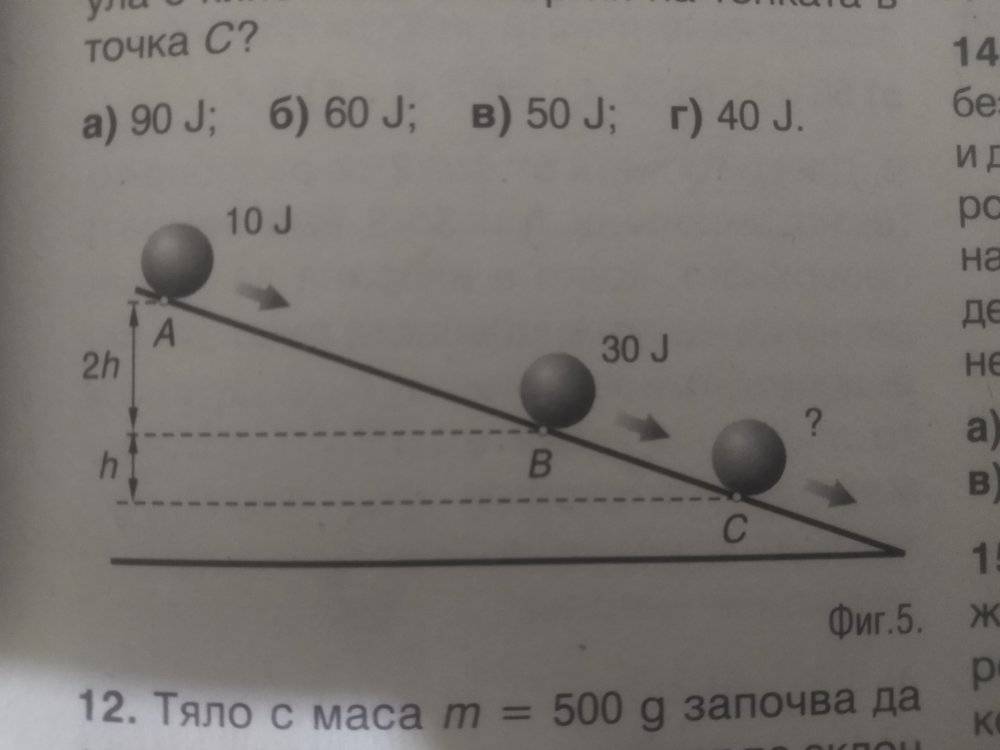
The discussion focuses on calculating the kinetic energy of a ball at point C while rolling down a ramp, given that the kinetic energy at point A is 10 J and at point B is 30 J. The mechanical energy conservation principle is applied, stating that the total mechanical energy (sum of potential and kinetic energy) remains constant throughout the motion. The equations derived are: E_A = 10J + mg(3h + h2), E_B = 30J + mg(h + h2), and E_C = E_k_c + mgh2, leading to the conclusion that E_A = E_B = E_C.

PREREQUISITES
  • Understanding of mechanical energy conservation
  • Familiarity with potential energy (E_p = mgh)
  • Knowledge of kinetic energy formula (E_k = mv²/2)
  • Basic algebra for solving equations
NEXT STEPS
  • Explore the concept of mechanical energy conservation in physics
  • Learn about potential energy differences and their implications
  • Study the relationship between kinetic energy and velocity
  • Investigate real-world applications of energy conservation in rolling objects
USEFUL FOR

Students studying physics, particularly those focusing on mechanics, as well as educators looking for examples of energy conservation principles in action.

kaloyan
Messages
4
Reaction score
0
Homework Statement
Consider the situation in the attached photo. The kinetic energy in A is 10 J, in B is 30 J. What is the kinetic energy in C?
Relevant Equations
no equations
Consider the situation in the attached photo. The kinetic energy in A is 10 J, in B is 30 J. What is the kinetic energy in C?
IMG_20200112_191935070.jpg

Using that the mechanical energy is the sum of potential energy ##(E_p=mgh)## and kinetic energy ##(E_k=\dfrac{mv^2}{2})##, we get that the mechanical energies in ##A,B,C## are ##E_A,E_B,E_C##, respectively: $$E_A=10J + mg(3h+h_2)$$ $$E_B=30J + mg(h+h_2)$$ $$E_C=E_{k_c}+mgh_2$$ They must be equal. In other words: $$10J + mg(3h+h_2)=30J + mg(h+h_2)=E_{k_c}+mgh_2$$
 
Last edited:
Physics news on Phys.org
Please, post your try, then we will know how to help you.
 
kaloyan said:
Homework Statement:: Consider the situation in the attached photo. The kinetic energy in A is 10 J, in B is 30 J. What is the kinetic energy in C?
Homework Equations:: no equations

Consider the situation in the attached photo. The kinetic energy in A is 10 J, in B is 30 J. What is the kinetic energy in C? View attachment 255522
Using that the mechanical energy is the sum of potential energy ##(E_p=mgh)## and kinetic energy ##(E_k=\dfrac{mv^2}{2})##, we get that the mechanical energies in ##A,B,C## are ##E_A,E_B,E_C##, respectively: $$E_A=10J + mg(3h+h_2)$$ $$E_B=30J + mg(h+h_2)$$ $$E_C=E_{k_c}+mgh_2$$ They must be equal. In other words: $$10J + mg(3h+h_2)=30J + mg(h+h_2)=E_{k_c}+mgh_2$$
Good so far. You have a system of equations and unknowns. You only care about finding one of the unknowns. So what do you do next?
 
Maybe will help you to think about what is the potential energy, and remember that doesn't make sense to talk about absolute potential energy, only its difference is measurable.
 

Similar threads

  • · Replies 32 ·
2
Replies
32
Views
3K
Replies
2
Views
3K
  • · Replies 10 ·
Replies
10
Views
3K
  • · Replies 14 ·
Replies
14
Views
3K
  • · Replies 10 ·
Replies
10
Views
3K
  • · Replies 6 ·
Replies
6
Views
3K
  • · Replies 12 ·
Replies
12
Views
12K
  • · Replies 12 ·
Replies
12
Views
2K
  • · Replies 17 ·
Replies
17
Views
3K