Kinetic energy of a ball rolling down a ramp

Click For Summary

Homework Help Overview

The discussion revolves around the kinetic energy of a ball rolling down a ramp, specifically comparing the kinetic energies at different points (A, B, and C) and how they relate to mechanical energy conservation principles.

Discussion Character

  • Exploratory, Conceptual clarification, Assumption checking

Approaches and Questions Raised

  • Participants discuss the relationship between kinetic and potential energy, referencing mechanical energy conservation. Questions arise about the potential energy differences and how they affect the kinetic energy at point C.

Discussion Status

Some participants have provided guidance on considering potential energy and its differences, while others are exploring the implications of the equations set up by the original poster. There is an ongoing exploration of how to approach finding the unknown kinetic energy at point C.

Contextual Notes

The original poster has presented a system of equations but has not yet provided a specific solution or method for finding the unknown. There is an emphasis on understanding the concepts rather than simply calculating values.

kaloyan
Messages
4
Reaction score
0
Homework Statement
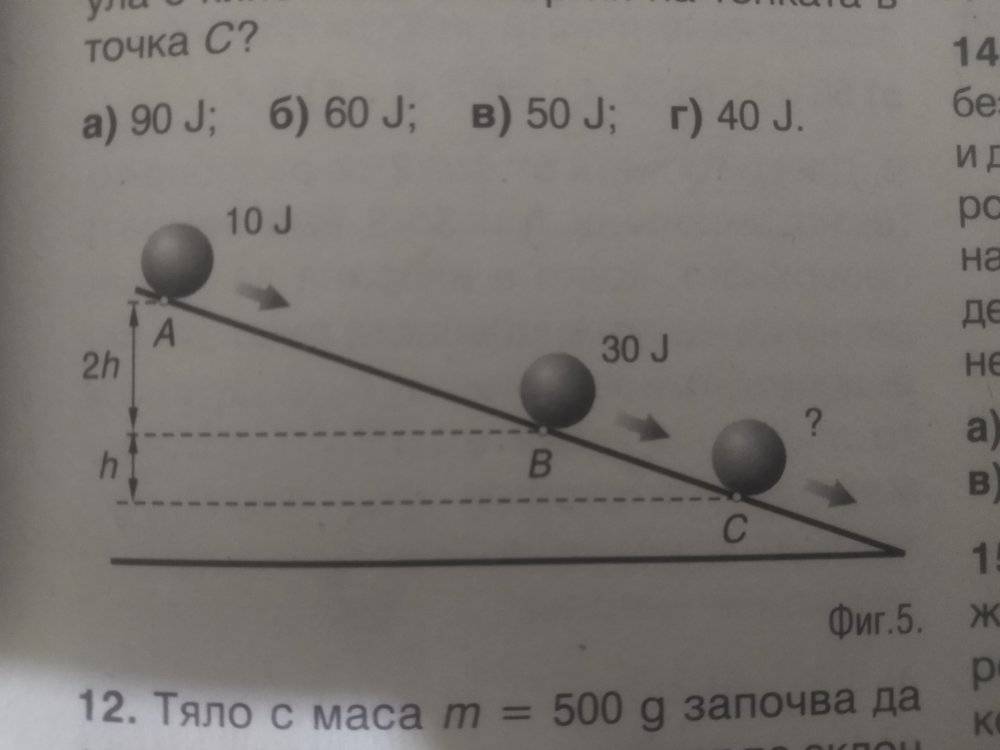
Consider the situation in the attached photo. The kinetic energy in A is 10 J, in B is 30 J. What is the kinetic energy in C?
Relevant Equations
no equations
Consider the situation in the attached photo. The kinetic energy in A is 10 J, in B is 30 J. What is the kinetic energy in C?
IMG_20200112_191935070.jpg

Using that the mechanical energy is the sum of potential energy ##(E_p=mgh)## and kinetic energy ##(E_k=\dfrac{mv^2}{2})##, we get that the mechanical energies in ##A,B,C## are ##E_A,E_B,E_C##, respectively: $$E_A=10J + mg(3h+h_2)$$ $$E_B=30J + mg(h+h_2)$$ $$E_C=E_{k_c}+mgh_2$$ They must be equal. In other words: $$10J + mg(3h+h_2)=30J + mg(h+h_2)=E_{k_c}+mgh_2$$
 
Last edited:
Physics news on Phys.org
Please, post your try, then we will know how to help you.
 
kaloyan said:
Homework Statement:: Consider the situation in the attached photo. The kinetic energy in A is 10 J, in B is 30 J. What is the kinetic energy in C?
Homework Equations:: no equations

Consider the situation in the attached photo. The kinetic energy in A is 10 J, in B is 30 J. What is the kinetic energy in C? View attachment 255522
Using that the mechanical energy is the sum of potential energy ##(E_p=mgh)## and kinetic energy ##(E_k=\dfrac{mv^2}{2})##, we get that the mechanical energies in ##A,B,C## are ##E_A,E_B,E_C##, respectively: $$E_A=10J + mg(3h+h_2)$$ $$E_B=30J + mg(h+h_2)$$ $$E_C=E_{k_c}+mgh_2$$ They must be equal. In other words: $$10J + mg(3h+h_2)=30J + mg(h+h_2)=E_{k_c}+mgh_2$$
Good so far. You have a system of equations and unknowns. You only care about finding one of the unknowns. So what do you do next?
 
Maybe will help you to think about what is the potential energy, and remember that doesn't make sense to talk about absolute potential energy, only its difference is measurable.
 

Similar threads

  • · Replies 32 ·
2
Replies
32
Views
3K
Replies
2
Views
3K
  • · Replies 10 ·
Replies
10
Views
3K
  • · Replies 14 ·
Replies
14
Views
3K
  • · Replies 10 ·
Replies
10
Views
3K
  • · Replies 6 ·
Replies
6
Views
3K
  • · Replies 12 ·
Replies
12
Views
13K
  • · Replies 12 ·
Replies
12
Views
2K
  • · Replies 17 ·
Replies
17
Views
4K