Kinetics question (Chemical engineering)

Click For Summary

Discussion Overview

The discussion revolves around a kinetics problem related to a chemical reaction where a substance X produces two molecules of product Y. Participants are exploring how to calculate the reaction rate constant based on absorbance measurements of Y over time, addressing issues related to data collection and analysis methods.

Discussion Character

  • Homework-related
  • Technical explanation
  • Debate/contested

Main Points Raised

  • One participant expresses confusion about how to graph the concentration data due to an inability to obtain equal amounts of points for analysis.
  • Another participant questions the validity of using certain concentration vs. time relationships given the data provided, suggesting that the reaction may be close to equilibrium after a certain time.
  • There is a suggestion to focus on the concentration of X for analysis, particularly when values are significantly different from zero.
  • A participant proposes assuming a first-order reaction and asks for the concentrations of X at various times based on that assumption.

Areas of Agreement / Disagreement

Participants appear to have differing views on the appropriate data to use for kinetics analysis and the implications of the reaction nearing equilibrium. There is no consensus on how to proceed with the calculations or which assumptions are valid.

Contextual Notes

Participants have noted limitations regarding the data available for analysis, particularly in relation to the timing of measurements and the concentrations of reactants and products. The discussion reflects uncertainty about the reaction order and the applicability of certain kinetic equations.

Who May Find This Useful

This discussion may be useful for students or individuals studying chemical kinetics, particularly those facing challenges in analyzing reaction data and understanding the implications of equilibrium in kinetics problems.

Beyar
Messages
7
Reaction score
0
Thread moved from the technical forums, so no Homework Template is shown
Hey!

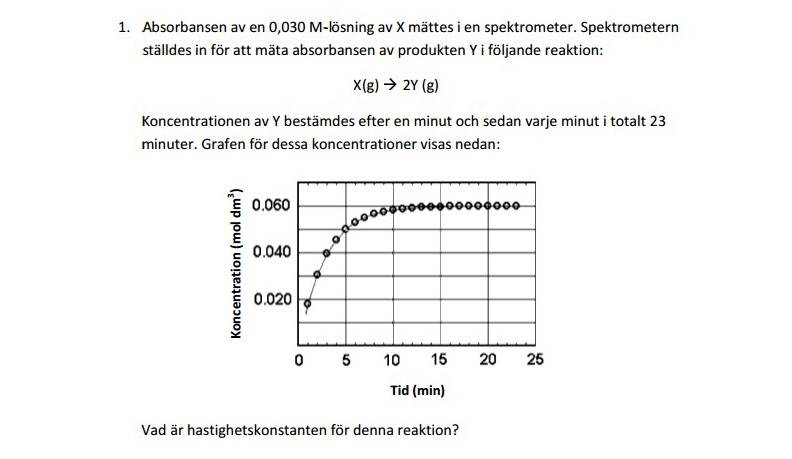
I have a question regarding this question that I have to answer. It is about the kinetics of a substance X whose product is 2Y. It is in Swedish and here is the translation:

The absorbance of a 0,030M-solution of X was calculated with the help of a Spectrometer. The Spectrometer was calibrated to measure the absorbance of the product Y in the following reaction: X(g)-->2Y(g). The koncentration of Y was measured after a minute and every minute consequentially in 23 minutes. The graph shows these concentrations:The question is, calculate the reaction rate constant.

Now to do this, in my opinion and hunch, is we have to know the reaction order and to find it out I usually use a calculator to make a graph of the concentration vs. time, ln(concentration) vs. time and 1/(concentration) vs. time to see whether we deal with a 0, 1 or 2nd order reaction. But I can't seem to get equal amounts of points to make a graph, hence I am stuck :/.
Would anyone please kindly help me with this question?
Kinetic1.jpg
 
Physics news on Phys.org
@Beyar I do not think this is homework. Is that correct?
 
This is homework, indeed. I've been having issues with it for a while now and made several calculations and still get the wrong answer.
 
What do you mean by "can't get equal amount of points to make a graph"?

Beyar said:
make a graph of the concentration vs. time, ln(concentration) vs. time and 1/(concentration) vs. time to see whether we deal with a 0, 1 or 2nd order reaction
For what data are those relationships valid? Can you use them with your given [Y]-t data?
 
These functions of concentration of what against time? X or Y? For your points after about 10 minutes you are so close to equilibrium or to zero [X] , i.e. essentially no reaction happening, that you cannot use them in your kinetics graphs - you cannot do kinetics where nothing is changing!
 
Last edited:
epenguin said:
These functions of concentration of what against time? X or Y? For your points after about 10 minutes you are so close to equilibrium or to zero [X] , i.e. essentially no reaction happening, that you cannot use them in your kinetics graphs - you cannot do kinetics where nothing is changing!
Against the concentration of Y.
 
It makes more sense to use [X] though only for values that are significantly different from zero.
 
Last edited:
Assume that the reaction is 1st order, and that the original concentration of Y is zero. What are the concentrations of X at the various times?
 

Similar threads

  • · Replies 3 ·
Replies
3
Views
7K
  • · Replies 1 ·
Replies
1
Views
3K
  • · Replies 3 ·
Replies
3
Views
3K
Replies
1
Views
2K
  • · Replies 1 ·
Replies
1
Views
3K
  • · Replies 5 ·
Replies
5
Views
5K
  • · Replies 12 ·
Replies
12
Views
3K
  • · Replies 11 ·
Replies
11
Views
3K
  • · Replies 11 ·
Replies
11
Views
5K