Lagrangian equations of particle in rotational paraboloid

Click For Summary

Homework Help Overview

The problem involves a particle of mass m moving without friction on the inner wall of a rotational paraboloid. The task includes deriving the Lagrangian, equations of motion, energy, and angular momentum for the particle, as well as finding the frequency of small oscillations around a circular trajectory.

Discussion Character

  • Exploratory, Conceptual clarification, Mathematical reasoning, Problem interpretation

Approaches and Questions Raised

  • The original poster attempts to derive the Lagrangian and equations of motion but struggles with expressing energy and angular momentum. They question the time derivative of the angle Θ and its relation to the equations of motion.
  • Some participants suggest that there should be two equations of motion and question the correctness of the original poster's equation (2).
  • Others raise concerns about the signs in the equations and the implications of circular motion on the derivatives of r.
  • There is a discussion about the relationship between angular velocity and angular frequency, particularly in the context of small oscillations.

Discussion Status

The discussion is ongoing, with participants providing corrections and suggestions for the equations of motion and the derivation of expressions. There is no explicit consensus, but several productive lines of reasoning are being explored, particularly regarding the dynamics of circular motion and small oscillations.

Contextual Notes

Participants are working under the constraints of the problem statement, which specifies the need to express various physical quantities in terms of mass, height, parameters of the paraboloid, and gravitational acceleration. There is also an acknowledgment of the original poster's absence from the discussion.

Oomph!
Messages
55
Reaction score
0
Hello. I solve this problem:

1. Homework Statement

The particles of mass m moves without friction on the inner wall of the axially symmetric vessel with the equation of the rotational paraboloid:
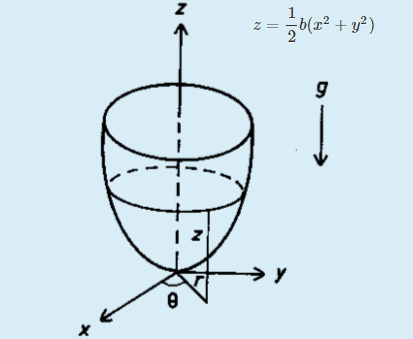
paraboild.png


where b>0.

a) The particle moves along the circular trajectory at a height of z = z(0).

express:
- Lagrangian
- the equation of motion for the polar coordinate r
- energy of the particle (with m, z(0), b and g only)
- angular momentum of the particle (with m, z(0), b and g only)

b) We slightly deflect the particles downwards. Find the frequency of small oscillations around the original intact trajectory.

2. Relevant equation
Lagrangian equations, equations for energy in conservative field and angular momentum.

The Attempt at a Solution


a) I didn't have any problem with Lagrangian and equation of motion for the polar coordinate r. Here is the result, I know how to do it:
- Lagrangian:

lagrangian.png
(1)
- equation of motion for the polar coordinate r:

equation2.png
(2)

I have problem to express the energy and angular momentrum od particle. I show you my attempt:
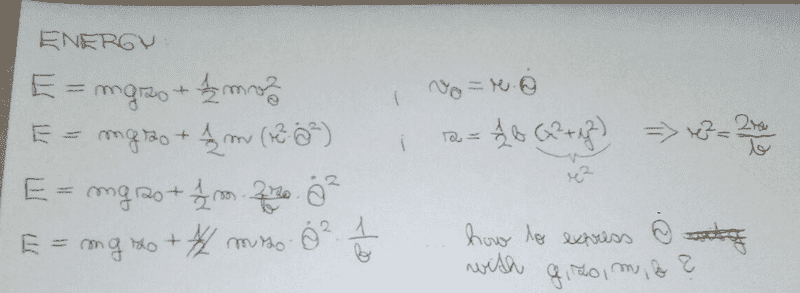
equations3.png

So, the problem is that I don't know, how to express the time derivation of Θ.
Could I just say, that the time derivation of Θ is the (gb)^(1/2) because the equation (2) is in standart form where ω^2=gb?

b) Well, I don't have any idea. I just have the result:
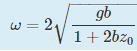
frequention.png

And it doesn't make sense if I told that ω^2=gb.

So, please, could you tell me what is wrong and what to do?

Thank you.
 

Attachments

  • paraboild.png
    paraboild.png
    7.5 KB · Views: 2,429
  • lagrangian.png
    lagrangian.png
    1.9 KB · Views: 1,411
  • equation2.png
    equation2.png
    1.7 KB · Views: 1,404
  • equations3.png
    equations3.png
    48.9 KB · Views: 1,424
  • frequention.png
    frequention.png
    1.2 KB · Views: 1,364
Physics news on Phys.org
You should have two equations of motion, one for the ##\phi## coordinate and another for ##r##.

You should also have ##\ddot{\phi} = 0## in you EOM.

Edit: your equation (2) seems wrong to me you should be getting:

$$0 = (1+b^2r^2)\ddot{r} + 2b^2 r\dot{r}^2+gbr - r\dot{\phi}^2=0$$

But I don't see how you can find ##\dot{\phi}##.
 
Last edited:
Oomph! said:
upload_2017-11-6_14-37-14.png

Check the sign of the second term.

Apply the ##r## equation of motion to the special case of circular motion. (What are ##\dot r## and ##\ddot r## for this case?)

Note: Be sure not to confuse the angular velocity of the circular motion of part (a) with the angular frequency of small oscillations in part (b).
 

Attachments

  • upload_2017-11-6_14-37-14.png
    upload_2017-11-6_14-37-14.png
    1.7 KB · Views: 1,385
So first you can find a solution for your velocity of a circular orbit. Therefore you know ##\dot{r} = \ddot{r} = 0##. From your corrected equation 2 (what TSny wrote) you get:

$$r\dot\varphi = gbr \Rigtharrow v_0=\sqrt{gb}r_0$$

From the other equation you would get, if you've derived the Lagrangian for ##\varphi## you get, that you angular momentum ##L## is constant (central, conservative force).

$$L = m\dot\varphi r^2 = mv_0r_0 \Rightarrow \dot \varphi = \frac{\sqrt{gbr_0^4}}{r^2}$$

This is your expression of $\dot\varphi$ written in terms of the current radius ##r(t)## and the radius ##r_0## of the stable orbit. Putting this into eqaution 2 we get:

$$\ddot r(1+b^2r^2) - b^2r\dot r^2 - \frac{gbr_0^4}{r^3} + gbr = 0$$

Furthermore, for small oscillations we can say: ##r(t) = r_0 + \epsilon(t)## with ##\dot r = \dot\epsilon## and ##\ddot r = \ddot \epsilon## and ##\epsilon << r_0##. Furthermore every term with an ##\epsilon## of higher order than 1 is neglegable. This means ##\epsilon^2 = 0##, ##\dot\epsilon^2 = 0##,##\dot\epsilon\epsilon = 0## ... Doing this we get:

$$\ddot \epsilon (1+b^2r_0^2) - \frac{gbr_0^4}{(r_0+\epsilon)^3} + gbr_0 + gb\epsilon$$

With ##(r_0 + \epsilon)^3 = r_0^3+3r_0^3\epsilon + 0 +0 \approx r_0^3## because ##r_0^3 >> 3r_0^2\epsilon## which leads to the differential equation:

$$\ddot\epsilon -\frac{gb}{1+b^2r_0^2}\cdot r = 0$

So we get

$$\omega = \sqrt{\frac{gb}{1+b^2r_0^2}}$$ = \sqrt{\frac{gb}{1+2bz_0}}

I know I'm missing a 2 in front of the squareroot. I don't know where I lost it
 
  • Like
Likes   Reactions: curious_mind
Please note that this thread is more than five years old and that the OP has not been seen for four years. It is unlikely that your response will be of help at this point but thank you for submitting it.
 
  • Like
Likes   Reactions: PhDeezNutz

Similar threads

  • · Replies 4 ·
Replies
4
Views
3K
Replies
6
Views
2K
  • · Replies 2 ·
Replies
2
Views
2K
  • · Replies 2 ·
Replies
2
Views
2K
  • · Replies 1 ·
Replies
1
Views
2K
Replies
5
Views
2K
  • · Replies 0 ·
Replies
0
Views
2K
Replies
1
Views
1K
  • · Replies 10 ·
Replies
10
Views
6K
  • · Replies 1 ·
Replies
1
Views
2K