Lagrangian mechanics: central-force-like problem

5 replies · 3K views · last reply
LuccaP4
Messages
24
Reaction score
9
Homework Statement
Under the action of gravity, a particle of mass m slides on a conical surface without friction.
The conical surface has the form: ρ=z tan⁡α

a. Find the motion equations using as coordinates θ and r (see picture).
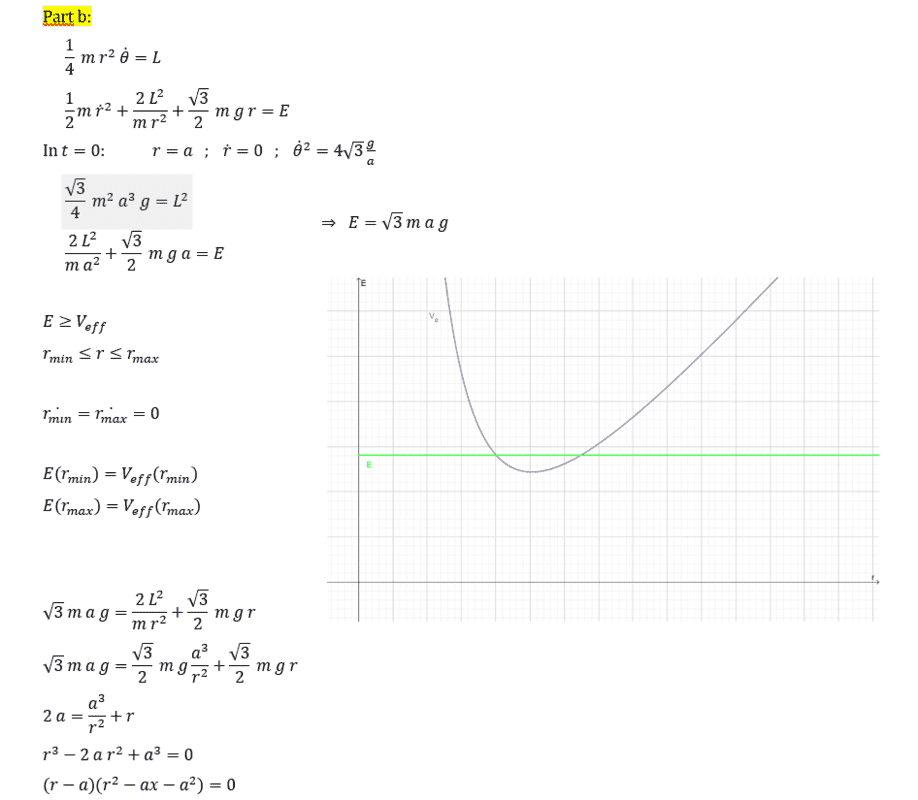
b. Find r_max and r_min if α=30° and initial conditions are:
r(0)=a ; r ̇(0)=0 ; θ ̇^2 (0)=4√3 g/a
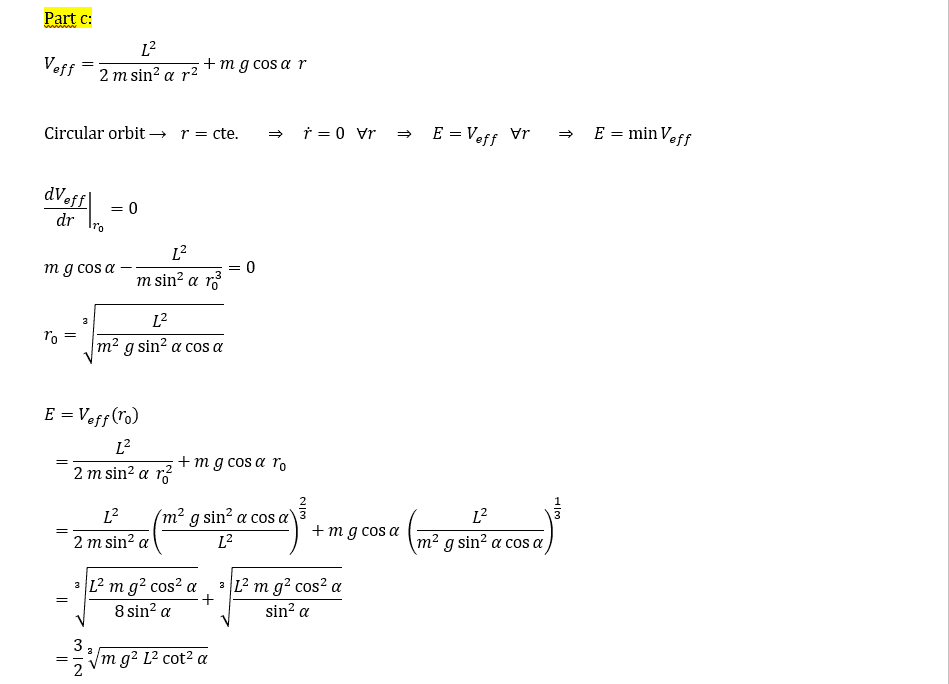
c. Find the effective potential and show that circular orbits are possible. Find the particle’s speed in circular orbits.
d. Assuming the particle in circular motion, find the oscillator constant and the period of oscillation for small perturbations of this motion.
Relevant Equations
Lagrange equations
I copy again the statement here:
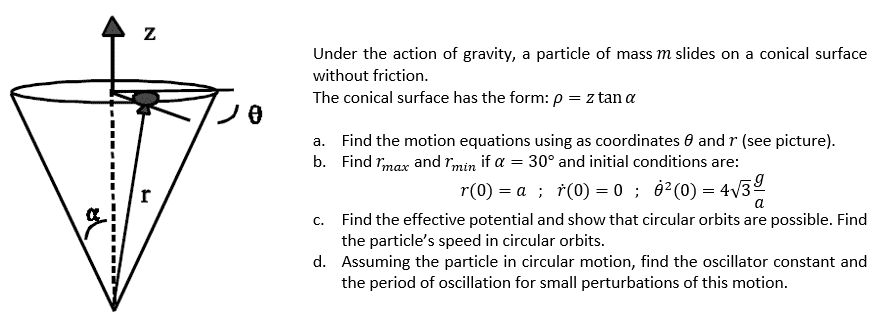
Diagram of a particle on an inverted cone with vertical z-axis, half-angle alpha at the apex, radial distance r and azimuthal angle theta marked along the cone surface.


So, I think I solved parts a to c but I don't get part d. I couldn't even start it because I don't understand how to set the problem.
I think it refers to some kind of motion like this one in the picture, so I'll have a maximum and a minimum r, and I can get the energy and initial speed of a circular motion from part c, but I don't know how to use them.
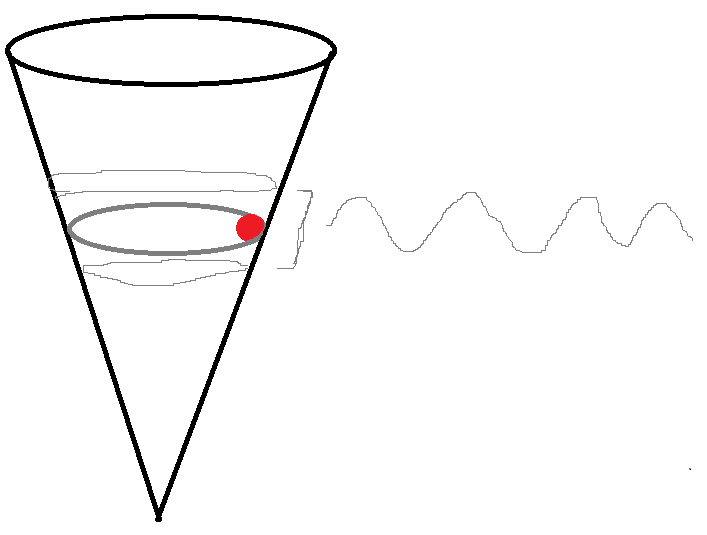
Hand-drawn sketch of a bead on a funnel-shaped cone surface, with a red dot on a horizontal gray circle, next to a wavy line showing a radial oscillation.


I attach my resolution on the other parts.
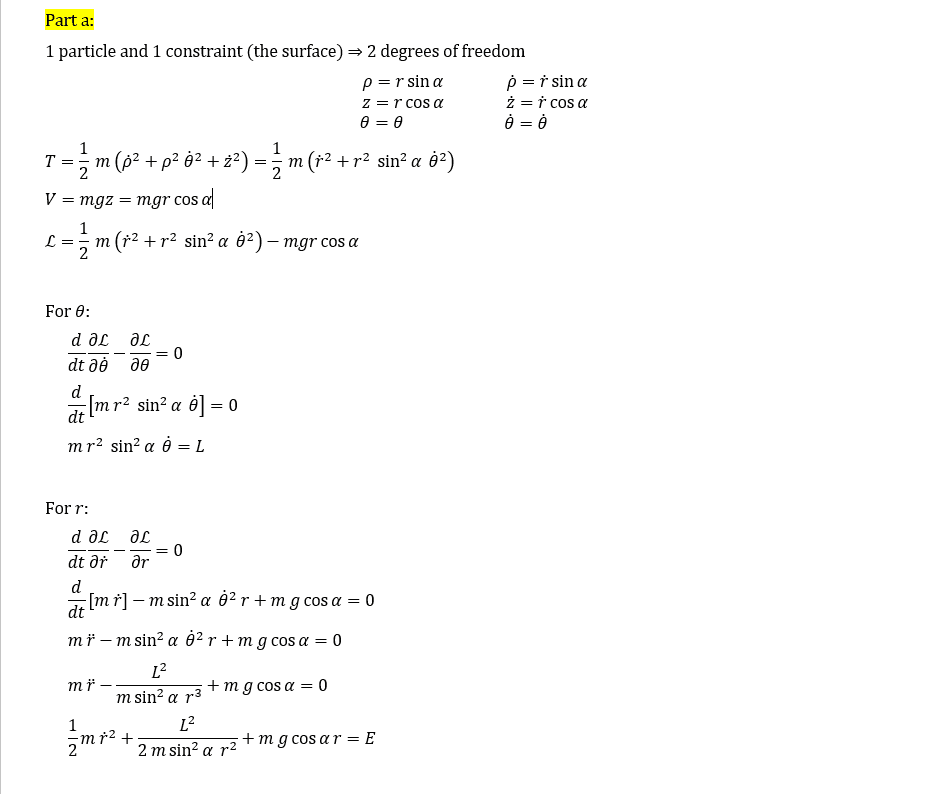
Handwritten-style typed derivation of Lagrangian mechanics for a particle on a cone: coordinates rho = r sin alpha, z = r cos alpha, Lagrangian L = (m/2)(r-dot^2 + r^2 sin^2 alpha theta-dot^2) - mgr cos alpha, angular momentum m r^2 sin^2 alpha theta-dot = L, and radial equation with energy E.

Handwritten-style derivation of effective potential energy equations for a central-force problem, with a graph of the effective potential V_eff against r and a horizontal line marking energy E crossing the curve at two points.

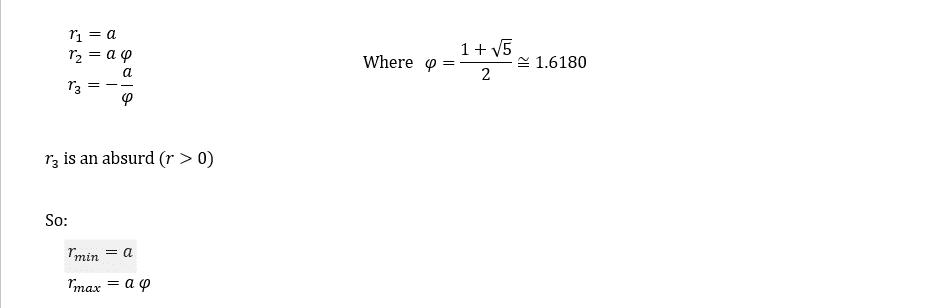
Handwritten-style typed derivation: r1 = a, r2 = a φ, r3 = −a/φ, where φ = (1 + √5)/2 ≈ 1.6180; then r3 is an absurd (r > 0), so rmin = a and rmax = a φ.

Handwritten-style typed derivation of the effective potential V_eff = L^2/(2 m sin^2 α r^2) + m g cos α r, circular orbit condition r = r0, and energy E = V_eff(r0) = (3/2) cube root of (m g^2 L^2 cot^2 α).

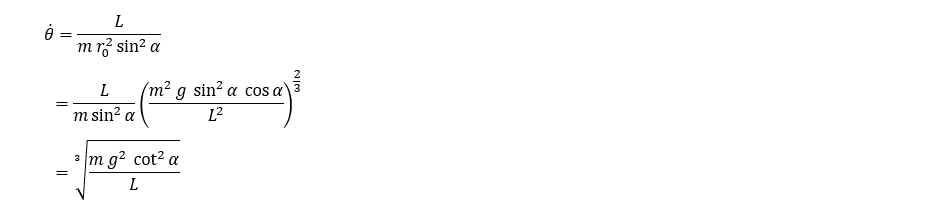
Handwritten derivation of theta-dot: theta-dot = L / (m r0^2 sin^2 alpha) = (L / (m sin^2 alpha)) (m^2 g sin^2 alpha cos alpha / L^2)^(2/3) = cube root of (m g^2 cot^2 alpha / L).
 
Attachments
  • Handwritten working listing r1 = a, r2 = a φ, r3 = -a/φ, followed by the note that r3 is absurd since r > 0, and so rmin = a and rmax = a φ.
    b2.png
    2.2 KB · Views: 335
  • Like
Likes   Reactions: JD_PM and Delta2
You can use ##V_{\rm eff}''(r_0)## to find the "oscillator constant" ##k## and the period of oscillation for small perturbations of the circular motion. See this and also page 2 of this example.
 
  • Like
Likes   Reactions: LuccaP4, JD_PM and Delta2
Is this valid in every case?
Text from a lecture note: 'So the frequency of small oscillations is' followed by the formula ω_ρ = sqrt(V''/m) = eB/m, with a highlighted sentence reading 'This is identical to the orbital frequency. So a small oscillation in the radial direction coupled with uniform circular motion causes a small overall translation of the circular orbit.'


In the frecuency ##\omega##, I should evaluate the second derivative in ##r_0##, shouldn't I?
 
LuccaP4 said:
Is this valid in every case?
View attachment 263728

In the frecuency ##\omega##, I should evaluate the second derivative in ##r_0##, shouldn't I?
The frequency of small oscillations does not equal the orbital frequency, in general. The example in the link is an interesting exception where they are equal.

Yes, you need to find ##\frac{d^2 V_{\rm eff}(r)}{dr^2} |_{r = r_0}##.

For part (c), I would express ##\dot \theta## in terms of ##r_0##, rather than ##L##. You are also asked to "find the speed". I think this is probably the linear speed of the particle.

For part (d), I would express the "oscillation constant" and the period of the oscillations in terms of the unperturbed radius ##r_0##, rather than in terms of the angular momentum ##L##.