Lattice specific heat, help understanding a passage in Ziman's book

Click For Summary

Discussion Overview

The discussion revolves around understanding specific passages in Ziman's book regarding the calculation of lattice specific heat, particularly the rationale behind dividing by total volume in certain expressions. The focus is on theoretical concepts related to specific heat and phonon density of states.

Discussion Character

  • Technical explanation
  • Conceptual clarification

Main Points Raised

  • One participant questions the reasoning behind dividing by total volume when calculating specific heat, seeking clarification on its implications.
  • Another participant explains that energy is extensive, and dividing by volume yields an intensive quantity, specifically volumetric heat capacity.
  • A further contribution reiterates the explanation regarding the division by volume in the context of phonon density of states, indicating it provides the number of modes per unit frequency per unit volume.
  • A participant expresses gratitude for the clarification but notes that the reasoning was not explicitly stated in the text, highlighting a potential gap in intuitive understanding.

Areas of Agreement / Disagreement

Participants generally agree on the rationale for dividing by volume to obtain intensive quantities, but the initial question reflects a lack of explicit clarity in the text, indicating some uncertainty in understanding.

Contextual Notes

The discussion highlights a potential limitation in the text regarding the explicitness of reasoning behind certain calculations, which may affect intuitive understanding for readers.

dRic2
Gold Member
Messages
887
Reaction score
225
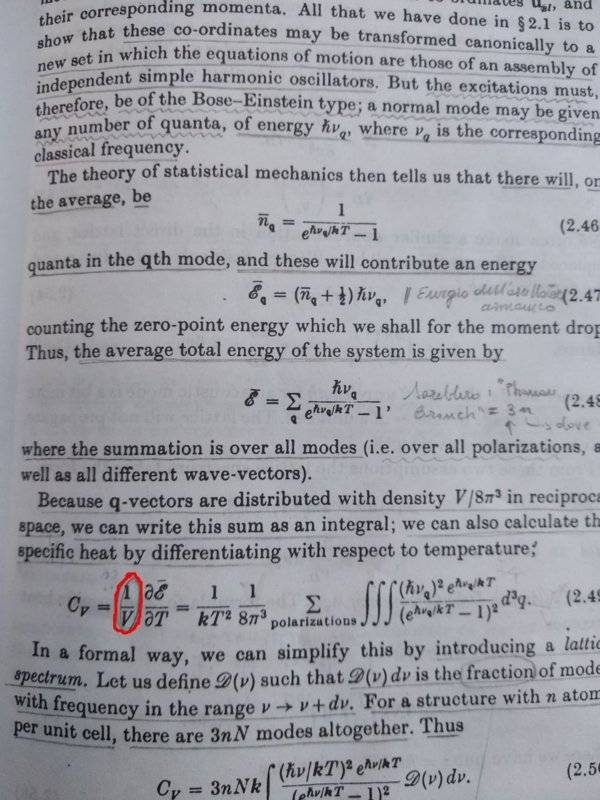
Hi, I don't understand why the author in calculating the expression for the specific heat, divides by ##1/V## (the total volume).
12.jpg


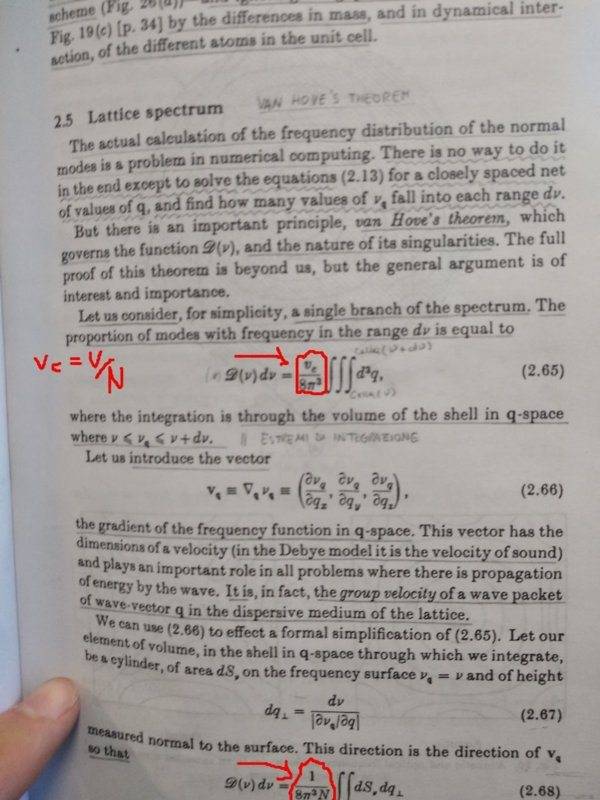
Also, in calculating the fraction of modes with frequency in the range ##v##, ##v+dv## he divides by ##V## (eq. 2.65, 2.67)
11.jpg
Thanks,
Ric
 
Physics news on Phys.org
Energy is extensive (varies with system size), and dividing by another extensive quantity (volume) gives an intensive quantity. In this case, it’s volumetric heat capacity. Mass or molar heat capacity (where you divide the derivative of heat wrt temperature by mass or amount of substance) are more familiar, but it’s the same idea: you’re looking for a property which is independent of the size of the system.
 
Last edited:
  • Like
Likes   Reactions: dRic2
dRic2 said:
Also, in calculating the fraction of modes with frequency in the range v, v+dv he divides by V (eq. 2.65, 2.67)
The same as indicated by @TeethWhitener: The phonon density of states gives the number of modes per unit frequency per unit volume of real space.
 
  • Like
Likes   Reactions: dRic2
Thank you very much. I had to be sure because it was not explicitly specified, although it might be intuitive.
 

Similar threads

  • · Replies 5 ·
Replies
5
Views
3K
  • · Replies 13 ·
Replies
13
Views
3K
  • · Replies 1 ·
Replies
1
Views
2K
  • · Replies 1 ·
Replies
1
Views
2K
  • · Replies 2 ·
Replies
2
Views
3K
Replies
1
Views
11K
Replies
5
Views
3K
  • · Replies 4 ·
Replies
4
Views
17K
  • · Replies 5 ·
Replies
5
Views
2K
Replies
1
Views
3K