Law of motion for orbiting particle in a uniform magnetic field.

Click For Summary
SUMMARY

The discussion focuses on deriving the law of motion for an orbiting particle in a uniform magnetic field, specifically using the equation $$\frac{d\vec{r}}{dt} = \vec{\omega}\times\vec{r}$$ where $$\vec{\omega} = \frac{e\vec{B}}{mc}$$. Participants explore the complexities of transforming coordinates when the axes are arbitrarily oriented, emphasizing the use of rotation matrices and the implications for angular velocity components. The conversation also touches on the advantages of using Lie group theory and matrix exponentiation to express motion equations in arbitrary coordinates.

PREREQUISITES
  • Understanding of classical mechanics, particularly motion in magnetic fields.
  • Familiarity with vector calculus and cross products.
  • Knowledge of rotation matrices and coordinate transformations.
  • Basic principles of Lie group theory and angular momentum representation.
NEXT STEPS
  • Study the derivation of the Lorentz force law and its implications for charged particles in magnetic fields.
  • Learn about rotation matrices and their applications in transforming coordinate systems.
  • Explore Lie group theory, focusing on the special orthogonal group SO(3) and its generators.
  • Investigate the use of matrix exponentiation in solving differential equations related to motion in magnetic fields.
USEFUL FOR

Physicists, engineers, and students studying electromagnetism and classical mechanics, particularly those interested in particle dynamics in magnetic fields and advanced mathematical methods in physics.

sergiokapone
Messages
306
Reaction score
17
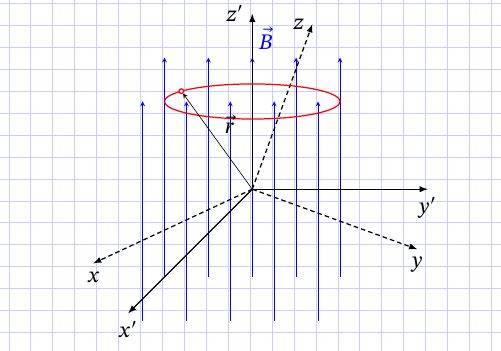
Hi all, I interested in how can I get low of motion in for orbiting particle in a uniform magnetic field
$$\frac{d\vec{r}}{dt} = \vec{\omega}\times\vec{r},\qquad
\vec{\omega} = \frac{e\vec{B}}{mc},$$
Буфер обмена-1.jpg

Of course, rotating about z' axis is very simple.
\begin{equation}\label{eq:K}
\begin{cases}
x' = R\cos(\omega_{z'} t ), \\
y' = R\sin(\omega_{z'} t ), \\
z' = z'_0.
\end{cases}
\end{equation}

But what can I do, when axes is arbitrary oriented?
 
Last edited:
Physics news on Phys.org
If you already solved for the trajectory in terms of one set of coordinates, finding the trajectory in another rotated set of coordinates is just a case of representing the position vector with respect to a new basis. I.e. if the rotation matrix that takes your old basis ##\boldsymbol{e}_i## to your new basis ##\bar{\boldsymbol{e}}_i## has components ##R_{ij}##, e.g.$$\bar{\boldsymbol{e}}_i = R_{ij}\boldsymbol{e}_j$$And the position vector has representations in both bases$$\boldsymbol{r} = r_i \boldsymbol{e}_i = \bar{r}_j \bar{\boldsymbol{e}}_j = \bar{r}_j R_{jk} \boldsymbol{e}_k$$Take inner product of both sides with ##\boldsymbol{e}_l##,$$r_l = R_{jl} \bar{r}_j \iff \bar{r}_j = (R^{-1})_{jl} r_l$$In other words, the column matrix of components transforms by applying the inverse of the matrix you used to rotate the coordinate system.
 
Last edited by a moderator:
  • Like
Likes   Reactions: Dale
Yes, but then the equations get more complicated and look something like this:
\begin{align*}\label{}
x(t) &= x'(t)\cdot(\ldots) + y'(t)\cdot(\ldots) + z'(t)\cdot(\ldots) ,\\
y(t) &= \ldots ,\\
z(t) &= \ldots
\end{align*}
 
sergiokapone said:
Yes, but then the equations get more complicated and look something like this:
\begin{align*}\label{}
x(t) &= x'(t)\cdot(\ldots) + y'(t)\cdot(\ldots) + z'(t)\cdot(\ldots) ,\\
y(t) &= \ldots ,\\
z(t) &= \ldots
\end{align*}
Sure, but isn't that what you wanted? Of course the equations of motion aren't going to look very nice if the coordinate system you are using isn't very nice
 
sergiokapone said:
Yes, but then the equations get more complicated and look something like this:
\begin{align*}\label{}
x &= x'(t)\cdot(\ldots) + y'(t)\cdot(\ldots) + z'(t)\cdot(\ldots),\\
y &= \ldots,\\
z &= \ldots
\end{align*}
Any coordinate system is well adapted for describing some kinds of motion (in particular, those lying in its surfaces of constant coordinate), and any other motion is not so efficiently described. You are switching from a system that allows you todescribe your particular motion very efficiently into one that is much messier.
 
  • Like
Likes   Reactions: Vanadium 50 and etotheipi
Before starting this dreary journey, I wonder if it will be possible to express them like this:
\begin{align*}\label{}
x &= \mathrm{const}(\underbrace{\psi, \theta, \phi}_\text{some angles between coord systems}) f(\omega_x t),\\
y &= \mathrm{const}(\underbrace{\psi, \theta, \phi}_\text{some angles between coord systems}) f(\omega_y t) ,\\
z &= \mathrm{const}(\underbrace{\psi, \theta, \phi}_\text{some angles between coord systems}) f(\omega_z t)
\end{align*}
 
Might I ask, what's the desired end-result here? You're probably making life more difficult than it needs to be!
 
  • Like
Likes   Reactions: Ibix
The end-result here is write down the equations of motion in arbitrary coordinates through the coordinates of the angular velocity \omega_x, \omega_y and \omega_z.

After I see these equations, I want to solve this problem by methods of Lie group theory ($SO(3)$, generators, matrix exponent). As I did, it will be easier for me to understand the group-theoretical approach itself.
 
In that case just apply the rotation matrix I defined in the post #2. If you really want, you can write the matrix in terms of the Euler angles, but that seems a bit unnecessary.

Remember that when you rotate your coordinate system the components of the angular velocity will also change, since ##\boldsymbol{\omega} = \omega \boldsymbol{e}_{z'}## and you must describe ##\boldsymbol{e}_{z'}## in terms of the new basis vectors in order to determine the new components. You can do this with the same matrix that you used to transform the position vector components.
 
  • #10
What I have now. I have a <<formal>> solution of \frac{d\vec{r}}{dt} = \vec{\omega}\times\vec{r} \rightarrow \frac{d\vec{r}}{dt}=i(\vec{\omega}\cdot\hat {\vec{S}})\ \vec{r}:
\begin{equation}
\vec{r}(t)=\vec{r}_0\exp(i\vec{\omega}t \cdot\hat{\vec{S}}),
\end{equation}
where
\begin{multline}\label{}
\hat{\vec{S}} =
\begin{bmatrix}
0 & 0 & 0 \\
0 & 0 & -i \\
0 & i & 0 \\
\end{bmatrix}
\vec{e}_x
+
\begin{bmatrix}
0 & 0 & i \\
0 & 0 & 0 \\
-i & 0 & 0 \\
\end{bmatrix}
\vec{e}_y
+
\begin{bmatrix}
0 & -i & 0 \\
i & 0 & 0 \\
0 & 0 & 0 \\
\end{bmatrix}
\vec{e}_z =
\hat{S}_x \vec{e}_x +
\hat{S}_y \vec{e}_y +
\hat{S}_z \vec{e}_z
.
\end{multline}

As you can see, the formal solutuion contains \omega_{x,y,z}. And now I need to get x(t), y(t), z(x) using matrix exponent. But I do not see clear advantages of this method, rather than just getting solutions in a convenient coordinate system, and then transforming them to rotated arbitrarily with matrix of rotation R.

Everything is really simple in the coordinate system where the axis coincides with the magnetic filed vector, and then what are the advantages of the group approach, the use of all these concepts of generators and so on?
 
Last edited:
  • #11
etotheipi said:
So, I still don't really see the issue?

Everything is really simple in the coordinate system where the axis coincides with the magnetic filed vector, and then what are the advantages of the group approach, the use of all these concepts of generators and so on? After all, I can simply apply a rotation matrix to the ready answer in a convenient coordinate system, and that's it. And it will also be cumbersome.
 
  • #12
sergiokapone said:
Everything is really simple in the coordinate system where the axis coincides with the magnetic filed vector, and then what are the advantages of the group approach, the use of all these concepts of generators and so on? After all, I can simply apply a rotation matrix to the ready answer in a convenient coordinate system, and that's it. And it will also be cumbersome.

I don't know. The equation ##\frac{d\mathbf{r}}{dt} = i (\hat{\boldsymbol{S}} \cdot \boldsymbol{\omega}) \mathbf{r}## seems fine to me, it's also coordinate independent.

I've never seen that before, so let's wait until someone who knows more about this than I do comes along. I still don't think I understand the question :-p
 
  • #13
I'm only a bit puzzled by the equation in #1. The equation of motion for a particle in a uniform magnetic field (in non-relativistic approximation) reads
$$m \dot{\vec{v}}=q \vec{v} \times \vec{B}$$
or
$$\dot{\vec{v}}=-\vec{\omega} \times \vec{v}, \quad \vec{\omega}=\frac{q}{m} \vec{B}.$$
To solve it, it's convenient to choose your arbitrary coordinates in a convenient way. So use a Cartesian right-handed basis such that ##\vec{\omega}=\omega \vec{e}_3##. Then
$$\dot{\vec{v}}=-\omega \vec{e}_3 \times \vec{v}=-\omega \begin{pmatrix}-v_2 \\ v_1 \\0 \end{pmatrix}.$$
For the 3-component you find
$$v_3=v_{30}=\text{const}.$$
The other two equations are most easily solved by writing
$$\xi=v_1+\mathrm{i} v_2.$$
Take the time derviative
$$\dot{\xi}=\omega (v_2-\mathrm{i} v_1)=-\mathrm{i} \omega \xi \; \Rightarrow \; \xi(t)=\xi_0 \exp(-\mathrm{i} \omega t)=(v_{10}+\mathrm{i} v_{20})[\cos(\omega t)-\mathrm{i} \sin(\omega t).$$
Taking the real and imaginary part gives
$$v_1(t)=v_{10} \cos(\omega t) + v_{20} \sin(\omega t), \quad v_2(t)=v_{20} \cos(\omega t) - v_{10} \sin(\omega t).$$
This you can write in a matrix-vector form
$$\vec{v}(t)=\begin{pmatrix} \cos(\omega t) & \sin(\omega t) & 0\\ -\sin(\omega t) & \cos(\omega t) & 0 \\ 0 & 0 & 1 \end{pmatrix} \vec{v}_0.$$
This is a rotation around the direction ##\vec{n}=\vec{\omega}/\omega## in the negative direction (i.e., with ##\vec{n}## pointing towards you in clockwise direction around this axis).

You can write this in a coordinate-free way,
$$\vec{v}(t)=\vec{n}(\vec{n} \cdot \vec{v}_0) -\sin(\omega t) \vec{n} \times \vec{v}_0 + \cos(\omega t) \vec{n} \times (\vec{n} \times \vec{v}_0).$$
To get the trajectory, just integrate it once more over ##t## from ##0## to ##t##:
$$\vec{x}(t)=\vec{x}_0 + \vec{n}(\vec{n} \cdot \vec{v}_0) t + \frac{\cos(\omega t)-1}{\omega} \vec{n} \times \vec{v}_0+ \frac{q}{\omega} \sin(\omega t) \vec{n} \times (\vec{n} \times \vec{v}_0).$$
 
  • Like
Likes   Reactions: etotheipi
  • #14
Yes, good, your LOM is coordinate free, but you use \omega as scalar. All become difficult if you use \vec{\omega}.
 
  • #15
I use, of course, ##\vec{\omega}=\omega \vec{n}##. Angular velocity is a (pseudo)vector not a scalar! If you want you can write ##\vec{n}=\vec{\omega}/\omega## everywhere.
 
  • Like
Likes   Reactions: etotheipi

Similar threads

  • · Replies 0 ·
Replies
0
Views
1K
  • · Replies 3 ·
Replies
3
Views
2K
  • · Replies 2 ·
Replies
2
Views
2K
  • · Replies 1 ·
Replies
1
Views
2K
  • · Replies 2 ·
Replies
2
Views
2K
  • · Replies 6 ·
Replies
6
Views
2K
  • · Replies 3 ·
Replies
3
Views
1K
  • · Replies 12 ·
Replies
12
Views
2K
Replies
1
Views
2K
  • · Replies 5 ·
Replies
5
Views
2K