Lebesgue Integration of Simple Functions .... Lindstrom, Lemma 7.4.6 ...

Click For Summary
SUMMARY

The discussion focuses on the proof of Lemma 7.4.6 from Tom L. Lindstrom's book, "Spaces: An Introduction to Real Analysis," specifically regarding the limit of integrals of simple functions. The key assertion is that for any numbers \(a < b\) and \(m < \mu(B)\), the limit \(\lim_{n \to \infty} \int_B f_n d\mu \geq b \mu(B)\) must hold. Participants clarify that the notation \(f_n(x) \uparrow b\) indicates a non-decreasing sequence of functions, which is crucial for the proof's validity. The discussion emphasizes the importance of understanding limits and inequalities in measure theory.

PREREQUISITES
  • Understanding of Lebesgue integration and measure theory.
  • Familiarity with the concepts of limits and inequalities in mathematical analysis.
  • Knowledge of simple functions and their properties in the context of integration.
  • Experience with the notation and terminology used in real analysis, particularly in the context of sequences of functions.
NEXT STEPS
  • Study the proof of the Monotone Convergence Theorem in measure theory.
  • Explore the properties of non-decreasing sequences of functions in Lebesgue integration.
  • Review the concept of limits in the context of integrals and their implications in analysis.
  • Examine additional examples of simple functions and their integrals to solidify understanding.
USEFUL FOR

Students and researchers in real analysis, particularly those studying measure theory and Lebesgue integration, as well as educators seeking to clarify the concepts of limits and inequalities in mathematical proofs.

Math Amateur
Gold Member
MHB
Messages
3,920
Reaction score
48
TL;DR
I need help in order to fully understand Lindstrom's proof of Lemma 7.4.6 concerning the Lebesgue integration of an increasing sequence of simple functions ...
I am reading Tom L. Lindstrom's book: Spaces: An Introduction to Real Analysis ... and I am focused on Chapter 7: Measure and Integration ...

I need help with the proof of Lemma 7.4.6 ...

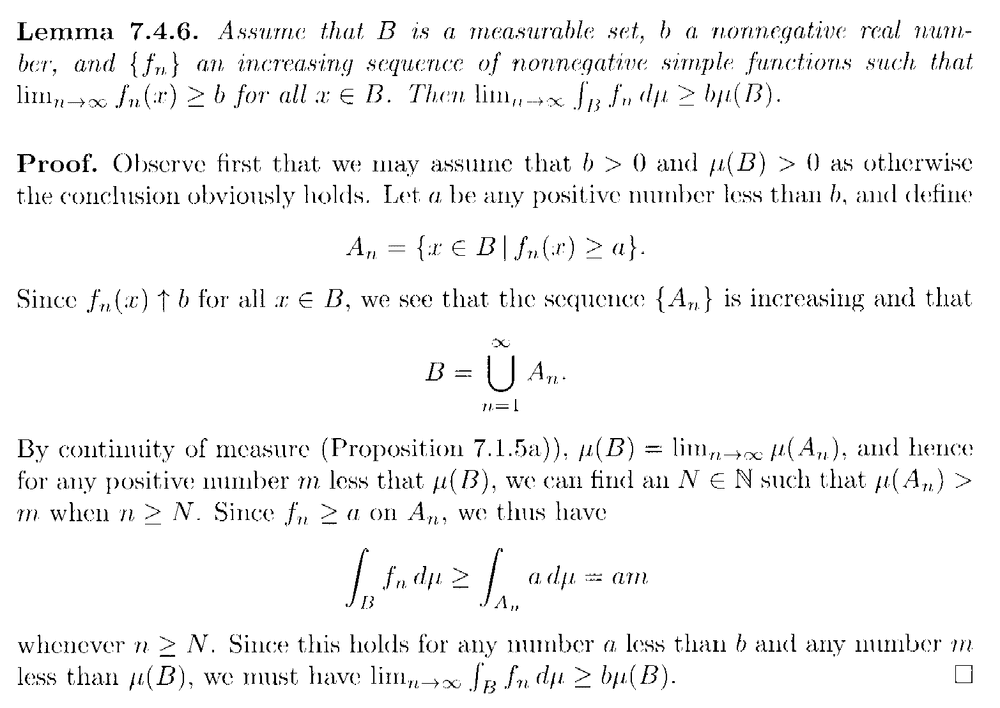
Lemma 7.4.6 and its proof read as follows:
Lindstrom - Lemma  7.4.6 .png


In the above proof by Lindstrom we read the following:

" ... ... Since this holds for any number ##a## less than ##b## and any number ##m## less than ##\mu (B)##, we must have ##\lim_{ n \to \infty } \int_B f_n d \mu \geq b \mu (B)##. ... ... "I need help in order to show, formally and rigorously, that ##\lim_{ n \to \infty } \int_B f_n d \mu \geq b \mu (B)## ... ...My thoughts are that we could assume that ##\lim_{ n \to \infty } \int_B f_n d \mu \lt b \mu (B)## ... ... and proceed to demonstrate a contradiction ... but I'm not sure how to formally proceed ... ...

Help will be much appreciated ...

Peter

=================================================================================================================


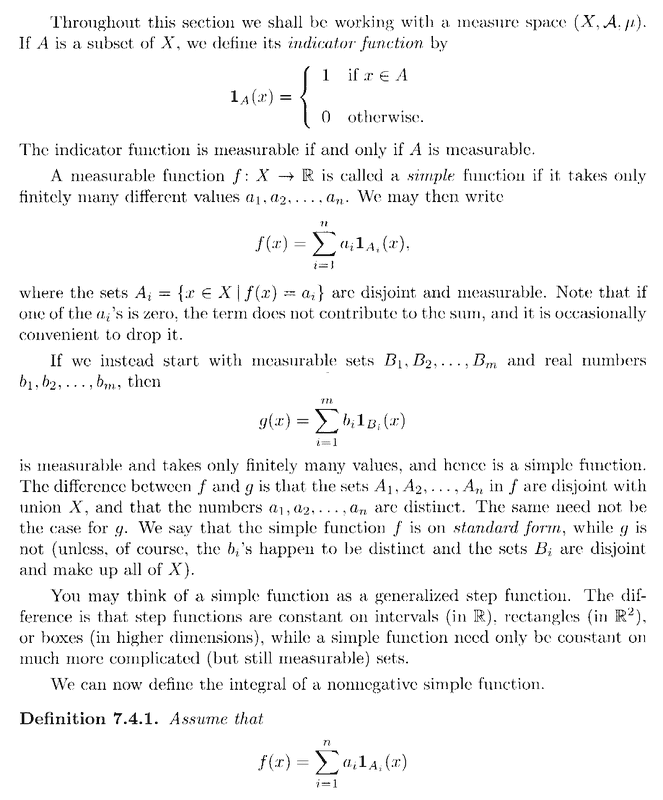
Readers of the above post may be assisted by access to Lindstrom's introduction to the integration of simple functions ... so I am providing access to the relevant text ... as follows:
Lindstrom - 1 - Section 7.4 ... Integration of Simple Functions ... Part 1... .png

Lindstrom - 2 - Section 7.4 ... Integration of Simple Functions ... Part 2 ... .png


Hope that helps ...

Peter
 
Physics news on Phys.org
Note that ##L:= \lim_n \int_B f_n d \mu## always exists (possibly with value ##\infty##), because it is the limit of an increasing sequence.

The claim the proof makes is:

$$\forall m < \mu(B), \forall a < b : am \leq L \implies b\mu(B) \leq L$$

Fix ##a < b##, taking the limit ##m \to \mu(B)-## (limit from the left) of ##am \leq L##, we obtain ##a \mu(B) \leq L##. Since this holds for all ##a < b##, you can take the limit ##a \to b-## (again limit from the left) to obtain ##b \mu(B) \leq L##.

Basically, this boils down to showing that limits preserve (non-strict) inequalities of functions, which you probably already know since you are studying measure theory.
 
  • Like
Likes   Reactions: Math Amateur
The answer lies in our total freedom to choose both ##a\in(0,b)## and ##m\in(0,\mu(B))##. Let ##a=b-h## and ##m=\mu(B)-h## where we can choose any ##h## such that ##0<h<\min(b,\mu(B))##.
Then

\begin{align*}
\lim_{n\to\infty} \int_B f_n\ d\mu
&\ge \lim_{n\to\infty} am
=am
= (b-h)(\mu(B)-h)
= (b\mu(B)-h\mu(B) -bh +h^2)\\
& =b\mu(B)-h\mu(B) -bh +h^2
> b\mu(B)-h(\mu(B)+b)
\end{align*}

whence
\begin{equation*}
\lim_{n\to\infty} \int_B f_n\ d\mu > b\mu(B)-h(\mu(B)+b)\ \ \ \textrm{(A)}
\end{equation*}
Now suppose the contrary of the theorem's result, that ##\lim_{n\to\infty} \int_B f_n\ d\mu = b\mu(B)-k## for some ##k>0##.

Then choose ##h= \min\left(b/2,\mu(B)/2, \frac k{2(\mu(B)+b)}\right)##, which we noted above that we are free to do. Substitute that expression for ##h## into RHS of (A) and you will get a contradiction:
$$\lim_{n\to\infty} \int_B f_n\ d\mu > b\mu(B)-k/2
> b\mu(B)-k = \lim_{n\to\infty} \int_B f_n\ d\mu$$
 
  • Like
Likes   Reactions: Math Amateur
Thanks to Andrew and Math_QED for most helpful posts ...

Working carefully through your proofs now ...

BUT ... I have another question ...

In the above proof by Lindstrom we read the following:

" ... ... Since ##f_n (x) \uparrow b## for all ##x \in B## ... ... "Unless I am misunderstanding the notation, ##f_n (x) \uparrow b## means ##f_n## tends to ##b## from below ... but ... all we are given is that ##\lim_{n \to \infty } f_n (x) \geq b## which surely is not the same ...

Can someone please clarify this issue ...

Peter
 
Last edited:
Math Amateur said:
Thanks to Andrew and Math_QED for most helpful posts ...

Working carefully through your proofs now ...

BUT ... I have another question ...

In the above proof by Lindstrom we read the following:

" ... ... Since ##f_n (x) \uparrow b## for all ##x \in B## ... ... "Unless I am misunderstanding the notation, ##f_n (x) \uparrow b## means ##f_n## tends to ##b## from below ... but ... all we are given is that ##\lim_{n \to \infty } f_n (x) \geq b## which surely is not the same ...

Can someone please clarify this issue ...

Peter

That notation means that the sequence is non-decreasing, which is a hypothesis.
 
  • Like
Likes   Reactions: Math Amateur
Oh ... OK ... thanks ...

Peter
 
Math Amateur said:
In the above proof by Lindstrom we read the following:

" ... ... Since ##f_n (x) \uparrow b## for all ##x \in B## ... ... "Unless I am misunderstanding the notation, ##f_n (x) \uparrow b## means ##f_n## tends to ##b## from below
It is justified by the theorem stating that ##\{f_n\}## is an "increasing sequence of non-negative simple functions." By "increasing", it means that ##\forall x:\ \forall n:\ f_{n+1}(x) > f_n(x)##.
 

Similar threads

Replies
4
Views
2K
  • · Replies 14 ·
Replies
14
Views
3K
  • · Replies 8 ·
Replies
8
Views
2K
  • · Replies 1 ·
Replies
1
Views
2K
  • · Replies 6 ·
Replies
6
Views
3K
  • · Replies 11 ·
Replies
11
Views
3K
  • · Replies 5 ·
Replies
5
Views
3K
  • · Replies 6 ·
Replies
6
Views
3K
  • · Replies 4 ·
Replies
4
Views
2K
Replies
3
Views
2K